
Board of Supervisors
The Board of Supervisors acts as the legislative branch of Township government. They are responsible for adopting and amending ordinances and establishing Township policy. They approve all subdivision and land development plans, as well as any other matter requiring official action of the Township.
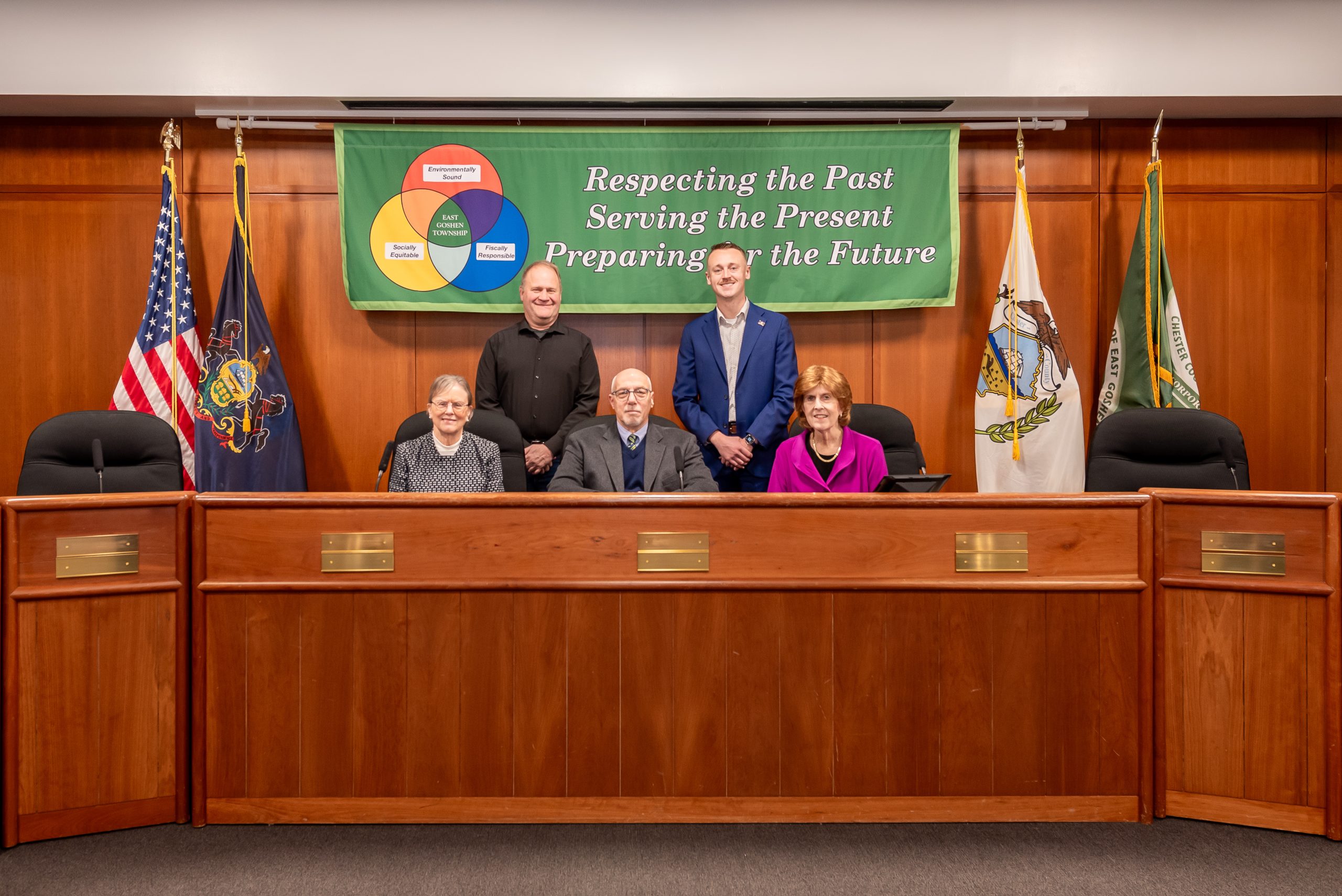
- Five members, serving six-year terms
- Meetings begin at 7:00 PM on the 1st and 3rd Tuesday of the month.
- Meetings will be held on the 2nd, 4th, and 5th Tuesday of the month as needed.
- All township meetings are held at the Township Building and are open to the public.
- View our meetings live via Zoom.
- View township meetings on YouTube.
- Executive Sessions are not public meetings
| Board of Supervisors | Term Expiration Date |
| Cody Bright, Chair | 2027 |
| Barbara Emery, Vice Chair | 2029 |
| Peter Hicks | 2029 |
| Ann Duffield | 2031 |
| Larry Massaro | 2031 |
Visit our YouTube Channel for meeting video recordings.
Documents
Back to the list | Open the original PDF
Notice: this accessible version was created automatically from the original document. The transcription may not be 100% accurate. It is provided for searching and for screen readers; please refer to the original document for the official version.
AGENDA EAST GOSHEN TOWNSHIP BOARD OF SUPERVISORS
Tuesday, January 20, 2015
7:00 PM 1. Call to Order 2. Pledge of Allegiance 3. Moment of Silence – Supervisor Carmen Battavio 4. Ask if anyone is recording the meeting 5. Public Comment – Hearing of Residents (Optional) 6. Chairman’s Report a. Comp Plan Update – Janet b. Police Commission – Chuck c. Announce ABC appointments 7. Public Hearings a. The Board will conduct a public hearing to consider and adopt an Ordinance Amending Authorizing The Participation of East Goshen Township In The PSATS Unemployment Compensation Group Trust Pursuant To The Pennsylvania Intergovernmental Cooperation Law 8. Police/EMS Report – Chief Brenda Bernot Malvern Fire Co. – Monthly Fire Operations Report – December 2014 Fire Marshal - none Goshen Fire Co. - none 9. Financial Report – December 2014 10. Old Business a. Consider conditional use decision for 200 Margaret Lane b. Consider police merger study (posted on Township website) c. Consider Applebrook sign d. Consider Township park pedestrian crossings 11. New Business a. Consider appointment of Jim Benoit for member-at-large for Police Commission b. Consider purchase of real estate tax and sewer/refuse invoice printer c. Consider recommendation to approve 1131 N. Chester Road /subdivision & land development with conditions
d. Consider 1331 E. Strasburg Rd./ZHB application dimensional variances e. Consider rooftop structures zoning amendment f. Consider wooded lot ordinance amendment g. Consider recommended tree species 12. Any Other Matter 13. Approval of Minutes a. December 16, 2014 b. January 13, 2015 14. Treasurer’s Report a. January 15, 2015
F:\Data\Shared Data\Agendas\Board of Supervisors\2015\01202015 Bluehilites .doc
15. Correspondence, Reports of Interest a. Acknowledge WEGO Audit 16. Dates of Importance Jan 21, 2015 Futurist Committee 7:00 pm Feb 03, 2015 Board of Supervisors 7:00 pm Feb 03, 2015 Pension Committee 9:30 am Feb 04, 2015 Planning Commission 7:00 pm Feb 05, 2015 Park Commission 7:00 pm Feb 09, 2015 Commerce Commission 7:00 pm Feb 09, 2015 Municipal Authority 7:00 pm Feb 10, 2015 Deer Committee 7:00 pm Feb 11, 2015 Conservancy Board 7:00 pm Feb 12, 2015 Historical Commission 7:00 pm Newsletter Article Deadlines for 2015: Spring: January 30 Summer: May 1 Fall: August 31 Winter: October 30 17. Public Comment – Hearing of Residents 18. Adjournment The Chairperson, in his or her sole discretion, shall have the authority to rearrange the agenda in order to accommodate the needs of other board members, the public or an applicant.
F:\Data\Shared Data\Agendas\Board of Supervisors\2015\01202015 Bluehilites .doc
EAST GOSHEN TOWNSHIP
CHESTER COUNTY, PENNSYLVANIA
ORDINANCE NO. ________
ORDINANCE AUTHORIZING THE PARTICIPATION OF EAST GOSHEN TOWNSHIP IN THE PSATS UNEMPLOYMENT COMPENSATION GROUP TRUST PURSUANT TO THE PENNSYLVANIA INTERGOVERNMENTAL COOPERATION LAW
WHEREAS, the PSATS Unemployment Compensation Group Trust (“Trust”), originally established in 1980, exists as an intergovernmental cooperative arrangement of municipalities to provide townships and certain other permitted governmental employers of Pennsylvania with a vehicle to pool resources and jointly leverage buying power to develop and maintain unemployment compensation insurance coverage; and
WHEREAS, the governing Declaration and Agreement of Trust for the Trust has been comprehensively updated, amended and restated effective July 16, 2014 (hereinafter “Restated Trust Agreement”); and
WHEREAS, pursuant to the Restated Trust Agreement any municipality wishing to commence participation in the Trust, or continue participation in the Trust after July 16, 2014, is required to take formal action in the form of an enacted ordinance in which the municipality agrees to participate in the Trust in accordance with the amended and updated terms of the Restated Trust Agreement; and
WHEREAS, East Goshen Township (“the Township”) has determined that it is in the best interest of the Township to participate in the Trust in accordance with the terms of the Restated Trust Agreement and to agree to and join in such Restated Trust Agreement; and
WHEREAS, pursuant to the Pennsylvania Intergovernmental Cooperation Law, 53 Pa. C.S.A. § 2301 et seq., a municipality may enter into an intergovernmental cooperative agreement upon the passage of an ordinance by its governing body.
The Board of Supervisors of East Goshen Township, Chester County, Pennsylvania does hereby ENACT and ORDAIN:
Section 1. That the Board of Supervisors adopts the Restated Trust Agreement and agrees to participate in the Trust in accordance with the amended and updated terms of the Restated Trust Agreement and that the Chairman of the Board of Supervisors and Secretary of the Township are hereby authorized to sign the Restated Trust Agreement and any other agreements necessary for the Township’s participation in the Trust.
The Restated Trust Agreement is on file for inspection and review at the Township’s offices at 1580 Paoli Pike; West Chester, PA 19380. The Restated Trust Agreement may be subsequently modified or amended in accordance with its terms, but in no event shall such modifications or amendments divert any of the trust funds from the purposes of the Trust. The Township may withdraw from the Trust in accordance with the Restated Trust Agreement, including if the Board of Supervisors determines the modifications or amendments are not in the best interests of the Township.
Section 2. That the participation of the Township in the Trust is authorized for the purpose of pooling resources for the purpose of providing unemployment compensation insurance for Participating Employers at reasonable cost.
Section 3. That, as set forth in greater detail in the Restated Trust Agreement and as otherwise stated herein, the following conditions apply to the participation of the Township in the Trust:
- That each Participating Employer must meet the admission and eligibility requirements set forth therein;
- That each Participating Employer agrees to pay all contributions when due as provided in the Restated Trust Agreement or as otherwise established by the Board of Trustees; and
- That each Participating Employer complies with all other conditions of the Restated Trust Agreement.
Section 4. That the Township agrees to participate in the Trust and may withdraw for any reason and in accordance with the Restated Trust Agreement provided that it has fulfilled all its financial obligations to the Trust upon withdrawal.
Section 5. That the effective date of the Township’s agreement to and joinder in the Restated Trust Agreement and the participation of the Township in the Trust pursuant to the terms of the Restated Trust Agreement will be January 21, 2015.
Section 6. That each Participating Employer delegates to the Board of Trustees the powers enumerated in the Restated Trust Agreement.
Section 7. That the organizational structure of the Trust shall consist of a Board of Trustees. Under the Restated Trust Agreement, the Board of Trustees is authorized to, among other things, enter into contracts with third parties to perform various services necessary for the administration of the Trust.
Section 8. That the funds required for the operation of the Trust shall be provided by the Participating Employers through scheduled appropriations as determined by the Board of Trustees.
2
Section 9. That the Trust is empowered to enter into contracts for policies of group insurance and employee benefits, including Social Security, for employees of the Trust, if any.
Section 10. That as a condition of participating in the Trust, the Township agrees to comply with all of the terms and conditions in the Restated Trust Agreement.
Section 11. That the Secretary of the Township shall provide a certified copy of this Ordinance upon its enactment to the Board of Trustees of the Trust.
Section 12. The Secretary of the Township is hereby authorized to take any and all such other actions as may be necessary or appropriate to carry out the purposes of this Ordinance and comply with the requirements of the attached Restated Trust Agreement and any duly adopted amendments thereto.
Section 13. The duration of the term of the Township’s participation in the Trust and obligations under the Restated Trust Agreement shall continue until withdrawal from the Trust by the Township in accordance with the terms of the Restated Trust Agreement.
Section 14. The Board of Supervisors hereby specifically finds and determines as follows:
- The conditions of the intergovernmental cooperative agreement are set forth in the Restated Trust Agreement incorporated by reference herein.
- The Township shall participate in the Trust in accordance with the Restated Trust Agreement until it withdraws by giving notice to the Board of Trustees in accordance with the terms of the Restated Trust Agreement.
- The purpose and objectives of the intergovernmental cooperative arrangement, including powers and scope of authority delegated to the Board of Trustees, are set forth in the incorporated Restated Trust Agreement.
- The manner and extent of financing of the agreement are that (i) funds to implement the Township’s obligations under the agreement shall come from the normal and usual budgeted amounts for Township employee compensation and employee benefits and (ii) no borrowing is anticipated to be required.
- The Trust shall be managed by the Board of Trustees pursuant to the terms of the Restated Trust Agreement.
- All assets and property, real or personal, of the Trust shall be titled to, acquired, managed, licensed or disposed of by the Trust, and its Board of Trustees, in accordance with the terms of the Restated Trust Agreement.
3
- The Trust in accordance with the Restated Trust Agreement shall be empowered to enter into contracts for policies of group insurance and employee welfare benefits to be offered to Participating Employers for their eligible employee and dependents.
Section 15. The provisions of this Ordinance are severable and in the event that any provision is held invalid, void, illegal, or unconstitutional by any court, it is the intent of the Board of Supervisors that such determination by the Court shall not affect or render void the remaining provisions of this Ordinance. It is the declared intent of the Board of Supervisors that this Ordinance would have been enacted if any provision subsequently declared to be void, invalid, illegal or unconstitutional had not been included at the time of enactment.
Section 16. Nothing in this Ordinance shall be interpreted to affect any rights or liabilities of the Township, or to affect any cause of action, existing prior to the enactment of this Ordinance.
Section 17. This Ordinance shall take effect five (5) days from the date of adoption.
This Ordinance is being enacted pursuant to the provisions of the Pennsylvania Intergovernmental Cooperation Law, Act of July 12, 1972, No. 180, as amended, 53 Pa.C.S. §§ 2301, et seq.
ENACTED AND ORDAINED this _____ day of ____________, 2015.
|
ATTEST: ___________________________ |
EAST GOSHEN TOWNSHIP ___________________________________ ___________________________________ ___________________________________ ___________________________________ ___________________________________ |
|---|
4
[Logo: Malvern Fire Company Fire 1886 Rescue Station]
Malvern Fire Company
424 East King Street
Malvern, PA 19355
Main 610-647-0693
Fax 610-647-0249
www.malvernfireco.com
Monthly Fire Operations Report - December 2014
| Calls for Month: 18 | Year Total: 322 | |||
|---|---|---|---|---|
| Call Type | Malvern | Willistown | East Goshen | Other |
| Automatic Fire Alarm | 1 | 6 | 0 | 1 |
| EMS Assist | 0 | 1 | 0 | 0 |
| Fire Police Assist | 0 | 0 | 0 | 1 |
| Fuel Spill | 1 | 0 | 0 | 0 |
| MVA | 0 | 2 | 0 | 0 |
| Residential Rescue | 0 | 1 | 0 | 0 |
| Structure Fire | 0 | 1 | 0 | 2 |
| Wires | 0 | 1 | 0 | 0 |
| MONTH TOTAL | 2 | 12 | 0 | 4 |
| YEAR TOTAL | 87 | 172 | 8 | 55 |
| Mutual Aid | Given | Received | Month Total | Year Total |
|---|---|---|---|---|
| Berwyn Fire Co. | 1 | 1 | 2 | 14 |
| East Whiteland Fire Co. | 3 | 1 | 4 | 46 |
| Goodwill Fire Co. | 0 | 0 | 0 | 1 |
| Goshen Fire Co. | 0 | 1 | 1 | 11 |
| Lionville Fire Company | 0 | 0 | 0 | 1 |
| Newtown Sq. Fire Co. | 0 | 0 | 0 | 8 |
| Paoli Fire Co. | 0 | 1 | 1 | 6 |
| Radnor Fire Co. | 0 | 0 | 0 | 1 |
| West Whiteland Fire Co. | 0 | 0 | 0 | 2 |
| Total Value of Property & Contents | Total Month Loss | Total Year Loss | Total Saved |
|---|---|---|---|
| $28,513,300 | $1,500 | $175,100 | $28,338,200 |
| Number of Personnel Attending Calls | Year Total | Hours in Service | Year Total |
|---|---|---|---|
| 137 | 2,588 | 61.8 | 1,425.26 |
| Number of Training Sessions | Year Total | Hours in Service | Year Total |
|---|---|---|---|
| 5 | 53 | 189 | 1636.75 |
| Number of Special Assignments | Year Total | Hours in Service | Year Total |
|---|---|---|---|
| 3 | 66 | 52 | 1,684.75 |
| Total Hours in Service (Month) | Total Hours in Service (Year) |
|---|---|
| 302.8 | 4,746.76 |
[Logo: Malvern Fire Company Fire 1886 Rescue Station]
Malvern Fire Company
424 East King Street
Malvern, PA 19355
Main 610-647-0693
Fax 610-647-0249
www.malvernfireco.com
Year End Fire Operations Report for 2014
| 322 Total Fire Responses | ||||
|---|---|---|---|---|
| Call Type | Malvern | Willistown | East Goshen | Other |
| Appliance Fire | 1 | 2 | 0 | 0 |
| Automatic Fire Alarm | 33 | 84 | 3 | 5 |
| Brush | 4 | 0 | 0 | 0 |
| Building Collapse | 1 | 0 | 0 | 0 |
| Chimney Fire | 0 | 2 | 0 | 1 |
| CO Alarm | 1 | 7 | 0 | 1 |
| Cover Assignment | 1 | 0 | 0 | 2 |
| Electrical Fire - Inside | 0 | 2 | 0 | 0 |
| Elevator Rescue | 0 | 0 | 0 | 1 |
| EMS Assist | 9 | 14 | 1 | 3 |
| Fire Police | 1 | 2 | 0 | 7 |
| Forcible Entry | 2 | 0 | 0 | 0 |
| Fuel Spill | 1 | 0 | 0 | 0 |
| Gas Leak - Inside | 2 | 1 | 0 | 4 |
| Gas Leak - Outside | 5 | 2 | 0 | 1 |
| Investigation - Inside | 2 | 3 | 0 | 1 |
| Investigation - Outside | 0 | 1 | 0 | 0 |
| Motor Vehicle Accident | 8 | 21 | 0 | 1 |
| Public Service | 2 | 0 | 0 | 1 |
| Residential Rescue | 1 | 1 | 0 | 0 |
| Search | 0 | 0 | 0 | 1 |
| Structure Fire | 3 | 7 | 3 | 25 |
| Train Fire | 1 | 0 | 0 | 0 |
| Trash Fire | 0 | 3 | 1 | 1 |
| Vehicle Fire | 2 | 5 | 0 | 0 |
| Wires | 7 | 15 | 0 | 0 |
| YEAR TOTAL | 87 | 172 | 8 | 55 |
| Mutual Aid | Given | Received | Year Total |
|---|---|---|---|
| Berwyn Fire Co. | 8 | 6 | 14 |
| East Whiteland Fire Co. | 40 | 6 | 46 |
| Goodwill Fire Co. | 1 | 0 | 1 |
| Goshen Fire Co. | 5 | 6 | 11 |
| Lionville Fire Co. | 1 | 0 | 1 |
| Newtown Sq. Fire Co. | 5 | 3 | 8 |
| Paoli Fire Co. | 3 | 3 | 6 |
| Radnor Fire Co. | 1 | 0 | 1 |
| West Whiteland Fire Co. | 0 | 2 | 2 |
| Total Value of Property & Contents | Total Year Loss | Total Saved |
|---|---|---|
| $28,513,300 | $175,100 | $28,338,200 |
| Number of Personnel Attending Calls | Hours in Service on Responses |
|---|---|
| 2,588 | 1,425.26 |
| Number of Training Sessions | Hours in Service for Training |
|---|---|
| 53 | 1,636.75 |
| Number of Special Assignments | Hours in Service for Assignments |
|---|---|
| 66 | 1,684.75 |
| Total Hours in Service for 2014 |
|---|
| 4,746.76 |
Memo
To: Board of Supervisors
From: Jon Altshul
Re: December 2014 Financial Report
Date: January 8, 2014
Net of pass-through accounts and the year-end transfer to the operating reserve fund, the general fund had revenues of $9,926,847 compared to expenses of $9,846,180 in 2014 to finish the year with a surplus of $80,667. Because the 2014 budget was adopted with a $86,939 surplus, the final variance was $6,272 less than what had been adopted. As of December 31, the general fund balance was $4,458,873.
Net of core revenues, Administration and Public Works were over-budget, while the remaining departments were under-budget.
- Public Works was over-budget (+$46,220) due primarily to the severe winter weather, with snow expenses being $199,740 over budget in total. This over-run was offset by savings across a number of other line items, in particular resurfacing materials, which was $110,614 underbudget despite Public Works paving the planned 5 miles of Township roads.
- Administration was over-budget (+$16,319) due to a handful of under-budgeted expenses (e.g. Blackboard Connect).
- Parks & Recreation was under-budget (-$4,429) due to savings across a number of recreation and parks maintenance line items, despite the fact that events fund-raising was roughly $25,000 below forecasted levels.
- Emergency Services was under-budget (-$34,974) due to the 2013 Police credit.
- Zoning and Code Enforcement was under-budget (-$167,353) due to higher than expected permit revenue (+$99,200), particularly from residential roofing and the new construction at Goshen Meadows, as well as savings across a number of line items.
Among non-core revenues, Earned Income Tax ended the year $223,150 under-budget, while Real Estate Property Tax (+$25,217), Transfer Tax (+$24,481), Cable Franchise Tax (+20,651) and Local Services Tax (+$5,862) all out-performed expectations.
Other funds
Other funds continue to be in a strong position through November.
- The State Liquid Fuels Fund had $398,110 in revenues and $398,058 in expenses. The fund balance is $204.
- The Sinking Fund had $422,968 in revenues and $780,862 in expenses. The fund balance is $6,237,436.
- The Transportation Fund had $26,334 in revenues and $11,639 in expenses. The fund balance is $1,067,853.
- The Sewer Operating Fund had $3,185,675 in revenues and $3,178,646 in expenses. The fund balance is $593,541.
- The Refuse Fund had $950,616 in revenues and $985,365 in expenses. The fund balance is $748,898
- The Sewer Sinking Fund had $162,576 in revenues and $32,756 in expenses. The fund balance is $1,950,312.
- The Operating Reserve Fund had $1,975,603 in revenues and no expense. The fund balance is $2,475,611.
- The Events Fund had $15,006 in revenues and no expenses. The fund balance is $30,006.
Accounts Receivable
Utilities accounts receivable was $297,614 as of December 31st, the lowest level since December 2012. In addition, delinquent 2014 real estate taxes totaled $9,247, or roughly $3,000 less than last year. We have now sent those delinquent accounts to the County for collections.
Misc. Issues
I am working on 2014 Cost of Services report and plan to have that finished by the February 3rd meeting. In addition, we have begun to prepare for the 2014 audit. The audit team is scheduled to be on site during the week of February 23rd.
Early 2015 update
The January Real Estate Transfer disbursement was $483,518.50 reflecting the sale of Wellington and 1302 Goshen Parkway in December. Because our audited financial statements are prepared on a modified accrual basis, the disbursement will be reflected as 2014 revenue for audit purposes.
EAST GOSHEN TOWNSHIP
UNAUDITED DECEMBER 2014 FINANCIAL RESULTS
December 31, 2014
| Account Title | Annual Budget | Y-T-D Actual | Budget-Actual Variance |
|---|---|---|---|
| GENERAL FUND | |||
| EMERGENCY SERVICES EXPENSES | 4,080,238 | 4,029,662 | (50,576) |
| PUBLIC WORKS EXPENSES | 2,350,469 | 2,436,092 | 85,623 |
| ADMINISTRATION EXPENSES | 1,590,156 | 1,793,139 | 202,983 |
| ZONING/PERMITS/CODES EXPENSES | 448,790 | 392,097 | (56,693) |
| PARK AND RECREATION EXPENSES | 577,466 | 549,468 | (27,998) |
| TOTAL CORE FUNCTION EXPENSES | 9,047,119 | 9,200,457 | 153,338 |
| EMERGENCY SERVICES REVENUES | 87,904 | 72,302 | (15,602) |
| PUBLIC WORKS REVENUES | 830,930 | 870,332 | 39,402 |
| ADMINISTRATION REVENUES | 321,404 | 508,068 | 186,664 |
| ZONING/PERMITS/CODES REVENUES | 286,900 | 397,559 | 110,659 |
| PARK AND RECREATION REVENUES | 135,964 | 112,394 | (23,570) |
| TOTAL CORE FUNCTION REVENUES | 1,663,102 | 1,960,656 | 297,554 |
| NET EMERGENCY SERVICES EXPENSES | 3,992,334 | 3,957,360 | (34,974) |
| NET PUBLIC WORKS EXPENSES | 1,519,539 | 1,565,759 | 46,220 |
| NET ADMINISTRATION EXPENSES | 1,268,752 | 1,285,071 | 16,319 |
| NET ZONING/PERMITS/CODES EXPENSES | 161,890 | (5,463) | (167,353) |
| NET PARK AND RECREATION EXPENSES | 441,502 | 437,073 | (4,429) |
| CORE FUNCTION NET SUBTOTAL | 7,384,017 | 7,239,801 | (144,216) |
| DEBT - PRINCIPAL | 456,000 | 456,000 | 0 |
| DEBT - INTEREST | 189,721 | 189,723 | 2 |
| TOTAL DEBT | 645,721 | 645,723 | 2 |
| TOTAL CORE FUNCTION NET | 8,029,738 | 7,885,523 | (144,215) |
| NON-CORE FUNCTION REVENUE | |||
| EARNED INCOME TAX | 4,840,552 | 4,617,402 | (223,150) |
| REAL ESTATE PROPERTY TAX | 1,981,993 | 2,007,210 | 25,217 |
| REAL ESTATE TRANSFER TAX | 515,000 | 539,481 | 24,481 |
| CABLE TV FRANCHISE TAX | 430,000 | 450,651 | 20,651 |
| LOCAL SERVICES TAX | 310,000 | 315,862 | 5,862 |
| OTHER INCOME | 39,132 | 35,585 | (3,547) |
| TOTAL NON CORE FUNCTION REVENUE | 8,116,677 | 7,966,190 | (150,487) |
| NET RESULT | 86,939 | 80,667 | (6,272) |
u:\altshul\Copy of 12-31-2014 General Fund Summary (version 1).xls 1/8/14
SUMMARY OF FUNDS REPORT (AKA "JOE REPORT")
ALL FUNDS DECEMBER 2014
* NOTE: GENERAL FUND INCLUDES PASS-THROUGH ACCOUNTS; FOR 2014, IT ALSO INCLUDED A $1,974,511 TRANSFER TO THE OPERATING RESEVE FUND
| GENERAL FUND* | LIQUID FUELS STATE FUND | SINKING FUND | TRANSPORT. FUND | REFUSE FUND | SEWER OP. FUND | SEWER SINK FUND | OPERATING RESERVE | EVENTS FUND | TOWNSHIP FUNDS | MUNICIPAL AUTHORITY | |
|---|---|---|---|---|---|---|---|---|---|---|---|
| 1/1/14 BEGINNING BALANCE | $6,354,203 | $152 | 6,595,329 | 1,053,158 | 783,647 | $586,512 | $1,820,492 | $500,008 | $15,000 | $17,708,501 | $1,598,270 |
| RECEIPTS | |||||||||||
| 310 TAXES | $7,980,581 | $0 | $0 | $0 | $0 | $0 | $0 | $0 | $6 | $7,980,587 | $0 |
| 320 LICENSES & PERMITS | $54,787 | $0 | $0 | $0 | $0 | $0 | $0 | $0 | $0 | $54,787 | $0 |
| 330 FINES & FORFEITS | $37,088 | $0 | $0 | $0 | $0 | $0 | $0 | $0 | $0 | $37,088 | $0 |
| 340 INTERESTS & RENTS | $129,219 | $536 | $64,374 | $2,559 | $1,215 | $826 | $2,576 | $1,093 | $0 | $202,397 | $1,594 |
| 350 INTERGOVERNMENTAL | $90,365 | $397,575 | $0 | $0 | $0 | $0 | $0 | $0 | $0 | $487,939 | $0 |
| 360 CHARGES FOR SERVICES | $901,870 | $0 | $0 | $0 | $949,401 | $2,973,224 | $0 | $0 | $0 | $4,824,495 | $125,616 |
| 380 MISCELLANEOUS REVENUES | $1,284,768 | $0 | $0 | $23,775 | $0 | $184,390 | $0 | $0 | $0 | $1,492,933 | $564 |
| 390 OTHER FINANCING SOURCES | $820,707 | $0 | $358,594 | $0 | $0 | $27,235 | $160,000 | $1,974,511 | $15,000 | $3,356,047 | $21,000 |
| $11,299,384 | $398,110 | $422,968 | $26,334 | $950,616 | $3,185,675 | $162,576 | $1,975,603 | $15,006 | $18,436,273 | $148,775 | |
| EXPENDITURES | |||||||||||
| 400 GENERAL GOVERNMENT | $1,460,749 | $0 | $557,635 | $0 | $0 | $0 | $0 | $0 | $0 | $2,018,384 | $0 |
| 410 PUBLIC SAFETY | $5,530,805 | $0 | $0 | $0 | $0 | $0 | $0 | $0 | $0 | $5,530,805 | $0 |
| 420 HEALTH & WELFARE | $6,000 | $0 | $0 | $0 | $0 | $0 | $0 | $0 | $0 | $6,000 | $0 |
| 426 SANITATION & REFUSE | $113,307 | $0 | $0 | $0 | $985,365 | $2,279,622 | $32,756 | $0 | $0 | $3,411,050 | $130,634 |
| 430 HIGHWAYS,ROADS & STREETS | $2,135,608 | $398,058 | $201,992 | $11,639 | $0 | $0 | $0 | $0 | $0 | $2,747,297 | $0 |
| 450 CULTURE-RECREATION | $493,128 | $0 | $21,235 | $0 | $0 | $0 | $0 | $0 | $0 | $514,363 | $0 |
| 460 CONSERVATION & DEVELOPMENT | $5,814 | $0 | $0 | $0 | $0 | $0 | $0 | $0 | $0 | $5,814 | $0 |
| 470 DEBT SERVICE | $668,949 | $0 | $0 | $0 | $0 | $878,024 | $0 | $0 | $0 | $1,546,973 | $27,235 |
| 480 MISCELLANEOUS EXPENDITURES | $784,526 | $0 | $0 | $0 | $0 | $0 | $0 | $0 | $0 | $784,526 | $0 |
| 490 OTHER FINANCING USES | $1,993,907 | $0 | $0 | $0 | $0 | $21,000 | $0 | $0 | $0 | $2,014,907 | $0 |
| $13,192,791 | $398,058 | $780,862 | $11,639 | $985,365 | $3,178,646 | $32,756 | $0 | $0 | $18,580,117 | $157,869 | |
| 2014 SURPLUS/(DEFICIT)* | (1,893,408) | $52 | ($357,893) | $14,695 | ($34,749) | $7,029 | $129,820 | $1,975,603 | $15,006 | ($143,844) | ($9,094) |
| CLEARING ACCOUNT ADJUSTMENTS | ($1,923) | ||||||||||
| 12/31/14 BALANCE | $4,458,873 | $204 | $6,237,436 | $1,067,853 | $748,898 | $593,541 | $1,950,312 | $2,475,611 | $30,006 | $17,562,735 | $1,589,177 |
U:\JAltshul\Quarterly reports\Q4 2014\Copy of December 2014 Joe report.xlsx Page 1 of 1 1/14/2015
BUCKLEY, BRION, McGUIRE,
& MORRIS LLP
By: KRISTIN S. CAMP, Esquire
Attorney I.D. # 74593
118 West Market Street, Suite 300
West Chester, Pennsylvania 19382
(610) 436-4400
| IN RE: CONDITIONAL USE APPLICATION OF DONALD G. EASTBURN, JR. | : |
BEFORE THE EAST GOSHEN TOWNSHIP BOARD OF SUPERVISORS |
|---|
DECISION AND ORDER
Donald G. Eastburn, Jr. (the “Applicant”) filed an application for conditional use (the “Application”) pursuant to Section 240-9.E(1), 240-31 and 240-32.J of the East Goshen Township Zoning Ordinance of 1997, as amended (the “Ordinance”) in order to operate a home occupation from his single family dwelling located on property at 200 Margaret Lane in East Goshen Township, Chester County, Pennsylvania (the “Property”).
The East Goshen Township Board of Supervisors (the “Board”) conducted a public hearing on December 16, 2014 at 7:00 p.m. Applicant appeared at the hearing pro se. The Board was represented by the Township Solicitor, Kristin S. Camp, Esquire. The following individuals were granted party status without objection by the Applicant; (i) John J. McKeon who resides at 203 Baldwin Drive; (ii) Michelle Andrews who resides at 1359 Mark Drive; (iii) Lisa Krause who resides at 1372 Mark Drive; and (iv) Dorothy Ann Plummer who resides at 1339 Park Avenue.
The evidentiary record was closed at the conclusion of the hearing on December 16, 2014 and the Board agreed to render a decision within 45 days as required by the Pennsylvania Municipalities Planning Code (the “Pa MPC”).
At the public meeting of the Board of Supervisors on January 20, 2015, the Board voted to approve the Application with the conditions set forth in this Decision and Order. From the testimony and exhibits presented at the hearing, the Board makes the following:
FINDINGS OF FACT
- All facts set forth in the introductory paragraphs above are incorporated herein by reference and are deemed to be factual findings of the Board.
- Applicant is an adult individual who is the owner of the Property.
- The first conditional use hearing which was held on December 16, 2014 was advertised in the Daily Local News on December 1, 2014 and December 8, 2014. See Exhibit B-2.
- The Township posted the Property with a copy of the public notice on December 10, 2014. See Exhibit B-3.
- The Township notified property owners who owned property within 1,000 feet of Applicant’s Property of the Application and hearing. See Exhibit B-4.
- The Township’s Planning Commission reviewed the Application at its meeting on December 3, 2014 and recommended that the Board approve the Application with the condition that Applicant follow all applicable federal, state and local Ordinances and secure all proper permits within 30-days of the conditional use approval. See Exhibit B-5.
- Applicant seeks approval to conduct a firearm sales and transfer business as a home occupation from a basement office occupying approximately 263.5 square feet.
2
8. Applicant is referred to as a Federal Firearms Licensee.
9. Applicant submitted with the Application a copy of a federal firearms license which was issued by the Bureau of Alcohol, Tobacco, Firearms and Explosives with an expiration date of June 1, 2015. See Exhibit B-1.
10. Applicant also submitted with the Application a license to sell firearms issued by the Commonwealth of Pennsylvania on July 8, 2013 and expiring on July 9, 2018. See Exhibit B-1.
11. Applicant testified that he has been in business as a firearms dealer for over 32 years and has operated the business from the Property since 1991.
12. Applicant explained that during an inspection by the Bureau of Alcohol, Tobacco, Firearms and Explosives the Bureau requested correspondence evidencing that he had approval from the Township to operate from his home.
13. According to Applicant, he previously sought approval from the Township to operate his home occupation and was given a letter that indicated his home occupation was approved. However, neither the Township or Applicant could produce a copy of such correspondence.
14. Because Applicant and the Township could not find evidence that the home occupation had been previously approved, the Zoning Officer determined that Applicant needed to obtain conditional use approval from the Board for his proposed home occupation pursuant to Sections 240-9.E(1) and 240-32.J of the Ordinance.
15. Applicant operates a business where individuals purchase firearms on the internet from a third party, or from Applicant. The firearms are then shipped to Applicant, who as a firearms dealer, retains possession of the firearm, until the
3
purchaser comes to his Property and provides identification. Applicant then contacts the Pennsylvania State Police who complete the necessary background check before the firearm is delivered to the purchaser.
16. Applicant testified that in the event the purchaser does not pass the State Police background check, under the terms of his license, he may sell the firearm to another purchaser who does pass the State background check. This situation is rare but has occurred at least one time since Applicant started his business.
17. Applicant explained that on average, he typically has less than one customer a day coming to the Property.
18. Applicant does not normally in the course of business sell ammunition or store ammunition from the Property, and is permitted to do so, but does not deliver the firearm to the customer with ammunition in it.
19. Applicant testified that the federal regulations require him to keep the firearms secured in a metal safe.
20. The firearms are delivered to the Property typically by the United States Postal Service (“USPS”), Federal Express, United Parcel Service (“UPS”) or another similar overnight carrier.
21. Applicant testified that he has a license to trade firearms which are classified as Class I Weapons. He has no intention to apply for a license to trade firearms which are designated as Class III.
22. The neighbors who requested party status were concerned about customers leaving the Property with loaded firearms. Applicant reassured them that customers do not leave the Property with the firearms loaded.
4
23. Neighbors were also concerned because there is a bus stop in front of the Property and they believed that the home occupation could present a danger to the children who wait at the bus stop.
24. Applicant testified that in the 23 years that he has been operating the home occupation from the Property, there have been no dangerous incidents relating to his business which would present a threat to the health, safety or welfare of the neighbors.
25. Applicant testified that his wife and granddaughter live with him, but they do not have access to the firearms which are traded.
26. Applicant testified that he can meet all of the relevant standards for a home occupation in Section 240-32.J of the Ordinance.
DISCUSSION
The Board recognizes that Applicant has operated his home occupation from his Property since 1991 without incident. The Township has never received a complaint from the operation of the home occupation. The Board listened to the concerns of the neighbors, but feels that Applicant has taken appropriate safety precautions, has all necessary license to operate and is well trained in his trade. The Board does not find that the proposed home occupation would cause a negative impact on the health, safety and welfare of the surrounding property owners.
Wherefore, the Board will vote to approve the home occupation by conditional use subject to the conditions stated herein.
CONCLUSIONS OF LAW
1. Applicant, as owner of the Property, has standing to file the Application.
5
2. The Board has jurisdiction to hear this Application.
3. The hearing was duly advertised and the Property posted in accordance with the PaMPC.
ORDER
AND NOW, this 20th day of January, 2015, the Board of Supervisors of East Goshen Township hereby approves the Application for conditional use to allow Applicant to operate a home occupation from the Property located at 200 Margaret Lane, West Chester, Pennsylvania, pursuant to Sections 240-9.E(1), 240-31 and 240-32.J of the East Goshen Township Zoning Ordinance. The approval is conditioned upon Applicant complying with the following conditions:
1. Applicant shall adhere to all testimony and evidence presented at the conditional use hearing.
2. Applicant shall maintain the federal firearms license issued by the Bureau of Alcohol, Tobacco and Explosives that was entered as Exhibit B-1.
3. Applicant shall only sell or transfer the type of firearms permitted by his federal license, which was admitted as Exhibit B-1, as Applicant testified to at the conditional use hearing.
4. Applicant may sell firearms that come into his possession as a result of a purchaser’s failure to pass the State Police background check on a consignment basis only.
5. Applicant shall maintain the license to sell firearms issued by the Commonwealth of Pennsylvania that was entered as Exhibit B-1.
6. Applicant shall comply with any other applicable federal, state or local licenses or permits necessary to operate as a firearms dealer at all times while conducting the home occupation.
7. Applicant shall store the firearms in a safe until the customer has passed the background check and all paperwork is completed.
6
8. If deliveries of firearms are made to Applicant's home address by the USPS, UPS, Federal Express or another similar postal carrier, Applicant or his wife or Applicant's adult daughter Jill Eastburn must personally sign for the delivery.
9. Applicant shall adhere to all applicable federal, state and local ordinances in the operation of the home occupation.
10. Applicant shall provide the Township with updated copies of the federal and state licenses that he obtains to operate as a firearms licensee.
ATTEST:
______________________________
Louis F. Smith, Secretary
EAST GOSHEN TOWNSHIP
BOARD OF SUPERVISORS
______________________________
E. Martin Shane, Chairman
______________________________
Senya D. Isayeff, Vice-Chairman
______________________________
Carmen Battavio, Member
______________________________
Charles W. Proctor, III, Esquire, Member
______________________________
Janet L. Emanuel, Member
7
Memo
East Goshen Township
1580 Paoli Pike
West Chester, PA 19380
Voice (610) 692-7171
Fax (610) 425-8950
E-mail rsmith@eastgoshen.org
Date: January 14, 2015
To: Board of Supervisors
From: Rick Smith, Township Manager
Re: Applebrook – Directional Sign
Section 240-22Q(7)(b) allows for the Township to install “freestanding signs whose primary purpose is to direct persons to various uses in the I-2 Zoning District.”
Attached is sketch of the sign that would be installed in the island on Hibberd Lane. The stone pillars would match those used for the LED signs.
The sign panel would be 24 square feet. If we went with 6 inch high letters (space permitting) on an 8 inch panel (which is what is required for street signs) we can accommodate 6 addresses. I would suggest using the same material utilized for street signs since it is very durable and reflective, which eliminates the need for lighting.
If we move the stop bar on Hibberd Lane forward a few feet the sight distance will be adequate. And trimming the tree on the south east corner of the intersection will allow motorists on Paoli Pike to readily to see the sign.
The Public Works Department will install a mock-up of the sign on Friday so you can get a sense of what it would actually look like before the meeting.
F:\Data\Shared Data\Property Management\53-4\53-4-89 (Pulte)\Access\Memo 011415.docx
Architectural sketch of a monument sign flanked by two stone pillars with stone caps and dimension callouts.
- CHAMBER OF COMMERCE 1600
- APPLEBROOK GOLF CLUB MAINTENANCE 1606
- APPLEBROOK PARK 1662
- IMX 1700
- Labels and dimensions: STONE CAP, STONE PILLAR (left and right), 6' (pillar height), 2' (pillar width), 6' (sign panel width), 4' (sign panel height)
Memo
East Goshen Township
Date: January 13, 2015
To: Board of Supervisors
From: Rick Smith, Township Manager
Re: Township Park Pedestrian Crossings
Pennoni has prepared Flashing Warning Device Permit Applications and Plans for the two pedestrian crossings between the Township Park and Applebrook Park.
At the Hibberd Lane/Township Park (South) & Paoli Pike location all but one of the existing mast arms will be removed. We will install Pedestrian Crossing Signs and 12” yellow lights on the remaining mast arm and a push button pedestal on the opposite side of Paoli Pike. The yellow lights will be activated by push buttons. The street name signs for Hibberd Lane and Twp Park will remain.
At the Township Park (North) & Paoli Pike location (the old entrance) we will install a single mast arm and a push button pedestal on the opposite side of Paoli Pike. We will install Pedestrian Crossing Signs and 12” yellow lights on the mast arm. The yellow lights will be activated by push buttons.
At both locations there will be a push button on each side of Paoli Pike and upon activation the yellow lights will flash for 20 seconds. This will provide pedestrians with sufficient time to cross Paoli Pike, while the lights are flashing.
This is the same type of system that they are using in East Whiteland where the Chester Valley Trail crosses a state road.
Penn DOT requires that a resolution be submitted with each permit application. The Resolutions and Permit Plans are attached.
Recommendation - I would recommend that you adopt resolution 2015-123 and 2015-124
F:\Data\Shared Data\Public Works Dept\Parks\55 Acre Park\Access\2014\Memo to BoS 060914.docx
Engineering site plan and signal detail drawing for a pedestrian flashing warning device at Paoli Pike (SR 2014) and East Goshen Township Park Drive (North), marked with red handwritten path alignments and note "TO BE REVISED".
- Title Block: FLASHING WARNING DEVICE / PENNSYLVANIA DEPARTMENT OF TRANSPORTATION, ENGINEERING DISTRICT 6-0 / COUNTY: CHESTER / MUNICIPALITY: EAST GOSHEN TOWNSHIP / LOCATION: PAOLI PIKE (SR 2014) AT EAST GOSHEN TOWNSHIP PARK DRIVE (NORTH) / SHEET 2 OF 2 / EGOS 0602 / FILE 12/23/14
- Roadway & Plan Labels: PAOLI PIKE (SR 2014), S.R. 2014 SEG 0074 OFF 1903, EAST GOSHEN TOWNSHIP PARK DRIVE (NORTH), LANDSCAPED MEDIAN, LEGAL RIGHT-OF-WAY LINE, SPEED LIMIT 45 MPH, 10' SHOULDER
- Handwritten Annotations (in red): PATH (twice, indicating trail crossing), TO BE REVISED
- Sign 'C' Detail (9" x 12"): PUSH BUTTON TO ACTIVATE WARNING LIGHTS
- Sign Tabulation: A (W11-2, 30"x30", PEDESTRIAN CROSSING SIGN); B (W11-2, 36"x36", PEDESTRIAN CROSSING SIGN); C (R10-4B, 9"x12", PUSH BUTTON TO ACTIVATE WARNING LIGHTS); D (W16-7P, 24"x12", DIAGONAL DOWNWARD POINTING ARROW (LEFT)); E (W16-9P, 24"x12", AHEAD PLAQUE); G (R1-5L, 36"x36", YIELD HERE TO PEDESTRIANS WITH LEFT ARROW); K (R1-1, 24"x24", STOP)
- Operation Notes: Illumination elements in the yellow lenses shall be flashing alternately at a rate of not less than 50 nor more than 60 times per minute each. Upon pedestrian activation lights shall flash for 20 seconds.
- Other Sections: SIGNAL INDICATIONS (12" LEDS, Y, 1,2,3,4), LEGEND, GENERAL NOTES
RESOLUTION
2015 - 124
BE IT RESOLVED, by authority of the Board of Supervisors (Name of governing body) of the East Goshen Township (Name of MUNICIPALITY), Chester County, and it is hereby resolved by authority of the same, that the Township Manager (designate official title) of said MUNICIPALITY is authorized and directed to submit the attached Application for Traffic Signal Approval to the Pennsylvania Department of Transportation and to sign this Application on behalf of the MUNICIPALITY.
|
ATTEST: _________________________________ |
East Goshen Township By: _________________________________ |
|---|
I, E. MARTIN SHANE (Name), CHAIRMAN (Official Title) of the EAST GOSHEN TWP. BOARD OF SUPERVISORS (Name of governing body and MUNICIPALITY), do hereby certify that the foregoing is a true and correct copy of the Resolution adopted at a regular meeting of the BOARD OF SUPERVISORS (Name of governing body), held the 20th day of JANUARY, 2015.
DATE: _________________________________
(Signature and designation of official title)
[Handwritten note:]
TWP PARK (NORTH)
&
PAOLI PIKE
Engineering site plan and signal detail drawing for a pedestrian flashing warning device at Paoli Pike (SR 2014), Applebrook Drive, and Township Park Drive (South), with red handwritten revisions changing Applebrook Drive to Hibberd Lane and marked "TO BE REVISED".
- Title Block: FLASHING WARNING DEVICE / PENNSYLVANIA DEPARTMENT OF TRANSPORTATION, ENGINEERING DISTRICT 6-0 / COUNTY: CHESTER / MUNICIPALITY: EAST GOSHEN TOWNSHIP / LOCATION: PAOLI PIKE (SR 2014) AT APPLEBROOK DRIVE AND TOWNSHIP PARK DRIVE (SOUTH) / SHEET 2 OF 2 / PERMIT # FB62-3252 / FILE # 3252 / EGOS 0602 / FILE FB62-3252 12/23/14
- Roadway & Plan Labels: PAOLI PIKE (S.R. 2014, S.R. 2014 SEG 0070 OFF 3351, Legal R/W Line, 4' Shoulder, 45 MPH, Nearest Signal 3,781' At N. Chester Road, LOCATED 600' FROM INTERSECTION), MONTE VISTA DRIVE, APPLEBROOK DRIVE (crossed out in red, +4.0% 25 MPH, LANDSCAPED MEDIAN, 6' SIDEWALK, CONC CURB), TOWNSHIP PARK DRIVE (SOUTH) (-1.7% 25 MPH, LANDSCAPED MEDIAN), No Signal Within One Mile
- Handwritten Annotations (in red): HIBBERD LANE (written twice, replacing crossed-out Applebrook Drive), TO BE REVISED
- Street Sign Details (96" x 32", CLEARVIEW, TYPE T ARROW): SIGN M ("<- Applebrook Dr" crossed out / "Twp Park Dr ->"); SIGN N ("<- Twp Park Dr" / "Applebrook Dr ->" crossed out)
- Sign 'C' Detail (9" x 12"): PUSH BUTTON TO ACTIVATE WARNING LIGHTS
- Sign Tabulation: A (R1-5L, 36"x36", YIELD HERE TO PEDESTRIANS WITH LEFT ARROW); B (R1-5, 36"x36", YIELD TO PEDESTRIANS); C (R10-4B, 9"x12", PUSH BUTTON TO ACTIVATE WARNING LIGHTS); D (W16-9P, 24"x12", AHEAD); E (R3-7L, 30"x30", LEFT LANE MUST TURN LEFT); F (R3-7R, 30"x30", RIGHT LANE MUST TURN RIGHT); G (R1-2, 36"x36", YIELD); J (R4-7, 24"x30", KEEP RIGHT); K (OM1-1, 18"x18", HAZARD MARKER); L (W2-1, 30"x30", CROSS ROAD); M (D3-2, 96"x32", <- Applebrook Dr / Twp Park Dr ->); N (D3-2, 96"x32", <- Twp Park Dr / Applebrook Dr ->); P (R1-1, 30"x30", STOP); R (W11-2, 30"x30", PEDESTRIAN CROSSING SIGN); S (W11-2, 36"x36", PEDESTRIAN CROSSING SIGN); V (W16-7P, 24"x12", DIAGONAL DOWNWARD POINTING ARROW (LEFT)); W (W16-7P, 24"x12", DIAGONAL DOWNWARD POINTING ARROW (RIGHT))
- Operation Notes: Illumination elements in the yellow lenses shall be flashing alternately at a rate of not less than 50 nor more than 60 times per minute each. Upon pedestrian activation lights shall flash for 20 seconds.
- Other Sections: DETAIL A N.T.S., SIGNAL INDICATIONS (12" LEDS, Y, 1,2,3,4), LEGEND, GENERAL NOTES
RESOLUTION
2015 - 123
BE IT RESOLVED, by authority of the Board of Supervisors (Name of governing body) of the East Goshen Township (Name of MUNICIPALITY), Chester County, and it is hereby resolved by authority of the same, that the Township Manager (designate official title) of said MUNICIPALITY is authorized and directed to submit the attached Application for Traffic Signal Approval to the Pennsylvania Department of Transportation and to sign this Application on behalf of the MUNICIPALITY.
|
ATTEST: _________________________________ |
East Goshen Township By: _________________________________ |
|---|
I, E. MARTIN SHANE (Name), CHAIRMAN (Official Title) of the EAST GOSHEN TWP. BOARD OF SUPERVISORS (Name of governing body and MUNICIPALITY), do hereby certify that the foregoing is a true and correct copy of the Resolution adopted at a regular meeting of the BOARD OF SUPERVISORS (Name of governing body), held the 20th day of JANUARY, 2015.
DATE: _________________________________
(Signature and designation of official title)
[Handwritten note:]
HIBBERD LANE / TWP PARK (SOUTH)
&
PAOLI PIKE
Memo
To: Board of Supervisors
From: Jon Altshul
Re: Real estate tax and sewer/refuse invoice printer
Date: January 12, 2015
Since 2004, we have used a Hewlett-Packard Laser Jet Printer to print real estate invoices, sewer/refuse invoices and late notices. The machine printed over 500,000 pages during that period. In addition, the company that serviced the machine recently went out of business.
Rothwell provided us with COSTARS/U.S. Communities pricing for two replacement printers and maintenance contracts. Both of these printers could be integrated with AMS.
| Model | Cost | Sheet capacity | Sheets per minute | Maintenance cost | Expected 5-year cost | Expected 10-year cost |
|---|---|---|---|---|---|---|
| Ricoh SP 8300DN | $2,395 | 1200 | 50 | $75 per quarter, plus $.009 per page surcharge for 8,500+ sheets per quarter | $4,066 | $5,736 |
| HP Laser Jet Enterprise M601 & 1500 sheet tray | $1,474 | 2100 | 45 | $.0175 per page | $4,012 | $6,549 |
Over 10 years, the Ricoh copier offers the superior return on investment and is a faster machine, although the HP (with the 1,500 sheet tray) has more sheet capacity. Brian does not believe that the smaller sheet capacity of the Ricoh creates a problem.
We budgeted $2,000 in the operating fund for this printer. However, the printer it would replace was purchased 11 years ago for $3,562 from the sinking fund. That printer is now fully depreciated and has a replacement value of approximately $5,000.
I would recommend that the Board authorize the purchase of the Ricoh SP 8300DN.
LANIER SP 8300DN
Handwritten note: LANIER IS SAME AS RICOH
B/W Laser Printer
- [ ] Copier
- [x] Printer
- [ ] Facsimile
- [ ] Scanner
Product photograph of the Lanier SP 8300DN printer ( trays 1, 2, 3) with left and right side attachments circled.
Handwritten note pointing to circled side attachments: ACCESSORIES WOULD NOT BE PURCHASED. ONLY MACHINE IN CENTER
SP 8300DN: 50 ppm monochrome
Lanier SP 8300DN
SYSTEM SPECIFICATIONS
Specifications
| Specification | Details |
|---|---|
| Configuration | Desktop |
| Technology | Laser beam scanning and electro-photographic printing with dual component toner development |
| Operation Panel | 4.3" color touch screen display with integrated USB 2.0 Type A host port and SD Card slot |
| Resolution | 300 x 300, 600 x 600 dpi |
| Printing Speed | 50 pages-per-minute |
| First Print Speed | 3.5 seconds or less |
| Dimensions (WxDxH) | 26.3" x 26.9" x 25.2" (670 x 684 x 641 mm) (Main Unit only) |
| Weight | Less than 160.9 lb. (73 kg) (Main Unit only) |
| Warm-Up Time | 25 seconds or less (from Main Switch On) |
| Power Requirements | 120 - 127V, 60Hz, 15A |
| Power Consumption | Operating: 1550 W or less Energy Saver: 3.5 W or less Energy Star compliant |
| Typical Energy Consumption | 3.288 kWh |
| Standard Paper Capacity | 550-Sheet Paper Tray 1 550-Sheet Paper Tray 2 100-Sheet Bypass Tray (1,200 sheets standard capacity) |
| Optional Paper Capacity | 550-Sheet x 2 Paper Feed Unit or 2,000-Sheet Large Capacity Tray (LCT); 1,200-Sheet Large Capacity Tray (LCT) |
| Maximum Paper Capacity | 4,400 sheets |
| Automatic Duplexing | Standard |
| Paper Sizes | Standard Trays 1 & 2: Auto Detect: 7.25" x 10.5" to 11" x 17"; Custom: 7.17" x 5.83" to 11.69" x 17" Bypass Tray: Auto Detect: 5.5" x 8.5" to 11" x 17"; Custom: 3.55" x 5.83" to 12" x 23.6" 550 x 2 Paper Feed Unit: Auto Detect: 7.25" x 10.5" to 11" x 17"; Custom: 7.17" x 5.83" to 11.69" x 17" 2,000-sheet LCT: Fixed for 8.5" x 11" 1,200-sheet Side LCT: Fixed for 8.5" x 11" When Duplexing: Auto Detect: 5.5" x 8.5" to 11" x 17"; Custom: 3.55" x 5.83" to 11.69" x 17" |
| Paper Weight | Std./Opt. Trays 1 – 4: 16 – 57 lb. Bond/120 lb. Index (60 – 216 g/m²) Bypass Tray: 14 – 57 lb. Bond/120 lb. Index (52 – 216 g/m²) When Duplexing: 16 – 45 lb. Bond/90 lb. Index (60 – 169 g/m²) |
| Paper Types | Std./Opt. Trays 1 – 4: Plain Paper, Recycled Paper, Color Paper, Letterhead, Bond Paper, Special Paper 1-3, Preprinted Paper, Prepunched Paper; Envelopes: Com 10, C5 & DL Bypass Tray: Plain Paper, Recycled Paper, Color Paper, Letterhead, Bond Paper, Special Paper 1-3, Preprinted Paper, Prepunched Paper, Cardstock, OHP Transparency, Labels; Envelopes: Com 10, Monarch, C5, C6 & DL LCT/Side LCT: Plain Paper, Recycled Paper, Color Paper, Letterhead, Bond Paper, Special Paper 1-3, Preprinted Paper, Prepunched Paper |
| Standard Output Capacity | 500 sheets (Face down) |
Controller Specifications
| Specification | Details |
|---|---|
| CPU | RM7035C @ 533 MHz |
| Printer Languages | Standard: PCL 5e, PCL 6, Genuine Adobe® PostScript® 3™, PDF Direct Print, Direct Media Print (JPEG/TIFF) Optional: Genuine Intelligent Printer Data Stream (IPDS), XPS (via download), Universal Driver (via download) |
| Fonts | Standard: PCL: 45 fonts + 13 International fonts; PostScript3/PDF: 136 fonts Optional: IPDS: 108 fonts |
| Memory | Standard: 512 MB RAM Maximum: 1 GB RAM |
| HDD | 120 GB (optional) |
| Standard Interfaces | 10/100Base-TX Ethernet USB 2.0 Hi Speed Type B (for direct computer connection) Dual USB 2.0 Host Type A (for external device connection) USB 2.0 Type A/SD Card Slot integrated into Control Panel (for Print From Portable Media) Dual rear VM card slots (for expanded functions) |
| Optional Interfaces | Gigabit Ethernet (1000Base-T) Type C IEEE 802.11a/g Wireless LAN Type L IEEE 1284/ECP Parallel Interface Type A |
| Network Protocols | Standard: TCP/IP (IPv6), Bonjour Optional: IPX/SPX |
| Operating Systems | Windows XP, Vista, 7, Server 2003/R2, Server 2008/R2 Citrix Presentation Server 4.5, Citrix XenApp 5.0, 6.0 Mac OS X v.10.4 or later SAP R/3 Device Type (provided in SAP Printer Vendor Program) Novell NetWare Server 6.5 (option is required) UNIX (using Lanier UNIX Filter): Sun Solaris 2.6/7/8/9/10, HP-UX 10.x/11.x/11i v2/11i v3, SCO OpenServer 5.0.6/5.0.7/6.0, RedHat Linux Enterprise 4/5/6, IBM AIX 5L version 5.3/6.1/7.1 |
| Software Utilities | Web Image Monitor Web SmartDeviceMonitor SmartDeviceMonitor for Admin SmartDeviceMonitor for Admin Accounting Report Package @Remote |
Controller and Memory Options
- 512 MB RAM Memory Unit Type L
- 120 GB Hard Disk Drive Type 8300
- IEEE 802.11a/g Wireless LAN Type L
- Gigabit Ethernet Board Type C
- IEEE 1284 Interface Board Type A
- VM Card Type U
- IPDS Unit Type 8300
Hardware Accessories
Paper Feed Unit Type PB3130
Paper Size: 7.25" x 10.5" to 11" x 17"; Envelopes: Com10, C4, DL
Paper Capacity: 550 sheets x 2 trays = 1,100 sheets
Acceptable Paper Weight: 16 – 57 lb. Bond/120 lb. Index (60 – 216 g/m²)
Dimensions (WxDxH): 22.8" x 24.7" x 10.2" (580 x 629 x 260 mm)
Weight: 57.3 lb. (26 kg)
2,000-Sheet Large Capacity Tray Type PB3140
Paper Size: 8.5" x 11" LEF
Paper Capacity: 1,000 sheets x 2 trays = 2,000 sheets
Acceptable Paper Weight: 16 – 57 lb. Bond/120 lb. Index (60 – 216 g/m²)
Dimensions (WxDxH): 22.8" x 24.7" x 10.2" (580 x 629 x 260 mm)
Weight: 57.3 lb. (26 kg)
1,200-Sheet Side Large Capacity Tray Type RT3020
Paper Size: 8.5" x 11" LEF
Paper Capacity: 1,200 sheets x 1 tray
Acceptable Paper Weight: 16 – 57 lb. Bond/120 lb. Index (60 – 216 g/m²)
Dimensions (WxDxH): 13.7" x 21.3" x 11.4" (348 x 540 x 290 mm)
Weight: 30.8 lb. (14 kg)
Large Cabinet Stand FAC 56
The Large Cabinet Stand FAC 56 must be selected when the printer main unit is to be configured with a Finisher, but not a paper supply option.
1,000-Sheet Finisher Type SR3090
Modes: Shift Sort, Stack, Staple
Number of Trays: 2 Trays: Proof Tray & Shift Tray
Paper Sizes: Proof Tray: Standard: 5.5" x 8.5" to 12" x 18", Custom: 3.94" x 5.83" to 12" x 18.1"; Shift Tray: Standard: 5.5" x 8.5" to 11" x 17"
Paper Weight: Proof Tray: 14 – 57 lb. Bond/120 lb. Index (52 – 216 g/m²); Shift Tray: 14 – 43 lb. Bond /90 lb. Index (52 – 160 g/m²)
Stack Capacity: Proof Tray: 250 sheets (8.5" x 11" or smaller), 50 sheets (8.5" x 14" or larger); Shift Tray: 1,000 sheets (8.5" x 11"), 500 sheets (8.5" x 14" or larger)
Stapling Capacity: 50 sheets (8.5" x 11" or smaller), 30 sheets (8.5" x 14" or larger), 16 sheets (mixed sizes)
Staple Paper Weight: 17 – 24 lb. Bond (64 – 90 g/m²)
Staple Positions: 1 Staple: 2 positions (Top, Bottom); 2 Staples: 1 position (Left Margin)
Dimensions (WxDxH): 20.5" x 20.5" x 31.2" (520 x 520 x 790 mm)
Weight: 55.0 lb. (25 kg)
Requires configuration with Bridge Unit (BU3060) and Two Tray Paper Feed Unit (PB3130), Large Capacity Tray (PB3140), or Large Cabinet Stand FAC 56.
3,000-Sheet Finisher Type SR3120
Modes: Shift Sort, Stack, Staple, Optional Hole Punch, Optional Jogging
Number of Trays: 2 Trays: Proof Tray & Shift Tray
Paper Sizes: Proof Tray: Standard: 5.5" x 8.5" to 12" x 18", Custom: 3.94" x 5.83" to 12" x 23.6"; Shift Tray: Standard: 5.5" x 8.5" to 12" x 18", Custom: 3.94" x 5.83" to 12" x 23.6"
Paper Weight: Proof Tray: 14 – 43 lb. Bond/90 lb. Index (52 – 163 g/m²); Shift Tray: 14 – 57 lb. Bond/120 lb. Index (52 – 216 g/m²)
Stack Capacity: Proof Tray: 250 sheets (8.5" x 11" or smaller), 50 sheets (8.5" x 14" or larger); Shift Tray: 3,000 sheets (8.5" x 11"), 1,500 sheets (8.5" x 14" or larger), 500 sheets (5.5" x 8.5")
Stapling Capacity: 50 sheets (8.5" x 11" or smaller), 30 sheets (8.5" x 14" or larger), 30 sheets (mixed sizes)
Staple Paper Weight: 16 – 20 lb. Bond (60 – 81 g/m²)
Staple Positions: 1 Staple: 3 positions (Top, Bottom, Top Slant); 2 Staples: 1 position (Left Margin)
Dimensions (WxDxH): 25.9" x 24.1" x 37.8" (657 x 613 x 960 mm)
Weight: 119 lb. (54 kg)
Other Components: Optional Output Jogger Unit; Optional 2-/3-hole Punch Unit
Requires configuration with Bridge Unit (BU3060) and Two Tray Paper Feed Unit (PB3130), Large Capacity Tray (PB3140), or Large Cabinet Stand FAC 56.
Bridge Unit Type BU3060
The Bridge Unit (BU3060) is a required accessory when the main unit is to be configured with either Finisher. The Bridge Unit transports pages from the printer's standard exit area into a Finisher for online stapling, punching, and/or folding.
Sheet Capacity: 250 sheets (8.5" x 11" or smaller); 125 sheets (8.5" x 14" or larger)
Punch Unit Type PU3030NA
The Hole Punch Unit Type PU3030NA is optional for the 3,000-Sheet Finisher only; installs inside the Finisher.
Punch Paper Sizes: 2 holes: 5.5" x 8.5" to 11" x 17"; 3 holes: 8.5" x 11", 11" x 17"
Punch Paper Weight: 14 – 43 lb. Bond/90 lb. Index (52 – 160 g/m²)
Output Jogger Unit Type 9002A
The Output Jogger Unit Type 9002A is optional for the 3,000-sheet Finisher only. It taps sheets in the Shift Tray into aligned sets for stacking or off-line binding.
Paper Size: 5.5" x 8.5" to 11" x 17"
Paper Weight: 14 – 43 lb. Bond/90 lb. Index (52 – 160 g/m²)
Shift Capacity: Up to 20 mm
Dimensions (WxDxH): 4.25" x 17.8" x 5.1" (108 x 452 x 130 mm)
Weight: 4.4 (2 kg)
Consumables & Yields
| Consumables | Yield |
|---|---|
| Black Toner Type SP 8200A | 144,000* (36,000 prints/bottle) |
| Printer Maintenance Kit SP 8300A (contains OPC Drum & Developer) | 160,000 |
| Printer Maintenance Kit SP 8300B (contains Transfer Belt & Fusing Unit) | 160,000 |
| Staple Type K for SR3090 Finisher | 5,000 |
| Staple Type K Refill for SR3090/SR3130 Finishers | 15,000 |
*Declared yield values in accordance with ISO/IEC 19752.
Actual yields may vary based on types of images printed and other factors.
For maximum performance and yield, we recommend using genuine Lanier parts and supplies.
www.lanier.com
Lanier, 70 Valley Stream Parkway, Malvern, PA 19355, 1-855-5-LANIER
Lanier® and the Lanier Logo are registered trademarks of Ricoh Americas Corporation. All other trademarks are the property of their respective owners. ©2012 Ricoh Americas Corporation. All rights reserved. The content of this document, and the appearance, features and specifications of Lanier products and services are subject to change from time to time without notice. Products are shown with optional features. While care has been taken to ensure the accuracy of this information, Lanier makes no representation or warranties about the accuracy, completeness or adequacy of the information contained herein, and shall not be liable for any errors or omissions in these materials. Actual results will vary depending upon use of the products and services, and the conditions and factors affecting performance. The only warranties for Lanier products and services are as set forth in the express warranty statements accompanying them.
L3410 | FSC® C103121
Memorandum
East Goshen Township
1580 Paoli Pike
West Chester, PA 19380
Voice: 610-692-7171
Fax: 610-692-8950
E-mail: mgordon@eastgoshen.org
Date: 1/8/2015
To: Board of supervisors
From: Mark Gordon, Zoning Officer MG
Re: Callaghan SD&LD / 1131 N. Chester Rd.
Dear Board Members,
The Township Engineer has reviewed the revised SD & LD plans for this application and the plans and has determined them to be adequate to recommend approval with conditions at this time.
DRAFT MOTION:
Mr. Chairman, I move that we approve the Preliminary / Final Subdivision and Land Development Plan and grant the waivers requested for 1131 N. Chester Rd. as depicted on the plans dated 9/26/2014 last revised 11/20/2014 for the creation of one new residential building lot with the following conditions:
- The Applicant shall revise the plans to address all remaining comments outlined in the Township Engineer’s review letter dated 12/30/2014 prior to the Board of Supervisors execution of the final plans.
- The applicant shall pay an Impact fee of $396.25 per trip for the project and the $2,000 sanitary sewer tap in fee prior to the issuance of a building permit.
- The applicant agrees to replace any tree, within the tree protection zone, that dies prior to the issuance of certificates of use and occupancy with similar trees at a ratio of two (2) trees for each tree that dies.
- The Applicant agrees to address the driveway sight distance issues to the satisfaction of the Township prior to the issuance of a building permit for lot 2.
- The applicant shall submit the appropriate Subdivision and Land Development agreements and post the required escrow for improvements prior to the Board of Supervisors execution of the final plans.
- The applicant will follow all applicable federal, State and Local laws and secure all proper permits prior to construction of the improvements depicted on the plans.
F:\Data\Shared Data\Property Management\53-2\53-2-31.2 (1131 N. Chester Rd.)\SD_LD 2014\BOS Draft Motion 01082015.doc
AREA CODE 610
692-7171
EAST GOSHEN TOWNSHIP
PLANNING COMMISSION
1580 PAOLI PIKE, WEST CHESTER, PA 19380-6199
January 8, 2015
East Goshen Township
Board of Supervisors
1580 Paoli Pike
West Chester, Pa. 19380
Re: 1131 N. Chester Rd., TPN 53-2-32.1
Subdivision and Land Development Application
Dear Board Members:
At their meeting on January 7, 2015 the Planning Commission voted unanimously in favor of the following motion:
Mr. Chairman, I move that we recommend that the Board of Supervisors approve the Preliminary / Final Subdivision and Land Development Plan and grant the waivers requested for 1131 N. Chester Rd. as depicted on the plans dated 9/26/2014 last revised 11/20/2014 for the creation of one new residential building lot with the following conditions:
- The Applicant shall revise the plans to address all remaining comments outlined in the Township Engineer’s review letter dated 12/30/2014 prior to the Board of Supervisors execution of the final plans.
- The applicant will follow all applicable federal, State and Local laws and secure all proper permits prior to construction of the improvements depicted on the plans.
- The applicant shall pay an Impact fee of $396.25 per trip for the project and the $2,000 sanitary sewer tap in fee prior to the issuance of a building permit.
- The applicant agrees to replace any tree, within the tree protection zone, that dies prior to the issuance of certificates of use and occupancy with similar trees at a ratio of two (2) trees for each tree that dies.
- The Applicant agrees to address the driveway sight distance issues to the satisfaction of the Township prior to the issuance of a building permit for lot 2.
Sincerely,
Mark A. Gordon
Mark A. Gordon
Township Zoning Officer
F:\Data\Shared Data\Property Management\53-2\53-2-31.2 (1131 N. Chester Rd.)\SD_LD 2014\PC Rec to BOS 01082015.doc
[Stamp:] JAN 16 2015
EDWARD B. WALSH & ASSOCIATES, INC.
Complete Civil Engineering Design / Consultation Services
Lionville Professional Center
125 Dowlin Forge Road
Exton, PA 19341
January 15, 2015
Mark Gordon
Director of Code Enforcement/ Zoning Officer
East Goshen Township
1580 Paoli Pike
West Chester, Pa. 19380
Re: James Callaghan Subdivision
EBWA # 3974
Dear Mark:
We have revised the above referenced plans in accordance with the Pennoni Associates December 30, 2014, as well as the recommendations of the Planning Commission. This letter is being provided to assist in following the revisions, its enumeration follows that of the consultants letters.
We offer the following:
- We have added note 7 requiring a site meeting with the township to determine tree removal if any during the building permit stage to obtain the adequate site distance.
- We added the size of the plants that will be required to the plant list.; We shifted the location of the waiver request.; The additional section has been added to the TPZ waiver request.; We revised the tree protection fencing to encompass the trunk of the 40" beech tree.
- All hydrographs have been included as requested.; The property owners certification will be signed on the plans to be recorded.; The requested O &M notes have been added.; We added the requested inlet inspection notes to the plan Under East Goshen notes.; The iron pin to be set has been added to sheet 1.; We have added the sewer later detail to sheet 5.
I believe we have addressed all of your consultants concerns within this submission. If you have any questions or need any additional information please contact me.
REGISTERED PROFESSIONAL ENGINEERS & LAND SURVEYORS
Pennsylvania, New Jersey, Delaware, Maryland & North Carolina
610-903-0060 FAX 610-903-0080
www.ebwalshinc.com
Established 1985
January 15, 2015
Mark Gordon
Re: Callaghan Subdivision
Page 2 of 2
Very Truly Yours:
Edward B. Walsh and Associates, Inc.
Andrew Eberwein
Andrew Eberwein
Cc: Tom Mohr/James Callaghan
PENNONI ASSOCIATES INC.
CONSULTING ENGINEERS
December 30, 2014
EGOS 0116
Mark A. Gordon
Director of Code Enforcement/Zoning Officer
East Goshen Township
1580 Paoli Pike
West Chester, PA 19380
RE: James J. Callaghan, Jr. (Lot 2), 1311 N. Chester Road (SR 352)
Preliminary/Final Subdivision and Land Development – Revised Submission
Dear Mr. Gordon:
As requested, we have reviewed the following information, prepared by Edward B. Walsh & Associates, Inc., regarding the referenced submission:
- “Subdivision Plan for James J. Callaghan, Jr.” (five sheets) dated September 26, 2014, last revised November 20, 2014; “Stormwater Management Report” dated October 1, 2014, last revised December 8, 2014; and
- Response letter dated December 8, 2014 and supplemental information.
The owner/applicant, James J. Callaghan, Jr., of West Chester, proposes to subdivide UPI No. 53-2-31.2 (1.989 acres) into two residential lots; Lot 1 (1.0 acre) will contain an existing residence, and Lot 2 (0.989 acre) will contain a new single-family detached dwelling. The applicant is additionally proposing an underground seepage bed for stormwater management and a private on-lot well and public sanitary sewer service for Lot 2; an on-lot well and public sanitary sewer service exists for Lot 1. The parcel is located on the south side of Atlee Drive (T-651), 300± feet east of its intersection with North Chester Road (SR 352), within the R-2 Low Density Residential zoning district. Lot 1 is accessed by an existing driveway to SR 352 via an existing right-of-way south of the property and through UPI Nos. 53-2-29, -30 and -31.1; a new driveway is proposed for Lot 2 to Atlee Drive.
The applicant received a zoning variance from §240-9.G, requiring a minimum lot area of one (1) acre in the R-2 district, for Lot 2 at the Zoning Hearing Board’s May 21, 2014 meeting. Additionally, the applicant received approval from the Conservancy Board at their November 12, 2014 meeting conditioned upon the applicant listing the proposed varieties and number of plants.
The applicant has requested five (5) waivers, as noted on Sheet 1:
- From §205-35.G requiring no grading within five (5) feet of an adjoining tract;
- From §205-55.B requiring side lot lines to be radial to curved street lines;
- From §205-62 requiring 3-inch caliper (minimum) street trees on forty-foot centers;
- From §205-7 requiring a tree protection zone (TPZ) 25 feet from the trunk of the tree to be retained or the distance from the trunk to the dripline, whichever is greater; and
- From §205-66.A requiring a public water supply for residential single-family detached dwellings on lots of less than one (1) acre.
One South Church Street, 2nd Floor • West Chester, PA 19382 • Tel: 610-429-8907 • Fax: 610-429-8918
www.pennoni.com
EGOS 0116
December 30, 2014
Page 2
Mark A. Gordon
James J. Callaghan, Jr. – 1311 N. Chester Road
The following comments from our October 31, 2014 review letter remain outstanding (new comments in italics):
- Clear sight triangles and sight distances in accordance with §240-23.D(11) and §205-57.D(4) should be indicated at the proposed driveway. Per §240-23.D(11), the applicant should review whether the existing vegetation on Atlee Drive, within the westbound sight lines, shall be removed and/or cut back.
- The developer shall submit an overall landscape plan in accordance with §205-35. (§240-27.D, §205-30.D(2)) No more than 20% of the trees on any wooded lot may be cleared or removed. (§205-61.C) As the Conservancy Board has reviewed and accepted the plan, we have no further comments. However, we recommend the following minor items be addressed: The plan should indicate the locations, size and grade of the proposed plantings will be indicated prior to building permit approval. (§205-35); The waiver to defer the submission of a landscape plan (Note 7) should be listed with the referenced waivers on Sheet 1, as applicable. (§205-30.D(2)); Regarding the TPZ, a waiver should be additionally requested from §205-63.A(1).; The tree protection fence for the 40-inch beech tree should encompass the trunk.
- The following minor issues have not been met and/or should be addressed: All hydrographs should be provided to verify input parameters. (§195-23.B, C); The property owner certification (Sheet 4) should be signed. (§195-27.A(4)); The O&M plan should indicate statements in accordance with §195-40.B, C and D.; The O&M notes should indicate the following: all inlets should be inspected and cleaned at least 2 times per year; the overlying vegetation should be maintained in good condition; and care should be taken to avoid excessive compaction by mowers.; An iron pin should be set along the north-south common property line.; The plan should indicate the East Goshen Township Sewer Lateral detail (attached).
Please additionally note the status of the following reviews/permits:
| Review/Permit | Agency/Authority | Status |
|---|---|---|
| Landscaping | Conservancy Board | Approval granted. (November 12, 2014 meeting) |
| Sanitary Sewer | Municipal Authority | Approval granted. (November 10, 2014 meeting) |
| Planning Module | DEP | Exemption granted. (December 10, 2014 letter) |
| E&S/NPDES | CCCD/DEP | Not Applicable. |
| HOP | PennDOT | Not Applicable. |
| On-Site Well | CCHD | To be acquired prior to Building Permit issuance. |
| Fire Protection | Fire Marshal | Not Applicable. |
| Historic Resource | Historical Comm. | Not Applicable. |
An O&M Agreement and blanket stormwater management easement (§195-27.F(2), §195-39) should be executed with the Township prior to plan recording. All legal descriptions, easements and agreements are subject to review and approval by the Township Solicitor. The Township Solicitor should further review if any revisions to the existing storm sewer easement and agreement are necessary.
r:\projects\egos\0116 callaghan - 1131 n chester rd\callaghan prelim ld rev ltr 2014-12-22.docx
EGOS 0116
December 30, 2014
Page 3
Mark A. Gordon
James J. Callaghan, Jr. – 1311 N. Chester Road
Should you have any further questions or comments, please contact the undersigned.
Sincerely,
PENNONI ASSOCIATES INC.
Nathan M. Cline, PE
Township Engineer
cc: Rick Smith, Township Manager (via e-mail)
James J. Callaghan, Jr., 1311 N. Chester Road, West Chester
Andrew Eberwein, PE, Edward B. Walsh & Associates Inc. (via e-mail)
r:\projects\egos\0116 callaghan - 1131 n chester rd\callaghan prelim ld rev ltr 2014-12-22.docx
Engineering detail drawing for East Goshen Township showing the Sewer Main Connection Detail and Sewer Lateral/Building Sewer Detail.
- Title Block: EAST GOSHEN TOWNSHIP / SEWER LATERAL/BUILDING SEWER DETAIL / PREPARED BY: PENNONI ASSOCIATES INC., Newark DE / DETAIL NO.: SS01 / CREATED: 2014-09-30 / REVISED: N/A
- Sewer Main Connection Detail (Not to Scale): EX. GRAVITY SEWER; SEWER LATERAL; *PVC SDR26 WYE SET IN DIRECTION OF FLOW; *WYE CONNECTION SHALL BE DUCTILE IRON FOR DUCTILE IRON SEWER MAIN AND COUPLING SHALL BE DRESSER STYLE; GASKETED SOLID WALL TRANSITION COUPLING FROM PVC/DI TO EX. MATERIAL (DRESSER, ROMAC, OR APPROVED EQUAL); CONCRETE CRADLE IF REQUIRED BY TOWNSHIP BASED ON SOIL CONDITIONS ENCOUNTERED; NOTE: WHENEVER POSSIBLE THE SEWER LATERAL CONNECTION SHOULD BE MADE TO THE EXISTING MAIN USING A WYE FITTING AND ONE PIPE COUPLING.
- Sewer Lateral/Building Sewer Detail (Not to Scale): SANITARY SEWER MAIN; WYE FITTING (SEE DETAIL ABOVE); 2B STONE BACKFILL (6" MIN.); 2B STONE BEDDING (6" MIN.); SEWER LATERAL; PVC SDR26 OR SCH. 40, MIN. 4" DIAMETER; MIN. 2% SLOPE (1/4" PER FOOT)* (*PERMISSION MAY BE GRANTED TO USE 1% SLOPE (1/8" PER FOOT) IN SPECIAL CIRCUMSTANCES); ROW / EASEMENT; SCH. 40 CLEANOUT, SCH. 40 PVC SWEEP TEE, CONCRETE COLLAR, MORTAR TYPE-II, CAST IRON FRAME & COVER, PVC SCREW-TYPE CAP, 12" (two cleanout assemblies); NEW BUILDING SEWER; 90° ELBOW, WYE, 45° BEND, SCH. 40 VENT STACK, 12", MUSHROOM VENT CAP, 10'-0" MAX.; 36" MIN. TO TOP OF PIPE; 5'-0", FERNCO 5000 SERIES STRONG BACK (RC) COUPLING OR APPROVED EQUAL; EXISTING BUILDING SEWER
EAST GOSHEN CONSERVANCY
November 20, 2014
East Goshen Township
Planning Commission
1580 Paoli Pike
West Chester, Pa. 19380
Re: Callaghan Land Development Application
Tree and Landscaping Plan
1131 N. Chester Rd.
Dear Commission Members:
At their meeting on November 12, 2013 the Conservancy Board voted in favor of the following motion:
I move that we Recommend that the Planning Commission recommend approval of the subdivision and land development plan and grant the waivers requested conditioned upon the applicant listing the proposed varieties and number of landscaping plants proposed on the final plan and that the Township staff confirm that the required plants are installed.
Sincerely,
Mark A. Gordon
Zoning Officer
F:\Data\Shared Data\Property Management\53-2\53-2-31.2 (1131 N. Chester Rd.)\SD_LD 2014\CB Rec to PC 11142014.doc
1580 PAOLI PIKE, WEST CHESTER, PA. 19380
Nov. 12. 2014 3:51PM CHESCO PLANNING COMMISSION No. 2491 P. 2
THE COUNTY OF CHESTER
COMMISSIONERS
Ryan Costello
Kathi Cozzone
Terence Farrell
Ronald T. Bailey, AICP
Executive Director
PLANNING COMMISSION
Government Services Center, Suite 270
601 Westtown Road
P. O. Box 2747
West Chester, PA 19380-0990
(610) 344-6285 Fax (610)344-6515
November 12, 2014
Louis F. Smith, Jr., Manager
East Goshen Township
1580 Paoli Pike
West Chester, PA 19380
Re: Preliminary/Final Subdivision - James J. Callaghan, Jr.
# SD-10-14-10767 - East Goshen Township
Dear Mr. Smith:
A preliminary/final subdivision plan entitled "James J. Callaghan, Jr.," prepared by Edward B. Walsh & Associates, Inc., and dated September 26, 2014, was received by this office on October 16, 2014. The subdivision is situated on the south side of Attlee Drive east of North Chester Road (Route 352) and involves the creation of two residential lots from a 1.99 acre site (UPI # 53-2-31.2). There is an existing residence on Lot 1, which will remain. The project site, which is served by on-site water and public sewer, is located in the R-2 Low Density Residential zoning district.
This plan is reviewed by the Chester County Planning Commission in accord with the provisions of Section 502 of the Pennsylvania Municipalities Planning Code (MPC). This report does not review the plan for compliance to all aspects of your ordinance, as this is more appropriately done by agents of East Goshen Township. We offer the following comments on the proposed subdivision for your consideration:
LANDSCAPES:
1. The project site is located within the Suburban Landscape designation of Landscapes2, the 2009 County Comprehensive Plan. The proposed subdivision is consistent with the guidelines of the Suburban Landscape.
ADMINISTRATIVE NOTES:
2. General Note 8 states that the Township Zoning Hearing Board, in May 2014, granted the applicant a variance from the minimum lot area requirements of the R-2 Low Density Residential district. Prior to granting final plan approval, the Township should ensure that this proposal fully complies with the Zoning Hearing Board's decision.
3. The site is located in an area designated by the Pennsylvania Department of Environmental Protection (DEP) as a Special Protection Watershed. Special Protection Watersheds are important because Chester County's High Quality and Exceptional Value Watersheds may be especially sensitive to degradation and pollution that could result from development. The DEP or the municipality may impose stricter limitations on proposed wastewater and stormwater discharges in these watersheds, and special care should be exercised in the design, construction, operation and maintenance of stormwater control facilities in these areas to prevent degradation of the waters of the Commonwealth.
E-mail: ccplanning@chesco.org • www.landscapes2.org • Web site: www.chesco.org/planning
Nov. 12. 2014 3:51PM CHESCO PLANNING COMMISSION No. 2491 P. 3
Page: 2
Re: Preliminary/Final Subdivision - James J. Callaghan, Jr.
# SD-10-14-10767 - East Goshen Township
4. The site plan depicts a 20 foot wide storm sewer easement traversing the eastern portion of Lot 2. The details of this easement should be incorporated into the deed of Lot 2.
5. The site plan depicts that vehicular access to the existing residence on Lot 1 is provided from an existing right-of-way arrangement on the adjoining parcels to the south. The details of this easement should be incorporated into the deed of Lot 1.
6. The item on the attached agency contact list should be addressed and reflected in the proposed subdivision.
7. A minimum of five (5) copies of the plan should be presented at the Chester County Planning Commission for endorsement to permit recording of the final plan in accord with the procedures of Act 247, the Pennsylvania Municipalities Planning Code, and to meet the requirements of the Recorder of Deeds, the Assessment Office, and the Health Department.
RECOMMENDATION: The Commission recommends that all East Goshen Township requirements be satisfied and the administrative issues raised in this letter be addressed before action is taken on this subdivision plan.
Sincerely,
[Signature]
Ronald T. Bailey, AICP
Secretary
RTB/PF
Attachment
cc: Tom Mohr Law Office
James J. Callaghan, Jr.
Edward B. Walsh & Associates, Inc.
Chester County Health Department
610-692-7171
www.eastgoshen.org
BOARD OF SUPERVISORS
EAST GOSHEN TOWNSHIP
CHESTER COUNTY
1580 PAOLI PIKE, WEST CHESTER, PA 19380-6199
October 16, 2014
Dear Property Owner:
The purpose of this letter is to inform you that the owner of 1131 N. Chester Rd., West Chester, PA 19380, has submitted a subdivision and land development application to the Township for review and approval. The owner, James J. Callaghan, proposes to subdivide his property into two lots. The existing parcel has an area of approximately 1.989 acres which includes an existing single family home. The plan proposes to subdivide the existing lot into two lots.
Pursuant to Township policy, property owners and residents within 1000 feet of the subject property are notified of subdivision and land development submissions.
The meeting dates and times scheduled for the review and discussion of this application are outlined below and subject to change.
- November 5, 2014 - Planning Commission (7:00 pm)
- November 12, 2014 - Conservancy Board (7:00 pm)
- December 3, 2014 - Planning Commission (7:00 pm)
- December 16, 2014 - Board of Supervisors (7:00 pm)
All meetings are held at the Township Building and are open to the public. The application and plans are available for review at the Township building during normal business hours. Please give me a call if you have any questions or need additional information.
Sincerely,
Mark A. Gordon
Township Zoning Officer
Cc: All Township Authorities, Boards and Commissions
F:\Data\Shared Data\Property Management\53-2\53-2-31.2 (1131 N. Chester Rd.)\SD_LD 2014\1000 foot letter for SD_LD PLAN.doc
COPY
EAST GOSHEN TOWNSHIP
CHESTER COUNTY, PA
SUBDIVISION AND / OR LAND DEVELOPMENT APPLICATION
[Stamp: RECEIVED OCT 15 2014]
Date Filed: 10/15/2014
Application for (Circle one): (Subdivision) [Circled] | Land Development | Subdivision & Land Development
A. Application is hereby made by the undersigned for approval of a Subdivision and or Land Development Plan, more particularly described below.
- Applicant’s name: James J. Callaghan, Jr. Address: 1131 N. Chester Road, West Chester, Pa. 19380 Phone: ______ Fax: ______ Email: ______
- Name and address of present owner (if other than 1. above) Name: Same Address: 1131 N. Chester Rd. West Chester, Pa. 19380 Phone: ______ Fax: ______ Email: ______
- Location of plan: 1131 N. Chester Rd. West Chester, Pa. 19380
- Proposed name of plan: Subdivision for James J. Callaghan, Jr.
- County Tax Parcel No.: 53-2-31.2 Zoning District: R-2 Low Density
- Area of proposed plan (ac.): 1.989 Number of lots: 2
- Area of open space (ac.): N/A
- Type of structures to be constructed: Single family house
- What provisions are to be made for water supply and sanitary sewer? public sewer and on-site well
- Linear feet of road to be constructed: N/A
- Name of Engineer: Andrew Eberwein / Edward B. Walsh and Assoc. Inc. Phone Number: 610-903-0029 Fax: 610-903-0080 Email address: andye@ebwalshinc.com
f:\data\shared data\code dept\application & forms\current forms and applications\subdivision and land dev application.doc
EAST GOSHEN TOWNSHIP, CHESTER COUNTY PA
SUBDIVISION AND/OR LAND DEVELOPMENT APPLICATION
- Name of Land Planner: N/A Phone Number: ______ Fax: ______ Email address: ______
- I/We agree to reimburse the Township of East Goshen for such fees and expenses the Township may incur for the services of an Engineer(s) in investigations, tests, and review in relation to the Subdivision Plan.
- I/We agree to post financial security for the improvements depicted on the Subdivision and or land Development Plan pursuant to the Subdivision and Land Development Ordinance.
- I/We agree to reimburse the Township of East Goshen for all inspection fees at the actual cost to Township.
NOTICE
The Township requires an Occupancy Permit before any building can be occupied; no Occupancy Permit will be issued until final inspection and approved by the Zoning Officer and Building Inspector.
James J. Callaghan, Jr.
Owner Signature
James J. Callaghan, Jr.
Applicant Signature
Administrative Use
Fees received from applicant $ 200.00 basic fee, plus $ — per lot
For — lots = $ 200.00
Application and plan received by: Mark A. Gordon Date: 10/15/2014
(Signature)
Application accepted as complete on: ______
(Date)
F:\Data\Shared Data\Code Dept\Application & Forms\Current Forms and Applications\Subdivision and Land Dev Application.doc
2
EAST GOSHEN TOWNSHIP, CHESTER COUNTY PA
SUBDIVISION AND/OR LAND DEVELOPMENT APPLICATION
SUBDIVISION AND/OR LAND DEVELOPMENT CHECKLIST
This checklist outlines the steps and items needed to insure completeness of the application and to insure the application follows the process and conforms to the timeframe outlined by the State of Pennsylvania and East Goshen Township. This checklist is broken into two parts, the Application Process and the Review Process. The application process must be completed in its entirety prior to the advancement into the Review Process.
* Review the formal Planning Commission review procedure on page five.
Application for (Circle all appropriate): (Subdivision) [Circled] | Land Development
Applicant Information:
Name of Applicant: James J. Callaghan, Jr.
Address: 1131 N. Chester Rd. West Chester, Pa. 19380
Telephone Number: Tom Mohr Esq. 610-431-0111 Fax: ______
Email Address: ______
Property Address: (Same)
Property Information:
Owner’s Name: James J. Callaghan, Jr.
Address: 1131 N. Chester Rd. West Chester, Pa. 19380
Tax Parcel Number: 53-2-31.2 Zoning District: R-2 Acreage: 1.989 Ac.
Description of proposed subdivision and or land Development:
Two lot subdivision with R-2 District. Lot 1 will contain the existing house. Lot 2 will be for sale and will ultimately contain a single family house.
F:\Data\Shared Data\Code Dept\Application & Forms\Current Forms and Applications\Subdivision and Land Dev Application.doc
3
EAST GOSHEN TOWNSHIP, CHESTER COUNTY PA
SUBDIVISION AND/OR LAND DEVELOPMENT APPLICATION
Application Process Checklist (Administrative use only):
| Item | Date Complete |
|---|---|
| 1. Completed Township Application Form: | 10/14/14 10/15/14 |
| 2. Township application and review fees paid: | 10/14/14 ″ |
| 3. County Act 247 Form complete: | 10/14/14 ″ |
| 4. Appropriate County Fees included: | 10/14/14 ″ |
| 5. 11 Copies of sealed Sub / LD plans: | 10/14/14 ″ |
| 6. 11 copies of other required plans: | |
| a. Landscape: (sealed) | N/A |
| b. Conservancy: (sealed) | N/A |
| c. Stormwater Management: (sealed) | N/A 10/15 |
| 7. Three copies of the stormwater report and calculations: | 10/14/14 10/15 |
| 8. Copies of supplementary studies, if required: | |
| a. Traffic Impact Study: | N/A |
| b. Water Study: | N/A |
Application accepted on 10/15/2014 by MARK GORDON
Official Signature: Mark A. Gordon Title: TWP. ZONING OFFICER
Review Process Checklist (Administrative use only)
| Item | Date Complete |
|---|---|
| 1. Date of first formal Planning Commission Meeting following complete submission of application, (Day 1): | 11-5-14 |
| Date Abutting property letter sent: | 10-16 |
| 2. Date presented to Planning Commission: | 11-5 |
| 3. Date submitted to CCPC: | 10-16 |
| 4. Date submitted to Township Engineer: | 10-16 |
| 5. Date by which the PC must act, (Day 70): | 12-24 |
| 6. Date by which Board of Supervisors must act, (Day 90): | 1-16-2015 |
| 7. Date sent to CB: | 10-16 |
| 8. Date sent To MA: | ″ |
| 9. Date sent to HC: | ″ |
| 10. Date sent to PRB: | ″ |
| 11. Date sent to TAB: | ″ |
F:\Data\Shared Data\Code Dept\Application & Forms\Current Forms and Applications\Subdivision and Land Dev Application.doc
4
Memorandum
East Goshen Township
1580 Paoli Pike
West Chester, PA 19380
Voice: 610-692-7171
Fax: 610-692-8950
E-mail: mgordon@eastgoshen.org
Date: 1/8/2015
To: Board of Supervisors
From: Mark Gordon, Township Zoning Officer
Re: 1331 E. Strasburg Rd. / ZHB Application (Dimensional Variances)
Dear Board Members,
The owners of 1331 E. Strasburg Rd., Jason and Elizabeth Grothmann, have submitted a ZHB application for dimensional variances for a proposed subdivision of their property. If you recall this property was removed from the Historic Registry in January of 2014. The owner is now seeking zoning relief for a possible subdivision of the property. The owner was before the commission with a sketch plan in November and they have revised their plan to reflect the comments from the commission.
The application proposes variances to support a two lot subdivision of the parcel, maintaining the existing house and creating a new lot to the west of the existing house, for a new single family home. This will create two non-conforming lots.
This parcel was last subdivided in 2002 creating a 1 acre parcel, 1333 E. Strasburg Rd.
Zoning Variances Requested
| Minimum Required Lot Area | REQUESTED Lot Area | LOT AREA VARIANCE | Minimum Required Lot Width at Building setback line | REQUESTED Lot Width at Building Setback Line | LOT WIDTH AT BUILDING SET BACK LINE VARIANCE | |
|---|---|---|---|---|---|---|
| Lot 1 | 1 Acre | 1 Acre | None | 150 Feet | 130 Feet | 20 Feet |
| Lot 2 (Existing House) | 1 Acre | .9 Acre | .1 Acre | 150 Feet | 106 Feet | 44 Feet |
This parcel is located in the R-2 district and is bordered to the north by the Supplee Valley development which is a cluster development with 25,000 s.f. lots. To the south, across E. Strasburg Rd., is the R-3 district and single family homes can be built on 18,000 s.f. lots.
F:\Data\Shared Data\Property Management\53-6a\53-6A-56 (1331 E Strasburg)\ZHB Application Dec 2014\Memo to BOS re. 1331 ESR 01082015.doc
The variances requested are necessary to move forward with a subdivision plan.
The Planning Commission was split on this application and did not pass a recommendation to approve. I have outlined three options for your consideration:
Option 1: Oppose the application and send the Solicitor to oppose the application at the ZHB Hearing on January 21, 2015.
DRAFT MOTION:
Mr. Chairman, I move that we oppose the application and direct the solicitor to enter an appearance for the Township at the Zoning Hearing.
Option 2: Take No Position on this application and let the Zoning Hearing Board Decide the matter.
DRAFT MOTION:
Mr. Chairman, I move that we take No Position on this application and allow the Zoning Hearing Board to decide the matter.
Option 3: Support the application.
DRAFT MOTION:
Mr. Chairman, I move that support the variance requests because the requested relief will not significantly alter the character of the surrounding neighborhood with the following conditions:
- The applicant shall follow all applicable Federal, State and Local regulations and obtain all permits and approvals.
- The applicant agrees to connect both lots 1 and 2 to public water and public sewer.
F:\Data\Shared Data\Property Management\53-6a\53-6A-56 (1331 E Strasburg)\ZHB Application Dec 2014\Memo to BOS re. 1331 ESR 01082015.doc
AREA CODE 610
692-7171
EAST GOSHEN TOWNSHIP
PLANNING COMMISSION
1580 PAOLI PIKE, WEST CHESTER, PA 19380-6199
January 8, 2015
East Goshen Township
Board of Supervisors
1580 Paoli Pike
West Chester, Pa. 19380
Re: 1331 E. Strasburg Rd.
Zoning Hearing Board Application / Variance Request
53-6A-56
Dear Board Members:
At their meeting on January 7, 2015 the Planning Commission voted on the following motion for the Zoning Hearing Board application requesting variances for lot size and lot width at building setback line in order to facilitate a subdivision of the lot.
Mr. Chairman, I move that we recommend that the Board of Supervisors support the variance requests because the requested relief will not significantly alter the character of the surrounding neighborhood with the following condition:
- The applicant shall follow all applicable Federal, State and Local regulations and obtain all permits and approvals.
- The applicant agrees to connect both lots 1 and 2 to public water and public sewer.
The motion did not pass with a vote of 2 members for and 2 members against the application.
Sincerely,
Mark A. Gordon
Township Zoning Officer
F:\Data\Shared Data\Property Management\53-6a\53-6A-56 (1331 E Strasburg)\ZHB Application Dec 2014\PC Rec to BOS 01082015.doc
FILE
[Stamp: RECEIVED DEC 5 2014]
EAST GOSHEN TOWNSHIP
ZONING HEARING BOARD APPLICATION
1580 PAOLI PIKE WEST CHESTER, PA 19380-6199
PHONE (610)-692-7171 FAX (610)-692-8950
Name of Applicant: Jason and Elizabeth Grothmann
Applicant Address: 2101 Valley Drive, West Chester, PA 19380
Telephone Number: 610-842-4810 Fax Number: ______
Email Address: jgrothmann@gmail.com
Property Address: 1331 East Strasburg Road
Tax Parcel Number: 53-06A-0056-0000 Zoning District: R-2 Acreage: ±1.9
Purpose of Application (check one)
- [ ] Variance ( Type: [ ] Use Variance [X] Dimensional Variance)
- [ ] Special Exception
- [ ] Appeal determination of the Zoning Officer
- [ ] Other ______
Sections of Zoning Ordinance in which relief is sought:
§ 240-9.G relating to minimum lot size and minimum lot width.
Description of the Zoning Relief requested and the future use of the property:
Applicant is proposing a minor two lot subdivision for single-family residential use and seeks the following relief: (1) §240-9.G from the minimum lot size to permit Lot #2 to be .9 acres (whereas 1 acre is required); (2) § 240-9.G from the minimum lot width to permit Lot #1 to be +/-106 feet and Lot #2 to be +/-130 feet (whereas 150 feet is required); and (3) Any other relief the Board deems necessary.
We hereby acknowledge that we have read this application and state that the above is correct and agree to comply with all provisions of the East Goshen Township Zoning Ordinance applicable to this project and property.
Debra A. Shulski 12-4-14
Signature of Applicant Date
Debra A. Shulski
Attorney/Agent for Applicant
*Please review the formal application and review procedures on page three.
F:\Data\Shared Data\Code Dept\Application & Forms\Current Forms and Applications\Zoning Hearing App 080409.doc
- 1 -
EAST GOSHEN TOWNSHIP
ZONING HEARING BOARD APPLICATION
1580 PAOLI PIKE WEST CHESTER, PA 19380-6199
PHONE (610)-692-7171 FAX (610)-692-8950
This checklist outlines the steps and items needed to insure completeness of the application and to insure the application follows the process and conforms to the timeframe outlined by the state of Pennsylvania and East Goshen Township. This checklist is broken into two parts, the Application process and the Review Process. The application process must be completed in its entirety prior to the applications advancement into the Review Process.
Applicant Name: Jason and Elizabeth Grothmann
Application Process Checklist (Administration use only):
| Item | Date Complete |
|---|---|
| 1. Completed Township Application Form: | 12-5-14 |
| 2. All related materials submitted: | 12-5-14 |
| 3. Township application and review fees paid: | 12-5-14 |
Application accepted on 12/5/2014 by MARK GORDON
Official Signature: Mark A. Gordon Title: ZONING OFFICER
Review Process Checklist
| Item | Date |
|---|---|
| 1. Start date: | 12-5 |
| 2. Date of first formal Planning Commission Meeting following complete application: | 12-5 |
| 3. Date sent to CCPC: | — |
| 4. Date sent to Township Engineer: | — |
| 5. Date presented to Planning Commission: | 1-7-15 |
| 6. Date sent to CB: | 12-18 |
| 7. Date sent To MA: | ″ |
| 8. Date sent to HC: | ″ |
| 9. Date sent to PRB: | ″ |
| 10. Date sent to TAB: | ″ |
| 11. Date by which the PC must act: | 1-7-15 |
| 12. Date by which Board of Supervisors must act: | 1-20-15 |
| 13. Drop Dead Date; (Day 60): | 1-26-15 |
| 14. Zoning Hearing Date: | 1-21-2015 |
| 15. Dates of public advertisement: | 1-6-15 & 1-13-15 |
F:\Data\Shared Data\Code Dept\Application & Forms\Current Forms and Applications\Zoning Hearing App 080409.doc
- 2 -
DEBRA A. SHULSKI
Debbie@rrhc.com
Extension 210
RILEY RIPER HOLLIN & COLAGRECO
ATTORNEYS AT LAW
December 4, 2014
via First Class Mail
[Stamp: RECEIVED DEC 5 2014]
Mark Gordon, Zoning Officer
East Goshen Township
1580 Paoli Pike
West Chester, PA 19380
RE: Jason Grothmann
1331 East Strasburg Road
Dear Mark:
Enclosed for filing please find Jason and Elizabeth Grothmann’s Zoning Hearing Board application with respect to their property located at 1331 East Strasburg Road, West Chester, Pennsylvania in East Goshen Township (the “Property”).
The Property is currently 1.899 acres in size and is situated in the R-2 Residential Zoning District. The Grothmanns intend to subdivide the Property into two lots for purposes of a proposed single-family residential dwelling. The subdivision would result in a de minimis decrease in the one-acre minimum lot area for one of the lots whereby Lot #2 would be .9 acres in size and Lot #1 would be compliant at 1.0 acres in size. Please note that the majority of the adjacent surrounding properties are much smaller lot sizes ranging in size from .54 acres to .65 acres.
The proposed subdivision would also result in a reduction in the minimum lot width with Lot #2 proposed at 130 feet and Lot #1 at 106 feet (whereas 150 feet is required). All other area and bulk requirements are compliant with applicable ordinances.
Note that the enclosed plans have been revised from the prior sketch plan submitted to the Township as a result of the review and comments provided by the Planning Commission at its November 5, 2014 meeting. Per the Planning Commission’s recommendation, the property line was slightly reconfigured so that one of the lots is now fully compliant with the minimum lot size. Also the footprint for the proposed home was revised to show a more realistic building footprint per the Planning Commissions’ suggestion.
443440.1
rrhc.com
PO Box 1265 717 Constitution Drive, Suite 201 Exton, PA 19341 Phone 610.458.4400 Fax 610.458.4441
Mark Gordon, Zoning Officer
East Goshen Township
December 4, 2014
Page 2
Enclosed as part of this submission are the following documents:
- One original and ten (10) copies of the Zoning Hearing Board Application Form;
- Eleven (11) sets of the reduced size plans (size 11 X 17);
- Deed evidencing the Grothmanns own the Property; and
- Check made payable to East Goshen Township in the amount of $450 representing the application fee.
It is my understanding that this matter does not need to go back before the Planning Commission for a review on the zoning application given that they provided thorough comments on the Sketch Plan at their November 5th meeting and overall agreed not to oppose the application. However, if this is not the case, please let me know and we would be happy to attend another meeting.
Please advise whether this matter will be reviewed by the Board of Supervisors and ultimately scheduled for a hearing before the Zoning Hearing Board.
Thank you for your attention to this matter. If you have any questions, please feel free to give me a call.
Very truly yours,
DEBRA A. SHULSKI
DAS/kch
Enclosures
cc: Jason Grothmann (via email only, w/encl.)
John Mullin (via email only, w/encl.)
443440.1
Memorandum
East Goshen Township
1580 Paoli Pike
West Chester, PA 19380
Voice: 610-692-7171
Fax: 610-692-8950
E-mail: mgordon@eastgoshen.org
[Handwritten: TABLE TO 1-20-15]
Date: 12/30/2014
To: Board of Supervisors
From: Mark Gordon, Township Zoning Officer
Re: Rooftop Structures
Dear Board Members,
Attached is a drafted ordinance for your review and consideration. This suggested amendment addresses the issue of screening rooftop structures. Due to the number of renovations occurring within the BP and I Districts the roof screening requirements are creating a significant impact on property owners. Existing buildings have rooftop structures that are currently not screened however when those structures need to be changed due to renovations these structures either get bigger to serve a larger part of the building or the structures need to be relocated on the roof top. The Township position today is that a building owner may replace rooftop structures in kind without screening since there was no change. However when the owner needs to relocate the structure or the new structure is going to be larger the screening requirement “kicks in”.
The staff recommendation to address this is reflected in this amendment.
Draft Motion:
Mr. Chairman, I move that we recommend that the Board of Supervisors direct the staff to submit this zoning ordinance amendment to the CCPC for review and comment.
1/7/15
At the meeting on 1/5/15 the Board tabled this issue. Based on comments received I have made some changes to what was initially presented. I have also enclosed the screening detail from the zoning ordinance. Rick
F:\Data\Shared Data\Admin Dept\Township Code\Roof Top Structures\Memo to BOS re. Rooftop structures 12302014 - Copy 010715.doc
[Handwritten: REVISED 1-5-15]
§ 240-19. I-1 Light Industrial District.
F.
Design and landscaping controls. The following shall apply within the I-1 District:
(1)
All applicable controls in § 240-27C and E.
(2)
New structures built after the adoption date of this ordinance shall incorporate a complete visual screen for aAll rooftop structures, including but not limited to heat pumps, cooling towers or other mechanical equipment. All rooftop structures shall be screened from view by a single piece of the building structure which is aesthetically compatible in design and materials and color with the building facade and which is at least equal in height to the highest rooftop structure. (See examples in Sketch D in the Appendix.)
(3)
For structures built prior to the adoption date of this ordinance; an existing rooftop structure may be replaced with a new rooftop structure of the same (or smaller) size in the same location. If the replacement rooftop structure is larger than the existing rooftop structure or is placed in a new location, or if a new rooftop structure will be installed, all the new rooftop structures added shall be painted to match the majority of other rooftop structures.
§ 240-20. I-2 Planned Business, Research and Limited Industrial District.
G.
Site plan and phasing plan regulations.
(1)
In addition to and in conjunction with the submission of any application for a land development, a site plan for the land development at a scale of one inch equals 200 feet shall be submitted depicting only the proposed development, perimeter building setback, floodplain, wetlands and all existing/as-built development.
(2)
A land development proposed to be constructed in phases shall contain a phasing plan at a scale of at least one inch equals 200 feet.
(3)
New structures built after the adoption date of this ordinance shall incorporate a complete visual screen for all rooftop structures, including but not limited to heat pumps, cooling towers or other mechanical equipment. All rooftop structures shall be screened from view by a single piece of the building structure which is aesthetically compatible in design and materials and color with the building facade and which is at least equal in height to the highest rooftop structure. (See examples in Sketch D in the Appendix.)
(4)
For structures built prior to the adoption date of this ordinance; an existing rooftop structure may be replaced with a new rooftop structure of the same (or smaller) size in the same location. If the replacement rooftop structure is larger than the existing rooftop structure or is placed in a new location, or if a new rooftop structure will be installed, the rooftop structure shall be painted to match the majority of other rooftop structures.
For structures built prior to the adoption date of this ordinance; all new rooftop structures added shall be painted to match the majority of other rooftop structures.
F:\Data\Shared Data\Admin Dept\Township Code\Roof Top Structures\Roof Top Structures Ordinance 010515.docxF:\Data\Shared Data\Admin Dept\Township Code\Roof Top Structures\Roof Top Structures Ordiance 12292014.docx
All rooftop structures, including but not limited to heat pumps, cooling towers or other mechanical equipment shall be screened from view by a single piece of the building structure which is aesthetically compatible in design, materials and color with the building facade and which is at least equal in height to the highest rooftop structure. (See examples in Sketch D in the Appendix.)
§ 240-20. I-2 Planned Business, Research and Limited Industrial District.
G.
Site plan and phasing plan regulations.
(1)
In addition to and in conjunction with the submission of any application for a land development, a site plan for the land development at a scale of one inch equals 200 feet shall be submitted depicting only the proposed development, perimeter building setback, floodplain, wetlands and all existing/as-built development.
(2)
A land development proposed to be constructed in phases shall contain a phasing plan at a scale of at least one inch equals 200 feet.
(3)
New structures built after the adoption date of this ordinance shall incorporate a complete visual screen for all rooftop structures, including but not limited to heat pumps, cooling towers or other mechanical equipment. All rooftop structures shall be screened from view by a single piece of the building structure which is aesthetically compatible in design and materials and color with the building facade and which is at least equal in height to the highest rooftop structure. (See examples in Sketch D in the Appendix.)
(4)
For structures built prior to the adoption date of this ordinance; an existing rooftop structure may be replaced with a new rooftop structure of the same (or smaller) size in the same location. If the replacement rooftop structure is larger than the existing rooftop structure or is placed in a new location, or if a new rooftop structure will be installed, the rooftop structure shall be painted to match the majority of other rooftop structures.
For structures built prior to the adoption date of this ordinance; all new rooftop structures added shall be painted to match the majority of other rooftop units.
All rooftop structures, including but not limited to heat pumps, cooling towers or other mechanical equipment shall be screened from view by a single piece of the building structure which is aesthetically compatible in design, materials and color with the building facade and which is at least equal in height to the highest rooftop structure. (See examples in Sketch D in the Appendix.)
F:\Data\Shared Data\Admin Dept\Township Code\Roof Top Structures\Roof Top Structures Ordinance 010515.docxF:\Data\Shared Data\Admin Dept\Township Code\Roof Top Structures\Roof Top Structures Ordianee 12292014.docx
EAST GOSHEN CODE
Diagrams illustrating Sketch C (two crossed-out lot width and required front yard depth diagrams along curved and cul-de-sac streets) and Sketch D (circled, showing two alternative rooftop HVAC screening options in plan view and elevation A-A using either a screen or a parapet wall).
Sketch C
- SIDE LOT LINES
- LOT WIDTH
- F = REQUIRED FRONT YARD DEPTH
- STREET
- STREET LINES
- SIDE LOT LINE
- STREET LINE
Sketch D
- ROOFTOP
- SCREEN
- HVAC UNITS
- ROOFLINE
- A - A
- PLAN VIEW
- ELEVATION A-A
- OR
- PARAPET WALL
240:A4 12-15-2002
Memorandum
East Goshen Township
1580 Paoli Pike
West Chester, PA 19380
Voice: 610-692-7171
Fax: 610-692-8950
E-mail: mgordon@eastgoshen.org
Date: 1/9/2015
To: Board of Supervisors
From: Mark Gordon, Township Zoning Officer
Re: Wooded Lot
Dear Board Members:
Currently the Township code does not define "Wooded Lot" however our Storm Water Management ordinance defines "Woods".
The Conservancy Board looked at this issue and forwarded a recommendation to the PC to add a definition of "Wooded Lot" to the Township SALDO.
The PC reviewed this and agreed and has forwarded you a recommendation to add this definition of "Wooded Lot" to the SALDO.
EGT SWM Ordinance Definition
WOODS
Any land area of at least 0.25 acre with a natural or naturalized ground cover (excluding manicured turf grass) and that has an average density of two or more viable trees per 1,500 square feet with a DBH of six inches or greater. The land area to be considered woods shall be measured from the outer driplines of the outer trees.
SALDO Definition
DIAMETER BREAST HEIGHT (dbh)
The diameter of a standing tree measured at 4.5 feet from ground level.
Suggested Definition
WOODED LOT
A wooded lot is any lot having two or more viable trees, six inches or greater in dbh, per 1500 square feet of gross lot area, exclusive of street right of way.
Draft Motion:
Mr. Chairman, I move that we recommend that the Board of Supervisors consider adding the following definition for "Wooded Lot" to the Township Subdivision and Land Development ordinance, and to direct staff to forward the amendment to the CCPC for review and comment.
F:\Data\Shared Data\Admin Dept\Township Code\Wooded Lot 2014\Memo to BOS re. Wooded lot 01092015.doc
AREA CODE 610
692-7171
EAST GOSHEN TOWNSHIP
PLANNING COMMISSION
1580 PAOLI PIKE, WEST CHESTER, PA 19380-6199
January 9, 2015
East Goshen Township
Board of Supervisors
1580 Paoli Pike
West Chester, Pa. 19380
Re: Wooded Lot
Dear Board Members:
At their meeting on January 7, 2015 the Planning Commission voted unanimously in favor of the following motion:
Mr. Chairman, I move that we recommend that the Board of Supervisors consider adding the following definition for "Wooded Lot" to the Township Subdivision and Land Development ordinance. This definition is consistent with the definition of "woods" in the Storm water Management ordinance.
WOODED LOT
A wooded lot is any lot having two or more viable trees, six inches or greater in dbh, per 1500 square feet of gross lot area, exclusive of street right of way.
Sincerely,
Mark A. Gordon
Township Zoning Officer
F:\Data\Shared Data\Admin Dept\Township Code\Wooded Lot 2014\PC Rec to BOS 01092015.doc
Memorandum
East Goshen Township
1580 Paoli Pike
West Chester, PA 19380
Voice: 610-692-7171
Fax: 610-692-8950
E-mail: mgordon@eastgoshen.org
Date: 1/14/2015
To: Board of Supervisors
From: Mark Gordon, Township Zoning Officer
Re: Recommended Tree Species
Dear Board Members:
The Conservancy Board reviewed the recommended tree species list and has propose the addition of two species to the list. This recommendation is based on the fact that white pines are easily damaged by ice and snow loads. The White and Norway Spruce are better suited to handle these types of weather conditions and the CB feels that it is appropriate to add them to the recommended tree species list.
F:\Data\Shared Data\ABC'S\Board of Supervisors\Resolutions\2015\Memo to BOS re. Tree Species 01142015.doc
EAST GOSHEN TOWNSHIP
CHESTER COUNTY, PENNSYLVANIA
Field Code Changed
RESOLUTION NO. 20112015-20
A RESOLUTION OF THE BOARD OF SUPERVISORS OF EAST GOSHEN TOWNSHIP, CHESTER COUNTY, PENNSYLVANIA, ADOPTING A LIST OF RECOMMENDED SPECIES OF TREES AND STREET TREES THAT MAY BE PLANTED WHEN REQUIRED BY THE PROVISIONS OF CHAPTER 205 OF THE EAST GOSHEN TOWNSHIP CODE, TITLED “SUBDIVISION AND LAND DEVELOPMENT”.
BE IT RESOLVED THAT the Board of Supervisors hereby approves the following list of tree and street tree species that may be used to satisfy the requirements in Chapter 205 of the East Goshen Township Code, Sections 205-61 and 205-62:
Deciduous canopy trees.
- Acer rubrum, saccaharum (maple: red, sugar).
- Catalpa speciosa (catalpa).
- Larix laricina (tamarack).
- Liquidambar styracifera (sweet-gum).
- Liriodendron tulipifera (tulip tree).
- Magnolia acuminata (cucumber tree).
- Nyssa sylvatica (sourgum or tupelo).
- Populus deltoides (poplar).
- Quercus coccinea, imbricaria, phellos, rubra (oak: scarlet, laurel, willow, red).
- Tilia americana, cordata (linden: american, littleleaf).
Understory trees.
- Amelanchier species (serviceberry or shadbush).
- Asimina triloba (pawpaw).
- Betula lenta (cherry or sweet birch).
- Betula nigra (river birch).
- Betula papyrifera (paper birch).
- Celtis occidentalis (hackberry).
- Cercis canadensis (redbud).
- Chionanthus virginicus (fringe tree).
- Cornus florida, alternifolis (dogwood: flowering, pagoda).
- Crataegus species (hawthorns).
- Diospyros virginiana (common persimmon).
- Halesia carolina (carolina silverbell).
1
13. Magnolia virginiana (sweetbay and other magnolias).
14. Malus species (crabapple).
15. Oxydendron arboreum (sourwood).
16. Sassafras albidum (sassafras).
17. Stewartia ovata f. grandiflora (mountain stewartia).
18. Styrax obassia (fragrant snowbell).
19. Viburnum prunifolium (black haw).
20. Abies concolor (white or concolor fir).
21. Pinus strobus fastigiata ('Fastigiata' Eastern White Pine).
22. Picea glauca (White Spruce)
23. Picea abies (Norway Spruce)
Street tree varieties.
1. Catalpa speciosa (northern catalpa).
2. Celtis occidentalis (hackberry).
3. Diospyros virginiana (common persimmon).
4. Carpinus betulus 'Fastigiata' (columnar hornbeam)
5. Carpinius betulus 'Frans Fontaine' (columnar hornbeam)
6. Carpinus caroliniana (American Hornbeam)
7. Acer Campestre (Hedge maple)
8. Acer Griseum (Paperbark maple)
9. Quercus imbricaria (laurel or shingle oak).
10. Quercus phellos (willow oak).
11. Tilia cordata (littleleaf linden).
12. American elm cultivars, 'Valley Forge' and 'New Harmony'"
RESOLVED AND ADOPTED this 22nd 20th day of FebruaryJanuary, 20112015.
ATTEST:
EAST GOSHEN TOWNSHIP
BOARD OF SUPERVISORS
F:\Data\Shared Data\ABC'S\Board of Supervisors\Resolutions\2015\DRAFT 2015-20 Tree Species.docF:\Data\Shared Data\ABC'S\Board of Supervisors\Resolutions\2011\2011-20 Tree Species.doc
2
EAST GOSHEN TOWNSHIP
BOARD OF SUPERVISORS MEETING
1580 PAOLI PIKE
December 16th, 2014—7:00 pm
Draft Minutes
Present: Chairman Marty Shane, Vice-Chairman Senya D. Isayeff, and Supervisors Carmen Battavio, Chuck Proctor, and Janet Emanuel, CFO Jon Altshul, Township Manager Rick Smith, Zoning Officer Mark Gordon, Township Solicitor Kristin Camp. Police Chief Brenda Bernot and ABC member Erich Meyer (Conservancy Board).
Call to Order & Pledge of Allegiance
Marty called the meeting to order at 7:00 pm and asked Jon Altshul to lead the Pledge of Allegiance.
Moment of Silence
Carmen called for a moment of silence to honor the troops and all those in uniform, especially those who have given their lives.
Recording of Meeting
No one indicated they would be recording the meeting.
Comprehensive Plan Update
Janet provided an update on the Comprehensive Plan. The Comp Plan Task Force will be taking a bus tour of the Township on Saturday, January 10th, and then meeting the following Monday. The Board of Supervisors plans to adopt the new Comp Plan by the end of 2015.
Acknowledge Receipt of Police Merger Study between Townships of East Goshen, West Goshen, and Westtown
Marty noted that the consultant study on the feasibility of a merger between the West Goshen Police Department and WEGO had been received and was available on the Township’s website. The study will be discussed at the January 20th Supervisors Meeting.
Public Hearings
Consider conditional use for 200 Margaret Lane
The Board conducted hearing on a conditional use application for 200 Margaret Lane. Mr. Donald Eastburn seeks conditional use approval to operate a Firearms Sale and Transfer business out of his home. The Board agreed to make a final decision on the matter at its January 20, 2015 meeting. A court reporter was present and will provide a full transcript of the hearing.
Consider conditional use for 1372 Enterprise Drive
12/16/2014 December 16th, 2014 BOS Minutes Page 1 of 9
The Board conducted hearing on a conditional use application for 1372 Enterprise Drive. Star Printing seeks conditional use approval to operate a printing and publishing establishment at this address. Carmen made a motion to approve the conditional use application with the condition that the applicant follows all applicable federal, state and local ordinances and secure proper permits prior to use and occupancy of the property: and that signs be in conformance with the plans presented at the hearing. Chuck seconded the motion. The Board voted unanimously to approve the motion. A court reporter was present and will provide a full transcript of the hearing.
Consider an Ordinance Amending Chapter 188 of the East Goshen Township Code
The Board conducted a public hearing on proposed amendments to the Township’s Sewer Ordinance. The proposal would amend the regulations for building sewer connections, testing of sewer connections and grinder pump regulations. Marty made a motion to adopt the ordinance as advertised, with the following changes: Delete subsection 188-33A(2), renumber section 188-33A, and add a new subsection (f) that reads “The name of the contractor performing the installation.” Carmen seconded the motion. A court reporter was present and will provide a full transcript of the hearing.
Police/EMS Report
Chief Brenda Bernot directed residents to www.westtownpolice.org for information about recent police activities and crime trends. Marty added that it is important to check the website for the latest scams. He also noted that a number of cars have been broken into recently and encouraged residents to lock their car doors and remove valuables.
Malvern Fire Company
Rick reported that there were no calls for service from East Goshen to the Malvern Fire Company last month.
Financial Report
Jon reported that as of November 30, the general fund had year-to-date revenues of $8,996,175 compared to expenses of $8,803,691 for a positive variance of $192,484, excluding pass through accounts. There was a positive YTD budget variance of $14,570.
Jon added that among non-core revenues, Earned Income Tax revenues were lower than expected in late November, but that December distributions have rebounded slightly. He expects that the Township will finish the year with a slight surplus of $20,829.
Jon informed the Board that the PSATS Unemployment Compensation Group Trust, our Unemployment Compensation Insurance carrier, recently amended its master agreement, which now requires participating PA municipalities to adopt an ordinance authorizing participation in it in order to comply with the Intergovernmental Cooperation Act. Jon stated that he sent a draft model ordinance to Kristin Camp and she was comfortable with it. Jon recommended that the Board authorize our solicitor to advertise for a hearing on the matter for the January 20th meeting.
12/16/2014 December 16th, 2014 BOS Minutes Page 2 of 9
Marty made a motion to authorize the Township solicitor to advertise for a hearing on an ordinance authorizing participation in the PSATS Unemployment Compensation Group Trust. Chuck seconded the motion. The Board voted to approve the motion unanimously.
Consider 12 Hour Shift Memorandum of Understanding
Marty reported that the Board has received a six-page Memorandum of Understanding from the Police Commission, concerning the change from an 8-hour shift schedule to a 12-hour shift schedule. He emphasized that the proposed change to a 12-hour shift would be for a trial period of one year.
Janet made a motion to accept the Memorandum of Understanding as set forth by WEGO. Chuck seconded the motion.
Senya noted that switching to a 12-hour shift can be dangerous due to officer fatigue. He has read studies that show that fatigue resulting from shifts associated with long work schedules interferes with concentration and decision-making. Senya added that since police officers are making life and death decisions, the Board should consider other options, such as keeping the 8-hour shift or using a 10-hour shift, as is used successfully in Tredyffrin.
Marty reiterated that this proposal would be for a trial period only. He noted that he too has read about the pros and cons of 12-hour shifts and has talked to Supervisors from other municipalities that had 12-hour shifts and found that such concerns about fatigue were unfounded. Marty added that checks would be set up so that if fatigue turns out to be an issue, it can be addressed immediately. Marty also noted that 10-hour shifts wouldn’t work for WEGO because there are not enough officers in the department. Marty explained that if the Board rejects the 12-hour shift, the matter would go to arbitration, where mostly likely both parties get some of their needs met, but neither would get all of them met. Marty indicated that there would be other efficiencies associated with the 12-hour shift, and that we would be gaining two more full-time officers.
Chief Brenda Bernot indicated that the 12-hour shift model helps to put the most officers on duty when the calls for service are the highest, which the 8-hour shift does not do. The 12-hour shift model assures that there is a supervisor plus three full-time officers scheduled on every shift, and part-time officers are only utilized to supplement full-time officers. Chief Bernot added that the officers like the idea of the 12-hour shift. They believe it will lead to more time with family and a higher quality of life.
Resident Joe Buonanno, 1606 Herron Lane, stated that he has read studies indicating that working over eight hours results in a loss of cognitive functioning. The Chief responded that the many reports she had read on the subject had not found cognitive functioning to be a problem. The Chief further clarified that under the current model, officers often work multiple eight hour shifts back-to-back, whereas with a 12 hour shift officers would be prohibited from working back-to-back shifts.
12/16/2014 December 16th, 2014 BOS Minutes Page 3 of 9
Resident Leo Sinclair, 217 Lochwood Lane, asked about the checks that would be put in place to monitor the effectiveness of 12-hour shifts during the trial period. The Chief responded that there will be meetings at the 1-month, 3-month, 6-month, and 9-month points in the trial and that variables such as sick leave utilization, traffic accidents, and complaints against officers will be analyzed.
Senya noted that with the 12-hour model, officers can work 12 hours three days in a row. After sleeping, that only leaves four hours for other activities. Senya said even if it costs more, he would suggest the 10-hr shift model, which would reduce fatigue and protect officer and resident safety.
Officer Ted Lewis, President of the Westtown-East Goshen Police Association, thanked everyone involved in the discussions about 12-hour shifts, particularly Chief Bernot. Mr. Lewis stated that the current 8-hour “McIntyre” schedule is not conducive to the effectiveness of the department, as it encourages overstaffing of full-time officers during slower the periods of the week and understaffing with part-time officers during heavier periods. He also noted that the 12-hour shifts would prohibit full-time officers from working back-to-back shifts and would put restrictions in place to prevent part-time officers, who may have already worked a long shift at their regular jobs, from working excessive hours in a row in two different jobs. Mr. Lewis said that the 12-hour schedule would likely improve the quality of life for WEGO Officers as officers would be able to better compartmentalize their personal lives from their professional lives. He also noted that with the monitoring controls in place, any concerns could be addressed along the way. Mr. Lewis thanked the Board of Supervisors for listening, and expressed hope that the Board would pass the motion.
Marty called to approve the Memorandum of Understanding as set forth by the Westtown East Goshen Police Department and to authorize implementation of a 12-hour shift schedule on a trial basis. The Board voted 4-1 to approve the motion, with Senya voting against it, for the reasons noted earlier.
Consider Milltown Reservoir Dam Construction Cost Estimate/Alternatives Analysis
Marty explained that we have been notified by the Pennsylvania Department of Environmental Protection that the Milltown Reservoir Dam no longer meets design specifications for a severe storm, and that the dam must be fixed or breached. Rick noted that Pennoni provided cost estimates for repairing or breaching the dam. Rick recommended that he and Nathan Cline, the Township Engineer, meet with DEP to get its recommendations on the matter and continue to explore grant options.
Resident Bob Simon, 30 Lochwood Lane, asked if the $500,000 it would cost to fix the dam would have to come from the Township. Marty replied that yes, the Township would have to pay for it, but that grants may be available to offset the cost. Bob asked if the final decision would have to be approved by the Board. Marty affirmed that the Board would have to approve the final decision, and encouraged residents to signup for
12/16/2014 December 16th, 2014 BOS Minutes Page 4 of 9
Constant Contact if they want to stay up-to-date about upcoming meetings and developments about the dam.
Rick added that prior to the Board making a final decision on the matter, a letter will be sent out to all residents within 1,000 feet of the dam, and that a final decision should be reached in or around February. Mr. Simon asked if the dam was breached, would it end up looking like just a mud flat, and Rick said no, it would be restored to a meadow-like condition. Senya asked Mr. Simon what his position was on the dam, and Mr. Simon stated that he would like to keep the dam and the reservoir. Marty noted that the DEP, environmental groups, and even the federal government generally support breaching dams, unless they are used for flood control or water supply.
Resident Ave Kane, 1345 Park Avenue, stated that she enjoys the scenic beauty of the dam, as well as the recreational activities, such as fishing and ice skating, that it affords residents. She said the reservoir is an asset to the Township and she hopes the Board will try to keep the dam.
Resident Baxter Wellmon, 46 Lochwood Lane, suggested that the Board consider researching park and recreation grants that might help offset the cost of a repair. Rick noted that even if the recreational amenities were upgraded, we’d still have to fix the dam. Carmen noted that the Park and Recreation Board did look at the possibility of creating a recreational site at the Milltown Dam several years and found it would create a number of challenges, including ADA accessibility, parking, park access and a location for a picnic area.
Marty explained that the Township has wrestled with a similar situation at the Hershey’s Mill Dam, and the residents in that section of the Township created Friends of the Hershey Mill Dam to raise money and research grants to fund the repairs to the dam.
Resident James Kane, 42 Lochwood Lane, stated that he would like to save the dam, as breaching the dam would negatively affect home values and because he does not want to back up to a wetland. He hopes the Board will continue to look for grants in support of repairing, rather than breaching the dam, and that he was able to find a number of potential grant options for dam repairs from simple internet searches. He suggested that someone be assigned to research grants to repair the dam full-time. Marty responded that Jon and Rick research grants, but that we have to be careful of what the grants are really for, as grants for flood control and water quality would not be applicable in this situation. He noted that the Friends of the Hershey Mill Dam have been researching grants opportunities to repair their dam for several years and have not yet identified one.
Resident Vincent Mcginnis, 32 Lochwood Lane, stated that the dam is a gem, a jewel in the Township. He asked why we would ever want to breach the dam and that the reservoir should stay in the Township forever. He asked the Board to do everything it can to preserve the dam.
Consider Adoption of 2015 Budget
12/16/2014 December 16th, 2014 BOS Minutes Page 5 of 9
Jon asked the Board to consider adopting the 2015 Township Budget, the WEGO budget 1.6, and the 2015 Township salaries. He noted that the only change that he’s made to the year end projections in the past 2 weeks was to lower Earned Income Tax by $125,000 as a result of falling revenue at the end of 2014. He noted that Wellington has been sold which would positively impact the Real Estate Transfer Tax in 2015.
Carmen made a motion to adopt the 2015 budget, as follows:
- General Fund expenses of $11,559,267, of which $10,207,604 is for core township functions and $1,351,663 is for pass-through accounts, and general fund revenues of $11,259,599. A further $299,668 is appropriated from the fund balance to cover the shortfall.
- State Liquid Fuel Fund expenses and revenues of $428,763.
- Sinking Fund expenses of $643,300 and revenues of $505,340.
- Transportation Fund expenses of $12,000 and revenues of $2,650.
- Sewer Operating Fund expenses and revenues of $3,436,356.
- Refuse Fund expenses of $1,085,672 and revenues of $988,195.
- Sewer Sinking Fund expenses of $155,080 and revenues of $177,580.
- Operating Reserve Fund expenses of $0 and revenues of $7,500.
- Events Fund expenses of $0 and revenues of $15,010.
He further moved to approve the 2015 Township salaries, which were prepared consistent with Board of Supervisor’s Resolution 08-54.
He further moved to adopt the 2015 Westtown East Goshen Police Department Budget, Version 1.6, in the amount of $6,740,110, of which the Township’s contribution is $3,221,550, plus a capital contribution of $35,000, of which East Goshen’s share is $22,003.
Janet seconded the motion. The Board voted 4-1 to approve the motion. Senya voted against because of the 12-hour shift schedule included in the budget, but thanked Mr. Altshul for his hard work in preparing the budget.
Consider Collette Travel
The Board received a memo from the Parks and Recreation Commission indicating that it will create an RFP to solicit bids for a destination trip to take place during 2015 and bring a recommendation to the Board at the February 17th meeting. Senya said that this was the proper way to go about hiring a travel company for the Township.
Marty made a motion to accept the memo from Parks and Recreation. Senya seconded the motion. The Board voted unanimously to approve the motion.
Consider PECO Landscaping
Rick explained that PECO has developed a landscaping plan at the Goshen substation, which the Conservancy Board has reviewed and made one change. Instead of Emerald Green Arborvitae, which will attract unwanted deer at a busy intersection, it is suggested
12/16/2014 December 16th, 2014 BOS Minutes Page 6 of 9
that Thuja Green Giant be planted instead. It looks similar and grows well, but the deer don’t like it.
Marty made a motion to accept the landscaping plan indicated in the letter from PECO, with the change recommended by the Conservancy Board. Chuck seconded the motion. The Board voted unanimously to approve the motion.
Consider West Chester Pike Project
Rick advised the Board that at the Commerce Commission Executive Breakfast on October 30th, several business owners expressed concern about traffic congestion on West Chester Pike. Since the road can’t be widened, the best the Township can do is improve the traffic signal timing. Nate Cline indicated that there is traffic adaptive technology available that permits traffic signals to adapt to traffic moment by moment instead of relying on predetermined schedules, and that there is grant money available for improving the signal technology. We also have non-impact fee money in the Transportation Fund. In order to proceed, the Township must discuss the fiber issue with Penn DOT and get a proposal from Pennoni to help with the grant applications. Rick added that he has reached out to Westtown and West Goshen to see if they are interested in submitting a grant application for a joint project, which would increase our chances for funding. Marty said it was a good idea to check the interest of our neighbors for a joint project.
Consider Sorrell Hill Escrow Release Request #8
The Harlan Corporation has requested the release of escrow funds of $125,741.68. Pennoni recommends that we only release $55,792.69, but that the remaining contingency funds not be released until the job is closed out.
Carmen made a motion to release $55,792.69 in escrow funds to the Harlan Corporation. Senya seconded the motion. The Board approved the motion unanimously.
Consider 2015 Health Insurance
Marty explained that the Finance Committee had researched three options for health insurance and had recommended that the Township renew its policy with Independence Blue Cross for 2015, but take the required steps over the next 12 months to be able to transition to DVIT in 2016. Marty noted that we had to work out some details with the Fire Company, and further that switching to DVIT now may create problems for employees on the high deductible plan.
Carmen asked if we were locked into DVIT if we choose it, and Jon replied that the Township would be locked in for two years.
Consider Recommendation on Truck Purchase
Marty references a memo from Mark Miller and Jon Altshul recommending that we replace the 2004 midsize dump truck in our fleet. Carmen noted that funding for the truck is in the budget and that it was obvious from the pictures provided that the old truck needs to be replaced. Carmen made a motion to accept the recommendation to replace the
12/16/2014 December 16th, 2014 BOS Minutes Page 7 of 9
2004 midsize dump truck. Senya seconded the motion. The Board voted to approve the motion unanimously.
Any Other Matter
Rick indicated that it has been suggested that we purchase a park bench in honor of Dr. Robert White (Doc White). The six foot park benches we use cost approximately $900. They have two boards on the back and there is room for the following inscription:
IN MEMORY OF DOC WHITE
YOUR FRIENDS AT EAST GOSHEN
All were in favor of ordering the bench.
Senya referenced a newspaper article about drones, and noted that FAA regulations prohibit drones within five miles of an airport, which could impact East Goshen because of our proximity to the Goshen Municipal Airport. Rick said he has been working with Kristin on a draft ordinance that can be discussed at a meeting in January, but that it is Kristin’s opinion that we can probably regulate drones operating with 100 ft. of the ground.
Approval of Minutes
The Board reviewed and corrected the draft minutes of November 18, 2014, and December 2, 2014. Marty said the minutes would stand approved as corrected.
Treasurer’s Report
See attached Treasurer’s Report for November 13, 2014. The Board reviewed the Treasurer’s Report and the current invoices. Carmen moved to accept the Treasurer’s Report and the Expenditure Register Report as recommended by the Treasurer, to accept the receipts and to authorize payment of the invoices just reviewed. Senya seconded the motion. There was no further discussion and no public comment. The Board voted unanimously to approve the motion.
Correspondence, Reports of Interest
The Board acknowledged receipt of the Goshen Volunteer Firemen’s Relief Association Incorporated Compliance Audit.
Adjournment
There being no further business, the Board adjourned at 11:30.
Pam Pastorino
Recording Secretary
Attachments: Treasurer’s Report
12/16/2014 December 16th, 2014 BOS Minutes Page 8 of 9
December 11, 2014
TREASURER'S REPORT
2014 RECEIPTS AND BILLS
| Receipts Description | Receipts Amount | Expenditures Description | Expenditures Amount |
|---|---|---|---|
| GENERAL FUND | |||
| Real Estate Tax | $4,954.29 | Accounts Payable | $381,703.33 |
| Earned Income Tax | $194,272.87 | Electronic Pmts: Health Insurance | $0.00 |
| Local Service Tax | $8,726.78 | Credit Card | $0.00 |
| Transfer Tax | $0.00 | Postage | $0.00 |
| General Fund Interest Earned | $514.64 | Debt Service | $14,894.16 |
| Total Other Revenue | $48,572.62 | Payroll | $89,960.86 |
| Total Receipts: | $257,041.20 | Total Expenditures: | $486,558.35 |
| STATE LIQUID FUELS FUND | |||
| Receipts | $0.00 | ||
| Interest Earned | $45.82 | ||
| Total State Liqud Fuels: | $45.82 | Expenditures: | $0.00 |
| SINKING FUND | |||
| Interest Earned | $370.69 | Expenditures: | $14,000.70 |
| TRANSPORTATION FUND | |||
| Interest Earned | $181.90 | Expenditures: | $0.00 |
| SEWER OPERATING FUND | |||
| Receipts | $73,832.54 | Accounts Payable | $56,789.69 |
| Interest Earned | $56.04 | Debt Service | $33,440.94 |
| Total Sewer: | $73,888.58 | Credit Card | $0.00 |
| Total Expenditures: | $90,230.63 | ||
| REFUSE FUND | |||
| Receipts | $20,957.97 | ||
| Interest Earned | $22.48 | ||
| Total Refuse: | $20,980.45 | Expenditures: | $65,547.82 |
| SEWER SINKING FUND | |||
| Interest Earned | $211.19 | Expenditures: | $0.00 |
| OPERATING RESERVE FUND | |||
| Receipts | $123.47 | Expenditures: | $0.00 |
| Events Fund | |||
| Receipts | $0.33 | Expenditures: | $0.00 |
12/16/2014 December 16th, 2014 BOS Minutes Page 9 of 9
EAST GOSHEN TOWNSHIP
BOARD OF SUPERVISORS MEETING
1580 PAOLI PIKE
January 13th, 2015—7:00 pm
Draft Minutes
Present: Chairman Marty Shane, Vice-Chairman Senya D. Isayeff, and Supervisors Janet Emanuel, Carmen Battavio, and Chuck Proctor. Also present was Township Manager Rick Smith.
Call to Order & Pledge of Allegiance
Marty called the meeting to order at 7:00 pm and asked Janet to lead the Pledge of Allegiance.
Moment of Silence
Carmen called for a moment of silence to honor the troops and all those in uniform, especially those who have given their lives.
Recording of Meeting
No one indicated they would be recording the meeting.
Chairman’s Report
None
Consider RFP for the Feasibility Study and Master Plan for the Paoli Pike Trail
Senya made a motion approve issuing the RFP as presented. Carmen seconded the motion. The Board voted to approve the motion unanimously.
After the vote had been taken resident Mike Broennle of Wyllpen Farms arrived to express his support for issuing the RPF for the trail. Marty advised him that the Board had unanimously approved the motion to issue it.
Any Other Matter
Chuck asked the Board if the Police Commission could be authorized to send letters to East Bradford, Pocopson and Birmingham Townships to determine if they had any interest in obtaining police services from WEGO. He noted that if there was interest, a contract would have to be negotiated and approved by both Westtown and East Goshen. It was consensus of the Board that the Commission could send the letters. Marty offered to call the respective Chairman of those Townships.
Public Comment
None
Adjournment
There being no further business, the regular meeting was adjourned at 7:15 pm.
1/14/2014 January 13th, 2015 BOS Minutes Page 1 of 2
Executive Session
The Board met in Executive Session to interview ABC applicants and discuss a pending legal issue. The Executive Session adjourned at 9:15 pm.
Louis F. Smith, Jr.
Township Manager
1/14/2014 January 13th, 2015 BOS Minutes Page 2 of 2
JAN 1 4 2015
WESTTOWN – EAST GOSHEN POLICE COMMISSION
REPORT ON FINANCIAL STATEMENTS
YEAR ENDED DECEMBER 31, 2013
WESTTOWN – EAST GOSHEN POLICE COMMISSION
TABLE OF CONTENTS
| Section | Page |
|---|---|
| Independent Auditor's Report | 1 |
| Financial Statements | |
| Statement of Assets, Liabilities, and Fund Balance – Modified Cash Basis | 2 |
| Statement of Revenues, Expenses and Changes in Fund Balance – Modified Cash Basis | 3 |
| Statement of General and Administrative Expenses – Modified Cash Basis | 4 |
| Notes to Financial Statements | 5-11 |
STEVEN J. HANDZEL
CERTIFIED PUBLIC ACCOUNTANT
302 N. HIGH ST.
WEST CHESTER, PA 19380-2614
PHONE/FAX (610) 696-7480
INDEPENDENT AUDITOR’S REPORT
Commissioners
Westtown – East Goshen Police Commission
West Chester, Pennsylvania
I have audited the accompanying statement of assets, liabilities, and fund balance – modified cash basis of the Westtown – East Goshen Police Commission as of December 31, 2013 and the related statement of revenues, expenses and changes in fund balance – modified cash basis and the related statement of general and administrative expenses – modified cash basis for the year then ended and the related notes to the financial statements.
Management’s Responsibility for the Financial Statements
Management is responsible for the preparation and fair presentation of these financial statements in accordance with accounting principles generally accepted in the United States of America; this includes the design, implementation, and maintenance of internal control relevant to the preparation and fair presentation of financial statements that are free from material misstatement, whether due to fraud or error.
Auditor’s Responsibility
My responsibility is to express an opinion on these financial statements based on my audit. I conducted my audit in accordance with auditing standards generally accepted in the United States of America. Those standards require that I plan and perform the audit to obtain reasonable assurance about whether the financial statements are free of material misstatement.
An audit involves performing procedures to obtain audit evidence about the amounts and disclosures in the financial statements. The procedures selected depend on the auditor’s judgment, including the assessment of the risks of material misstatement of the financial statements, whether due to fraud or error. In making those risk assessments, the auditor considers internal control relevant to the entity’s preparation and fair presentation of the financial statements in order to design audit procedures that are appropriate in the circumstances, but not for the purpose of expressing an opinion on the effectiveness of the entity’s internal control. Accordingly, I express no such opinion. An audit also includes evaluating the appropriateness of accounting policies used and the reasonableness of significant accounting estimates made by management, as well as evaluating the overall presentation of the financial statements.
I believe that the audit evidence I have obtained is sufficient and appropriate to provide a basis for my audit opinion.
Opinion
In my opinion, the financial statements referred to above present fairly, in all material respects, the assets, liabilities, and fund balance of the Westtown – East Goshen Police Commission as of December 31, 2013, and its revenues and expenses for the year then ended, on the basis of accounting described in Note B.
Steven J. Handzel
West Chester, PA
December 8, 2014
MEMBER AMERICAN AND PENNSYLVANIA INSTITUTES OF CERTIFIED PUBLIC ACCOUNTANTS
WESTTOWN - EAST GOSHEN POLICE COMMISSION
STATEMENT OF ASSETS, LIABILITIES, AND FUND BALANCE - MODIFIED CASH BASIS
DECEMBER 31, 2013
ASSETS
| Cash | |
|---|---|
| Operating Accounts | $ 30,441 |
| Payroll Account | 122,665 |
| Reserve Fund Account | 81,679 |
| Citizens Police Academy | 99 |
| Capital Reserve Fund | 61,792 |
| Grant Fund Account | 1,470 |
| DARE | 890 |
| Petty Cash | 100 |
| Total Cash | 299,136 |
| Total Assets | $ 299,136 |
LIABILITIES AND FUND BALANCE
| Liabilities | $ 28,920 |
|---|---|
| Fund Balance | 270,216 |
| Total Liabilities and Fund Balance | $ 299,136 |
The accompanying notes are an integral part of these financial statements.
Page - 2 -
WESTTOWN -- EAST GOSHEN POLICE COMMISSION
STATEMENT OF REVENUES, EXPENSES AND CHANGES IN FUND BALANCE - MODIFIED CASH BASIS
FOR THE YEAR ENDED DECEMBER 31, 2013
| Revenues Collected | |
|---|---|
| Township Payments | $ 5,797,214 |
| Grant Revenue | 1,293 |
| Donations | 200 |
| Reimbursements and Refunds | |
| Insurance | 24,010 |
| Gasoline | 1,450 |
| Special Police Detail | 126,908 |
| Special Programs | 505 |
| Restitution Payments | 1,578 |
| Police Reports | 7,004 |
| Fingerprint Fees | 2,200 |
| Tickets and Fines | |
| Parking | 5,225 |
| Alarms | 770 |
| Proceeds from Sale of Vehicle(s) | 20,649 |
| Interest Income | 1,595 |
| Other Revenue | 16,894 |
| Total Revenues Collected | 6,007,495 |
| Expenditures Paid | |
| Personal Services | |
| Gross Wages | 3,453,233 |
| Payroll Taxes | 274,425 |
| Health and Disability Insurance and Direct Payments | 625,473 |
| Workers’ Compensation Insurance | 271,564 |
| Pension | 578,760 |
| Other Benefits | 127,904 |
| Vehicle Expenditures | |
| Vehicle Replacements | 134,678 |
| Fuel | 106,557 |
| Insurance | 58,398 |
| Maintenance and Repair | 40,878 |
| Tires | 7,800 |
| General and Administrative | 451,296 |
| Total Expenditures Paid | 6,130,966 |
| Excess (Deficit) | (123,471) |
| Fund Balance - Beginning of Year | 393,687 |
| Fund Balance - End of Year. | $ 270,216 |
The accompanying notes are an integral part of these financial statements.
Page -3-
WESTTOWN -- EAST GOSHEN POLICE COMMISSION
STATEMENT OF GENERAL AND ADMINISTRATIVE EXPENSES - MODIFIED CASH BASIS
FOR THE YEAR ENDED DECEMBER 31, 2013
| Building Occupancy | |
|---|---|
| Rent, Repair and Maintenance | $ 139,151 |
| Law Enforcement Operating | |
| Canine Unit | 484 |
| Communications | 26,667 |
| Citizens’ Police Academy and DARE | 948 |
| Detective Unit | 2,652 |
| Emergency Response Team | 10,363 |
| Firearm Supplies | 5,888 |
| Police Supplies | 27,364 |
| Traffic Unit | 10,223 |
| Training Expenses and Tuition | 15,524 |
| Equipment Purchases & Leases | |
| Computers | 45,667 |
| Radio Purchases and Repairs | 3,459 |
| Legal | 39,280 |
| General and Miscellaneous | |
| General and Office Expenses | 51,577 |
| Office Supplies | 9,953 |
| Public Officials’ Insurance | 55,678 |
| Property and Equipment Insurance | 1,878 |
| Other Miscellaneous | 4,540 |
| Total General and Administrative | $ 451,296 |
The accompanying notes are an integral part of these financial statements.
Page - 4-
WESTTOWN – EAST GOSHEN POLICE COMMISSION
NOTES TO FINANCIAL STATEMENTS
A. THE ORGANIZATION
The Articles of Agreement between Westtown Township and East Goshen Township establishing the Westtown – East Goshen Police Commission (the Commission) as a combined police force were approved on September 15, 1981 by the townships. The Articles have been subsequently revised, the most recent revision being effective February 17, 2004. The initial term of the Articles of Agreement was for a two-year period with subsequent automatic renewal periods of one-year each.
Services are also provided to Thornbury Township under a separate agreement subject to periodic negotiation and renewal.
The Commission is comprised of three members who set policy and oversee operations of the police department.
B. SUMMARY OF SIGNIFICANT ACCOUNTING POLICIES
Basis of Accounting
The Commission prepares its financial statements on the modified cash basis of accounting. Consequently, revenues are recognized when received rather than when earned, and expenses and purchases are recognized when cash is disbursed rather than when the obligation is incurred with one exception. Payroll taxes payable are recognized when the net paychecks are disbursed as it relates to both the taxes withheld from the employees and the employer portion of the related payroll taxes.
Use of Estimates
The preparation of financial statements in conformity with accounting principles generally accepted in the United States of America requires management to make estimates and assumptions that affect the reported amounts of assets and liabilities and disclosure of contingent assets and liabilities at the date of the financial statements and the reported amounts of revenues and expenses during the reporting period. Actual results could differ from those estimates.
Cash and Cash Equivalents
For financial statement purposes, money market accounts and all highly liquid investments purchased with original maturities of three months or less are considered to be cash equivalents.
Page -5-
WESTTOWN – EAST GOSHEN POLICE COMMISSION
NOTES TO FINANCIAL STATEMENTS
B. SUMMARY OF SIGNIFICANT ACCOUNTING POLICIES, continued
Property, Plant and Equipment
The building housing the Commission and the police department is owned by Westtown Township. The Commission pays operating costs for the building such as utilities and routine maintenance. As is more fully described in Amendment 1, Article XI, Section C of the Addendum to Articles of Agreement between East Goshen Township and Westtown Township, East Goshen has a security interest in the Police Building. Further, Section D of Article XI states that “Westtown agrees that it shall not sell and/or convey the Police Building or Westtown’s real estate on which the Police Building is located to any third person or entity whatsoever, nor shall it encumber same without the prior written consent of East Goshen, unless East Goshen’s Equity Interest in the Police Building is first repaid in full by Westtown to East Goshen.” The Addendum to the Articles of Agreement between East Goshen Township and Westtown Township are on file in the Police Commission offices.
Equipment, consisting of office equipment and vehicles, owned by the Commission is charged fully to expenditures at the time of payment.
Because purchases are expensed as acquired, there is no allowance for depreciation reflected in the accompanying financial statements.
C. COST APPORTIONMENT
Cost apportionment between Westtown and East Goshen Townships is reviewed annually and adjusted, as necessary, to insure that the cost to each Township fairly represents the cost of the police services received by that Township. An annual budget is prepared and submitted to each Township’s governing body for approval. The approved budget is the basis for amounts collected from each Township for the upcoming year.
The Commission provides police services to Thornbury Township, Chester County under an agreement that expires December 2018 whereby it contributes agreed to amounts in exchange for police services. (See Note I regarding the particulars of the current agreement).
D. FUND BALANCE
In accordance with the Articles of Agreement, any excess or deficit resulting from annual operations is to be allocated to Westtown Township and East Goshen Township based on the apportionment percentage utilized during that year.
Page -6-
WESTTOWN – EAST GOSHEN POLICE COMMISSION
NOTES TO FINANCIAL STATEMENTS
E. PENSION PLAN
General
The Westtown – East Goshen Police Pension Plan is a single – employer defined benefit pension plan controlled by the provisions of a resolution dated September 14, 1989, as amended, and adopted pursuant to Act 600. The Commission governs the plan, which is responsible for the management of plan assets. The Commission has delegated the authority to manage certain plan assets to Provident Mutual Life Insurance Company and Key Financial, Incorporated.
Plan Membership
As of December 31, 2013, the pension plan’s membership consisted of:
| Active Employees | 23 |
|---|---|
| Retirees and beneficiaries currently receiving benefits | 12 |
| Terminated employees entitled to benefits but not yet receiving them | 1 |
| Total | 36 |
Benefit Provision
The plan provides retirement, disability, and death benefits to plan members and their beneficiaries. Net assets held in trust for pension benefits were $8,819,166 at December 31, 2013.
Contributions
Act 205 requires that annual contributions to the plan be based upon the plan’s minimum municipal obligation (MMO). The MMO is based upon the plan’s biennial actuarial valuation. In accordance with the plan’s governing document, employees are required to contribute five percent of their compensation to the plan. However, employee contributions are currently reduced. The plan may be eligible to receive an allocation of state aid from the General Municipal Pension System State Aid Program, which must be used for pension funding. Any funding requirements established by the MMO in excess of employee contributions and state aid must be paid by the municipality in accordance with Act 205.
Investment expenses, including investment manager and custodial services, are funded through investment earnings. Administrative expenses, including actuarial and consultant services, are funded through investment earnings and contributions.
Page -7-
WESTTOWN – EAST GOSHEN POLICE COMMISSION
NOTES TO FINANCIAL STATEMENTS
E. PENSION PLAN, continued
Contributions
Contributions for 2013 were $201,987 in state aid, $129,132 in employee contributions, and $577,070 in employer contributions. The 2013 contribution rates from employees and the contributing municipalities were 5% and 13.52% of compensation paid, respectively.
Funding
As a condition of participation, full-time officers are required to contribute five percent of their compensation to the plan. Furthermore, the Commission allocates State Aid received from the Commonwealth of Pennsylvania to this plan. To the extent that the funding is not adequate, the Commission would then be required to contribute. In accordance with Act 205, the municipal (Commission) minimum required contribution for 2013 was $778,959, $201,987 of which was covered by Commonwealth financial aid.
The plan disclosed an unfunded accrued actuarial liability of $4,825,356 as of January 1, 2013, the most recent measurement date. This reflected an increase of $493,090 from the prior measurement date of January 1, 2011. The next required measurement date is January 1, 2015 and will be disclosed in the Police Pension Plan report for the year ended December 31, 2015.
Financial Report
The Westtown-East Goshen Police Pension Plan receives annual financial statements and related disclosures from Thomas J. Anderson & Associates, Inc., municipal pension specialists. The Police Pension Plan report for the year ended December 31, 2013, from which the above data is derived, is on file in the Commission offices.
Compliance Audit Report – Distress Level
The Commonwealth of Pennsylvania conducts triennial compliance audits of the Westtown-East Goshen Police Pension Plan. Their most recent Compliance Audit Report covers the period January 1, 2008 to December 31, 2010 and is dated April 27, 2011. The audit can identify one of three levels of distress, minimal, moderate and severe. The Commission’s plan was rated a Level II (moderate distress) meaning that the funding for the plan is at 50-69 percent of the accrued liability. The plan was 59.8% funded at the time of the compliance audit.
The audit reports that “in all significant respects, the Westtown-East Goshen Police Pension Plan was administered in compliance with applicable state laws, regulations, contracts, administrative procedures, and local ordinances and policies.” The audit is a public record and is on file in the Commission offices.
Page -8-
WESTTOWN – EAST GOSHEN POLICE COMMISSION
NOTES TO FINANCIAL STATEMENTS
F. OTHER POST-EMPLOYMENT BENEFITS
In 2004, the Government Accounting Standards Board (GASB) issued a new set of accounting rules known as Statements 43 and 45. These new rules pertained to the measurement and reporting of the cost of “Other Post-Employment Benefits” (OPEB) for public sector employers. OPEB includes benefits other than pension that are provided to retirees including medical, prescription drug, dental, vision, hearing, death benefits, long term care, and any payments made to the retiree that are to be used for such coverage. In the past, government employers have traditionally accounted for these benefits by reporting the cost of the benefit in the year it was actually paid.
These new GASB Statements require the use of accrued based accounting methods for the disclosure of liabilities relating to post-retirement benefits other than pension on the financial statements of the plan (GASB 43) (if an irrevocable trust has been established) and on the financial statements of the government entity (GASB 45). This accrual based accounting recognizes costs when an employee earns a benefit, not when the benefit is actually paid. While pre-funding of these benefits is preferable, the Statements do not require it. They only require disclosure of the liabilities on an accrued basis if the benefits are not fully funded.
Since the Westtown-East Goshen Police Commission is not a municipality or municipal entity, it is not required to disclose such liability on its financials. However, the Police Commission does provide other post-employment benefits to its current and future retirees, and as such a liability does exist.
The Commission pays the costs associated with post-employment benefits for current retirees from current operating funds and reports the expense in the year it is paid.
In March 2009, the Commission entered into an agreement establishing an OPEB (Other Post-employment Benefits) trust. The purpose of the trust is to accumulate funds to meet the unfunded accrued actuarial liability of the benefits to be paid in the future. The Commission has funded the trust in the amount of $66,000 for each year beginning 2009. Amounts transferred are recorded as employee benefit expense in the accompanying Statement of Revenues, Expenses and Changes in Fund Balance – Modified Cash Basis. Accordingly, as of December 31, 2013, $330,000 has been transferred to the trust.
The market value of the funds held in trust on December 31, 2013 was $302,974. Accordingly, the trust had accrued earnings and net unrealized gains of $27,026 from its inception through December 31, 2013.
Page -9-
WESTTOWN – EAST GOSHEN POLICE COMMISSION
NOTES TO FINANCIAL STATEMENTS
F. OTHER EMPLOYEE POST-EMPLOYMENT BENEFITS, continued
As of January 1, 2013, the most recent measurement date, the unfunded accrued actuarial liability as calculated by Beyer-Barber Company, employee benefit and actuarial consultants, was $4,043,998. The report of Beyer-Barber is available in the Commission offices.
G. COMPUTER AND VEHICLE LEASES
The Commission purchases automobiles under lease agreements. Because the Commission’s financial records are maintained on the modified cash basis of accounting, neither the assets nor the accompanying debt that would be recognized under the accrual basis of accounting for financing leases are reflected herein.
Vehicle lease obligations are as follows:
| Number of Vehicles | Number of Annual Payments | Final Payment Due | Imputed Interest Rate | Annual Payment |
|---|---|---|---|---|
| 4 | 4 | 05/27/14 | 6.75% | $28,806.38 |
| 4 | 4 | 04/11/15 | 6.10% | $26,270.22 |
| 4 | 4 | 03/11/16 | 5.95% | $29,468.24 |
H. GENERAL AND OFFICE EXPENSES
General and office expenses includes expenditures such as transcription of minutes, audit fees, consulting services, advertising, dues and subscriptions, and other similar administrative expenses.
I. CONTRACTED AGREEMENT WITH THORNBURY TOWNSHIP, CHESTER COUNTY
As is referenced in Note A, the Commission provides police services to Thornbury Township, Chester County. Such services have been provided continuously since 1993. The current agreement covers six years. However, Thornbury Township can terminate the agreement on December 31, 2015 and again on December 31, 2017 upon twelve months written notice if certain staffing criteria within the department are not met.
Page -10-
WESTTOWN – EAST GOSHEN POLICE COMMISSION
NOTES TO FINANCIAL STATEMENTS
I. CONTRACTED AGREEMENT WITH THORNBURY TOWNSHIP, CHESTER COUNTY, continued
The Township’s payments during the remaining duration of this contract follow:
- $771,449 for 2014
- $802,307 for 2015
- $834,399 for 2016
- $867,775 for 2017
- $902,486 for 2018
J. INCOME TAXES
The Commission was created pursuant to Articles of Agreement executed by Westtown Township and East Goshen Township. Accordingly it is exempt from federal income taxes as well as income and capital stock taxes from the Commonwealth of Pennsylvania.
K. SUBSEQUENT EVENTS
The Commission has evaluated events and transactions that occurred after the balance sheet date through December 8, 2014, the date of the report for potential recognition and disclosure in the financial statements. Management has further evaluated subsequent events through January 14, 2015, the date the statements were made available to the public. Management is not aware of any subsequent events that require further recognition or disclosure in the financial statements.
Page -11-
Analysis of Police Services
in East Goshen, West Goshen, and Westtown
Chester County,
Pennsylvania Options for Future Operations
October, 2014
Prepared for: Townships of East Goshen, West Goshen, and Westtown
Chester County, PA
Prepared By: Paul A. Bishop, MPA
Project Director
In partnership with:
1 South Washington Street Suite 400 Rochester, NY 14614
585.325.6360 www.cgr.org
i
Analysis of Police Services in East Goshen, West Goshen and Westtown Options for Future Operations
October, 2014 EXECUTIVE SUMMARY
The communities of East Goshen, West Goshen, and Westtown engaged CGR and the Laberge Group to identify the costs and issues related to merging the West Goshen Police Department (WGPD) and the Westtown – East Goshen Police Department (WEGO).
This report is intended to serve as a set of objective information and clear interpretations to allow the communities to make the choices that they feel will benefit them the most. From a strictly theoretical perspective, it would be more efficient to police 54,000 people in 34 square miles with one department than with two departments. To take that one step further, a single municipal government could effectively provide all the necessary services in the four townships covered by these agencies for less cost than the current governmental structure. However, this report is not an academic exercise. It evaluates the current services that are provided, their costs and looks to identify the fiscal and operational impacts of change related to merging.
The Community Background section describes the current population and demographics of the communities. It also provides a high level scan of the fiscal operations of the four communities (including the Township of Thornbury, which contracts for services from WEGO).
The Police Department Overviews section provides a description of the current operations of each department including operational structure, personnel numbers, and a budget summary. The intention is to describe the departments as they currently operate. The two departments strive to provide a very high level of service to the community and provide many proactive services. Both departments also place a strong emphasis on traffic safety issues as a result of having significant highways and resulting traffic in their jurisdictions. The section includes information showing that the crime rate in the area is low relative to Chester County and Pennsylvania. Police activities for the department are summarized showing that about 75 percent of police activities are related to special patrols, traffic concerns, administrative tasks, ambulance calls and alarms.
ii
WGPD is busier during the week than on the weekend because of the predominance of traffic related to commuting and the commerce in the area. Both departments have lower call volumes in the late evening and overnight.
The Staffing and Personnel Costs section is the heart of the report and considers many of the factors necessary to evaluate the suggestion of merging. It evaluates the current staffing levels of the departments compared to their current workload.
Determining the optimum number of patrol officers for a police department is not an exact science. The International Association of Chiefs of Police (IACP) developed a formula in the early 1970’s that is widely accepted across the industry as a benchmark for minimum staffing levels required to handle public safety concerns in a community. This report uses their formula. However, the assumptions that govern the inputs to the formula must be clearly defined or the formula could produce widely different outputs. For instance, the IACP standard for what constitutes a call for service is understood to be a specific time sensitive request for service that requires action from an officer and they are unable to respond to another event during that time. These would include activities such as a domestic complaint, a suspicious person or traffic accident.
However, some communities (including those in this study) define a call for service much more broadly. The Current Level of Service (CLS) model estimates staffing levels using the IACP formula but attempts to cover a full range of service and not just time sensitive issues. It uses the same calculations as the IACP model, but the focus is on providing a high level of service and thus inputs include activities that might be considered proactive or non-public safety related. For instance a check of house where the homeowner is on vacation, an extra patrol of a business area at the request of management or observing traffic for potential infractions are recorded as a call for service by both WEGO and WGPD, but would not be considered a call for service by IACP.
The communities’ desire for service is the largest factor on the level of police staffing in the community. Both departments provide extensive proactive and community services in addition to responding to calls from the community. This current level of service (CLS) requires more staff than would be needed if the department focused more on reacting to time sensitive needs of the community. The analysis is focused on patrol staff and the staff of the traffic safety units. It doesn’t consider other functions of the department including detectives and supervision.
Based on the analysis, WEGO is appropriately staffed to meet the current level of service that is provided in the community. Using the IACP
iii
assumptions of what constitutes a time sensitive and/or public safety related issue, WEGO could reduce the force by about eight officers.
Based on the output of the two models, WGPD staffing is currently between the two suggested levels. Based on the current level of service provided in the community, WGPD is likely understaffed by about six officers in total (patrol and traffic combined). However, maintaining the current staffing level or reducing it by as much as three officers is possible to meet suggested minimum staffing requirements to handle time sensitive and/or public safety related calls.
A combined department would be responsible to handle the same events as the two departments handle currently. Estimating the required staffing level for a combined department can be done using the same formula. Based on the formula a combined department would need seven additional officers to meet the demands of the current levels of service provided in each community. However, current combined staffing levels exceed the minimum staffing requirements if the department focused on strictly public safety operations. It could be operated with ten fewer officers.
The staffing analysis also identified that there is not an immediate need for the departments to expand the staffing of the criminal investigative unit. The attrition rate for officers over the past 10 years was calculated to be about 3.5% a year. There is forecast population growth based on planned building that could necessitate a 7 percent increase in officers, particularly in West Goshen.
The staffing of a combined department was modeled based on both a high level of service (current service) and a lower level of service (focusing on reacting to issues). For the high level model, the dispatch function and all administrative staff are retained. The reduced model shows an elimination of the dispatch function and a twenty percent reduction of administrative staff.
iv
In order to model a new combined department, compensation packages were developed for all current full time law enforcement union employees as if they worked for the other department. The projected salary, benefit, leave and miscellaneous costs (education and uniform) illustrate that for a new department with the current level of staffing. The WGPD contract is the most lucrative for the officers in nearly every category. The aggregate cost differential between the WGPD and the WEGO contract is 17%. The primary driver of this difference is in health insurance where the WGPD package costs double the WEGO package and in the leave costs where the WGPD costs are 40 percent higher. The WGPD health insurance package follows a traditional model with copayments while the WEGO package follows a high deductible health plan model. WGPD’s chart time benefit related to the 12 hour shifts is the major driver of the cost difference in the leave area. Officers could receive slightly better benefits from WEGO in the area of salaries at greater longevity, vacation at certain years, and in clothing. The summary table below assumes that officers receive all
Combined
Current
Proposed
High Level
Proposed
Reduced
Level Chief 2 1 1 Captain/Lieutenants 3 2 2 Patrol Sergeants 7 7 5 Traffic Sergeants *** 2 1 1 Detective Sergeants *** 2 1 1 Administrative Sergeants 1 1 1 Patrol Officers (FT) 22.4 28 17.4 Traffic Officers 5 7 3 Detective Officers 6 7 6 Patrol Officers (PT)* 12 12 12 Juvenile/Community Officer** 1.6 2 1.6 Sworn 64 69 51 Road (Traffic and Patrol Sgt and Ofc)FTE 41.6 48.2 31.6 Full Time Bargaining Unit (Officers and Sgts) 47 54 36 Admin Staff 5 5 5 Dispatchers (FT) 2 2 0 Dispatchers (PT) 1 1 0 Total Employees 72.0 77 56 Total FTE 65.2 67 49
*** Sergeant positons were changed to officer positons. This would occur through attrition.
*WEGO Part Time Officers worked an equivalent of 6.8 FTE in 2013 and 3.5 in 2012
**WEGO Juvenile Officer Works in Patrol 16 hours per week
Combined Department Staffing Matrix
Source: Department records
v
possible leave, uniform and education benefits. The “Best Case” for the officer is similarly the highest cost for the community.
Pension costs were analyzed as were potential options for the future. As of 2013, WEGO had an unfunded liability of about $4.8 million and was deemed to have funded 63 percent of their accrued liability. As of 2013, WGPD had an unfunded liability of $1 million and was deemed to have funded 91 percent of their accrued liability.
For an officer’s given scenario, the WGPD would be slightly more beneficial to the officers, and therefore, more costly to the taxpayers at year 25 because it includes the potential for being based on overtime and extra duty pay, both of which are excluded under WEGO’s contract for officers hired after October 2012. Also, for officers that work beyond 26 years, the WGPD plan would provide the officers an additional $100 for each year until year 30.
Including the best provisions of each plan would lead to a “Cadillac” pension plan that would be very costly, from both an actuarial and funding viewpoint. Although beneficial to the officers, this would be costly to the townships. As an alternative, consideration should be given to freezing the plans as they are, and negotiating a new, consolidated plan going forward if a merger occurred.
In relation to post-retirement health benefits, the costs are substantially similar meaning the long term impact of switching to either option is not going to vary significantly. It may be less expensive for the municipalities for the new retirees to enter under the WEGO model given the recent change to only cover the officer.
The study committee asked for a projection of the “life cycle” costs of the department based on several different assumptions. The “life cycle” costs represent the cost of employing all sworn union personnel for one year and then projecting that cost for each year into the future. The individual annual costs are then added together to estimate the cost of the employees of the department over a given period of time. Under our analysis, the WEGO model would have the lowest cost at the 5 year, 10 year and 15 year time horizon as well. Using these lifecycle projections, the core compensation model that would be most likely to bring savings to the community would be using the WEGO contract. The primary difference
WEGO Contract 6,040 $ WGPD Contract 7,070 $ Best Case for Officer 7,220 $ Worst Case for Officer 5,900 $
Salary, Benefit, Leave and Misc. Cost (1000s)
vi
between the two is the cost of healthcare and the salary structure for employees under 5 years.
The Vehicles, Equipment and Operations section considers the impact that a merger might have on those aspects of the police departments. Additional vehicles would not be needed to provide an adequate presence on the road, although a smaller department could allow for some to be surplused. If the combined department reduced its fleet, it could expect to bring in between $7,000 and $12,000 per set of excess equipment. It appears, based on available information, that conducting in-house maintenance does not change the cost of annual maintenance and does not provide a measurable improvement in efficiency or time. In a new department, the vehicles would be rebranded and the estimated cost would be $1,000 per vehicle or an estimated $24,000 for the current 24 marked vehicles.
We considered the costs related to transitioning to a new weapon for WEGO and also if both departments switched. Several weapons were used for modeling the costs. The cost estimates including the weapon, holster, training ammunition and personnel costs are forecast below showing scenarios of both departments and WEGO only changing.
The cost of a new uniform issue for an officer is just over $2,100. It would cost nearly $120,000 if all 62 sworn officers were issued new uniforms for a merger. If the smaller department (WGPD) were to be issued new uniforms to match WEGO’s standard, it would cost about $52,000. Converting the current uniforms to a new standard with patches and badges would cost an estimated $23,000.
Unit Cost WEGO Only Both Depts. Potential Weapon Choices Glock LE 21 Gen 4 470 $ 21,150 $ 43,240 $ Smith and Wesson M & P 45C 500 $ 22,500 $ 46,000 $ Sig Sauer P227 800 $ 36,000 $ 73,600 $ Heckler & Koch USP 45ACP 900 $ 40,500 $ 82,800 $ Non Weapon Costs Accessories (holster, tac light, mag pouch) 275 $ 10,450 $ 17,600 $ Practice Ammunition (420 per officer) 113 $ 4,309 $ 7,258 $ Service Ammunition (80 per officer) 26 $ 983 $ 1,655 $ Hours of Training -8 hours at $61.00 (OT) 488 $ 18,544 $ 31,232 $ Firearms Instructors (8 hours per 6 officers) 488 $ 3,091 $ 5,205 $ Non Weapon Costs Total 37,376 $ 57,744 $ Low End Transition Cost Estimate 58,526 $ 100,984 $ High End Transition Cost Estimate 77,876 $ 140,544 $
Source: Costs from Markl Supply, Atlantic Tactical and Impact Guns
Estimated Firearm Transition Costs
vii
The Other Operational Areas section addresses the remaining questions related to the department. The operational variations between the departments are very few. WGPD works on 12 hour shift and WEGO works 8 hour shifts. During interviews, several members of each department identified that the departmental cultures are different and this could create difficulties during a merger. Both departments operate in the West Chester School District, but receive minimal compensation for their presence from the school district.
Both departments provide back up to other municipalities, including each other, but it is not a significant drain on their operations. WGPD operates their own dispatching center on weekdays from 7:00 am to 11:00 pm. WGPD could operate without a dispatcher with little change in their operation, and it does so for about half of the week already. At this stage, it appears that the additional efficiency for the officers, improved knowledge of the community and personal touch at the reception area is considered worth the additional expense for the department.
Both departments are currently using the same records management system to track departmental activities. The cost of merging the two databases would be minimal and the new licensing agreement would be less than the two currently pay combined.
The Facilities Section describes how the operation would continue in the near term using both buildings and splitting operational divisions. Administration and patrol would be housed at the current WGPD station. Detectives, Traffic Safety Unit and Juveniles would be housed at the current WEGO station. There would be an estimated $150,000 in renovations at each facility to accomplish the needed repurposing of space.
The Findings, Cost Allocation Models and Grants section includes most of the key findings of the report.
The changes associated with merging the two police departments can generally be categorized into advantages and drawbacks. However, some of the changes might be viewed as an advantage by one group (the community) and a drawback to another group (officers). Likewise, when it comes to redistributing costs from the current situation, some in the community are projected to pay less than they currently do while others will pay more.
Merger Advantages
A merged department would be able to revise its patrolling patterns and
patrol sectors to respond to the needs of a four township jurisdiction. This change would likely enhance response times and allow for more
viii
rapid back up, particularly compared to the current WEGO operation because of the geography of the jurisdiction.
If permitted by the bargaining agreement, the merged department would
be able to adjust their staffing levels to match community demand for services and could redeploy officers from overnight shifts to busier times of the day. In the long term, this could limit the department’s need to add additional staff as the population grows.
A merged operation would allow detectives to further develop areas of
specialty that might allow for improved rates of conviction and case clearance. A larger unit would allow particular specialization in enforcing narcotics and other drug related offenses.
A single extended injury or illness would have a more diffuse impact.
The additional workload of replacing that person would spread across a larger number of officers.
A combined agency could choose to add specialty units. WEGO had a
canine unit until 2013, when the officer resigned. A larger department with a greater patrol area would help support the need for this resource. The departments already participate in a regional Emergency Response Team and accident reconstruction team. A combined agency could consider dedicating additional resources to WEGO’s bike patrol.
There is the potential of cost savings through the reduction of a chief’s
position and one senior sworn position (lieutenant or captain). This would save about $400,000 in salary and benefits in total.
Merger Drawbacks
A significant potential drawback to the community of a merger is the
relative impermanence of regional police departments. During the last negotiation between WEGO’s police commission and union, the Townships considered disbanding WEGO. If a newly formed regional department were dissolved, it would likely result in additional expenses to the communities related to recreating separate police departments.
During workforce mergers, it is common practice to “level up” contracts
to the best value for the employee. While this would be advantageous to the employees, this would increase costs to the community. Three particular areas of concern would be salary, healthcare benefits and the retirement age.
The actual task of combining the operations of the departments would
require significant additional work from employees. The bulleted list below highlights some of the tasks:
Developing standardized policies and procedures using the current
documents as a base
Merging patrol zones that would flow across the municipal borders
ix
Establishing a new labor agreement through a collective bargaining
process
Rebranding of vehicles
Modification or new issuance of uniforms
Creating a consolidated schedule
Relocation of personnel and equipment
Merging of records management system
Consolidating evidence storage
Disruption related to Facilities modifications as outlined in the facilities
section
Each of the above tasks and many others that would be identified during
a transition process will take personnel time and may take months to complete. The merging of two complex organizations will take significant planning and cooperation in addition to the costs outlined above. Indeterminate Factors of a Merger
Finances -Although a detailed analysis of each municipality’s finances
was not conducted, none of the four Townships reported that they were currently in fiscal distress. There are concerns related to unfunded accrued liabilities for pension and post-retirement medical benefits. Recent changes to their financial management and collective bargaining agreement are making a positive impact. Therefore, there is not an imperative to reduce costs at the current time. However, there is a proactive desire to keep costs from escalating.
Staffing Levels Changing Levels of Service - The essential driver of
costs in a police department is the number of staff, particularly in the road patrol. The staffing of a police department is based in large part on the types of services that the community desires. Either department could reduce their current costs by choosing to reduce the level of service in the community such as performing fewer vacation checks, stopping the practice of opening locked car doors, eliminating the school resource officer or spending less time on specific property checks.
Staffing Levels – Maintaining Status Quo - the additional housing
planned in West Goshen, it is likely that the demand for police services will increase in 5 to 10 years and additional officers might be needed to keep the current level of service. The hiring of additional officers to maintain the current level of service could occur with either separate or combined departments. Because of the projected future demand for
x
service and the need for additional staffing to meet it, there is likely little cost savings to the community because of a reduction of road patrol staffing unless services are scaled back.
The method of sharing the cost of the new department would have to be developed and agreed to by the involved Townships. The current WEGO method of using PPUs was modeled and compared to a population based method. If population were used as the basis for sharing costs in the future, East Goshen would see their expenses for police service rise. In a workload distribution model, West Goshen would see their expenses rise. In any regional model, there would be a shift of costs from the status quo. The only way each township would see cost savings is if there was a reduction in overall police costs (which likely corresponds to a reduction in service).
Municipality Current Population Workload East Goshen 2,797 $ 3,608 $ 2,598 $ Westtown 2,307 $ 2,164 $ 2,164 $ Thornbury 742 $ 605 $ 424 $ WEGO Other Revenue* 495 $ 495 $ 495 $ West Goshen 4,997 $ 4,465 $ 5,657 $ West Goshen Other Revenue* 323 $ 323 $ 323 $ Total Police Costs (2013) 11,661 $ 11,661 $ 11,661 $
Comparison of Models (Based on 2013 Actuals)
* Other revenue is Act 205 Pension Funding, parking fines, and fund balance
Building Renovation $300,000 Vehicle Rebranding $24,000 Badge and Patch Change $23,215 Software Conversion $3,000 Actuarial Analysis unknown Contract Negotiation unknown Moving of Offices unknown Department Rebranding unknown
Identified Merger Expenses
xi
Acknowledgements
CGR would like to thank the valuable input from all members of the Westtown East Goshen Police Department, the West Goshen Police Department and the township staff of East Goshen, West Goshen and Westtown. There were countless e-mails, phone calls and gigabytes of information that were shared to allow us to learn about the two departments and the communities. In particular the study steering team of Chief Brenda Bernot, Chief Joseph Gleason, Casey Lalonde, Robert Pingar and Rick Smith provided much guidance and support throughout the process. Kathy Brill and Cindy Haldeman also answered many questions throughout the process.
Staff Team
Scott Sittig
Rachel Rhodes
Kate Bell
Mike Silva
Brian Roulin
Katrina Steinley
Eric Hepler
Ben Syden (Laberge Group)
Ron Laberge (Laberge Group)
Nicole Allen (Laberge Group)
Roger Hake (Retired- Monroe County Sheriff’s Office)
Peter Brunett (Retired- Rochester Police Department)
xii
TABLE OF CONTENTS
Executive Summary ........................................................................................... i
Table of Contents .............................................................................................xii
Introduction ....................................................................................................... 1
Community Background .................................................................................. 1
Origins .......................................................................................................................... 2
Geographic Size & Location ......................................................................................... 2
Economy of Area .......................................................................................................... 4
Population & Demographics ......................................................................................... 5
Budget Overview .......................................................................................................... 9
Shares of Revenue ................................................................................................ 9
Shares of Expenditures ........................................................................................ 11
Police Department Overviews .........................................................................13
Westtown East Goshen PD Overview ........................................................................ 13
Organizational Structure ...................................................................................... 14
Personnel ............................................................................................................. 14
Administration ................................................................................................ 14
Patrol Unit ...................................................................................................... 14
Traffic Safety Unit .......................................................................................... 15
Criminal Investigative Unit ............................................................................. 15
School Resource Officer................................................................................ 15
Emergency Response Team ......................................................................... 16
Organizational Chart ...................................................................................... 16
Vehicles ................................................................................................................ 17
Equipment ............................................................................................................ 17
Dispatching .......................................................................................................... 17
Unions .................................................................................................................. 17
Calls for Service ................................................................................................... 18
Budget .................................................................................................................. 18
Police Protection Units (PPUs) ............................................................................ 19
West Goshen PD Overview ........................................................................................ 19
Organizational Structure ...................................................................................... 19
Personnel ............................................................................................................. 20
Administration ................................................................................................ 20
Road Patrol Division ...................................................................................... 20
Traffic Safety Division .................................................................................... 21
xiii
Criminal Investigative Division ....................................................................... 21
Juvenile and Community Policing ................................................................. 21
Emergency Response Team ......................................................................... 22
Organizational Chart ...................................................................................... 22
Vehicles ................................................................................................................ 22
Equipment ............................................................................................................ 23
Dispatching .......................................................................................................... 23
Union .................................................................................................................... 24
Calls for Service ................................................................................................... 24
Budget .................................................................................................................. 24
Crime Context ............................................................................................................. 25
Police Activities ........................................................................................................... 26
Traffic Safety Unit Activities ................................................................................. 29
Staffing and Personnel Costs .........................................................................31
Recommended Staffing Levels .................................................................................. 32
Staffing Estimation for WEGO ............................................................................. 35
Staffing Estimation for WGPD .............................................................................. 36
Staffing Estimation for a Combined Department ................................................. 37
Recommended Staffing for Detective Units ............................................................... 38
Existing Staffing & Attrition ......................................................................................... 38
Police Staffing to Support Future Land Use ............................................................... 39
Police Need for Existing & New Service Population ............................................ 42
Impact on Staffing Estimates ......................................................................... 42
Staffing of a Combined Department ........................................................................... 43
Chief ..................................................................................................................... 43
Captains and Lieutenants .................................................................................... 43
Detective Units ..................................................................................................... 43
Road Patrol and Traffic Staff ................................................................................ 43
Juvenile Officer .................................................................................................... 44
Part Time Officers ................................................................................................ 44
Administrative Staff .............................................................................................. 44
Dispatchers .......................................................................................................... 45
Evaluation of Personnel Costs ................................................................................... 46
Salary Comparison .............................................................................................. 46
Insurance Benefits ............................................................................................... 47
Leave Costs ......................................................................................................... 47
Miscellaneous Costs ............................................................................................ 48
xiv
Summary of Projected Costs ............................................................................... 48
Community Perspective ....................................................................................... 49
Pension Costs ............................................................................................................ 49
Introduction .......................................................................................................... 49
Funding ................................................................................................................ 50
Distress Levels ..................................................................................................... 53
Individual Plans and Notable Differences ............................................................ 53
Comparison of Plans ............................................................................................ 55
Post-Retirement Medical ............................................................................................ 57
WEGO .................................................................................................................. 57
West Goshen ....................................................................................................... 57
Departmental Funding & Funding Levels ............................................................ 57
Options and Costs ............................................................................................... 58
Life Cycle Costs of the Department ............................................................................ 59
Approach .............................................................................................................. 59
Results ................................................................................................................. 60
WEGO Status Quo Projection ....................................................................... 60
WGPD Status Quo Projection ....................................................................... 61
Status Quo -Department Cost Combined...................................................... 62
Projections ..................................................................................................... 62
Cost Projection Summary .............................................................................. 63
Vehicles, Equipment and Operations .............................................................65
Level of Vehicles ........................................................................................................ 65
Level of Equipment ..................................................................................................... 65
Value of Excess Equipment........................................................................................ 65
Vehicle Repair Bringing Maintenance In-House: Pros and Cons............................... 66
Current Operations .............................................................................................. 66
Benefits .......................................................................................................... 67
Costs.............................................................................................................. 67
Rebranding of the Vehicles ........................................................................................ 67
Firearms...................................................................................................................... 67
Uniforms ..................................................................................................................... 69
Other Operational Areas ..................................................................................71
Operational Variations between Departments............................................................ 71
Departmental Effectiveness........................................................................................ 73
Benefits and Cost of a Dedicated Officer in the Schools ........................................... 73
Back Up to Adjacent Municipalities ............................................................................ 74
xv
Self-Dispatching compared to Regional Dispatch ...................................................... 75
Crime Records Management ..................................................................................... 75
File Records Management ......................................................................................... 76
Impact of Improved Communication ........................................................................... 77
Overtime .................................................................................................................... 77
Holding Cell Usage ................................................................................................... 78
Differences in Management Rights ........................................................................ 78
Facilities ...........................................................................................................78
Existing Facilities Inventory ........................................................................................ 78
West Goshen Facility ........................................................................................... 78
WEGO Facility ...................................................................................................... 79
Proposed Space Plan ................................................................................................. 79
West Goshen Facility: .......................................................................................... 81
First Floor ...................................................................................................... 81
Second Floor ................................................................................................. 81
WEGO Facility:..................................................................................................... 82
Upper Level ................................................................................................... 82
Lower Level ................................................................................................... 82
Debt Service ......................................................................................................... 82
Operating Costs ................................................................................................... 83
Findings, Cost Allocation Models and Grants ...............................................83
Advantages and Drawbacks of Merging ..................................................................... 83
Advantages .......................................................................................................... 83
Drawbacks ........................................................................................................... 84
Indeterminate Factors .......................................................................................... 85
Costs of Merging .................................................................................................. 86
Community Cost Sharing ............................................................................................ 86
Share Costs by Population .................................................................................. 87
Share Costs by Workload .................................................................................... 87
Comparison of Models ......................................................................................... 88
Implementation Grants ............................................................................................... 88
Municipal Assistance Program ............................................................................. 88
Regional Police Assistance Program ................................................................... 89
Community Oriented Policing Services (COPS) .................................................. 89
Encouraging Innovation (Bureau of Justice Assistance) ..................................... 90
Community Development Block Grant ................................................................. 90
Chester County Community Foundation .............................................................. 90
xvi
- The Philadelphia Foundation ............................................................................................ 91
- Connelly Foundation .......................................................................................................... 91
- Appendices ........................................................................................................................92 Full Budgets..................................................................................................................... 92 WEGO Budget ............................................................................................................... 92 WGPD Budget............................................................................................................... 94; WEGO Budget ............................................................................................................... 92; WGPD Budget............................................................................................................... 94; IACP Reference Document ................................................................................................ 95; Facilities Space Report....................................................................................................... 96
CGR Inform & Empower
1
INTRODUCTION
The Townships of East Goshen, West Goshen and Westtown, PA have considered forming a regional police department for many years. East Goshen and Westtown already share a regional department, and the opportunity to include West Goshen has historically been considered viable because of the similarities of the two departments, the close working relationship between them, and their contiguous jurisdictions. Recent financial pressure related to pension and post-retirement benefit liabilities coupled with the desire to maintain the current level and quality of service in each community spurred renewed interest in the idea and key leaders in both communities decided to engage in a full operational study to determine the current feasibility.
A dedicated Study Committee was formed and they identified a series of seventy-seven discreet questions that needed to be answered in order to adequately inform the leaders in each community on the merits and drawbacks of a regional department. With those criteria, the communities developed an RFP that outlined the questions and ultimate goals of the study and they solicited interest from qualified candidates. The Townships hired the combined team of CGR (Center for Governmental Research, Inc.) and Laberge Group to meet the project objectives. The report that follows articulates key characteristics of the community and each police force in order to develop a shared information base and then answers the questions posed by the Study Committee including, where appropriate, specific options for the community to consider going forward.
The community and their leaders will need to evaluate the costs and benefits of the various levels of police service in the community on both a short and long term basis. The report informs the community of the different options related to structural changes in police services.
COMMUNITY BACKGROUND
The communities at the center of this police study are all located in Chester County, Pennsylvania. Chester County is located between Philadelphia, PA and Wilmington, DE, and serves as a suburban residential area for the two urban centers. The four townships have no significant geographic barriers or demographic differences. They are primarily served by the West Chester Area School District. The area is relatively affluent and was ranked with the 25th highest median income nationally during the 2010 Census.
2
Origins
The townships of East and West Goshen were once part of a land area called “Goshenville”, split in 1817 to form the two townships. Westtown and Thornbury were incorporated earlier; two of the only three townships to be organized before 1700 in Chester County. In 1798, Thornbury Township was split between Chester and Delaware County, resulting in a Thornbury Township in each county. Thornbury Township (Chester County) is not a partner of this study, but receives services from the Westtown-East Goshen Regional Police Department and is therefore part of the service area.
Geographic Size & Location
The seat of Chester County is the Borough of West Chester, surrounded on three sides by the township of West Goshen. East Goshen is directly to the east on the eastern side of West Goshen. The township of Westtown lies just south of West Goshen and East Goshen, and the township of Thornbury is south of Westtown.
In total, the four communities encompass nearly 35 square miles, with West Goshen spanning the largest number of square miles.
3
Participating Townships
Map showing the boundaries and municipal locations of the four participating townships in Chester and Delaware Counties.
- West Goshen
- East Goshen
- Westtown
- Thornbury
- Chester / Delaware
Legend
- West Goshen
- Westtown
- East Goshen
- Thornbury
Copyright: ©2012 Esri, DeLorme, NAVTEQ
CGR Inform & Empower
4
The four townships are near to both the cities of Philadelphia, PA and Wilmington, DE.
Economy of Area
West Goshen had more businesses per capita than any of the other study communities, the county, and the state, primarily due to proximity to the Borough of West Chester and the location of Route 202. In total, West Goshen has about 2,850 businesses, bringing increased traffic and visitors to the area.
5
Population & Demographics
Within the police service area, West Goshen Township accounts for the highest proportion of the population, with just over 40%. East Goshen and Westtown followed with about 33% and 20%, respectively. Thornbury had the smallest population, making up about 6% of the total study area population. The total population of the service area was estimated at 54,100 in 2012.
6
Populations in all four communities have increased at a higher rate than the state since 1980. Pennsylvania’s population increased 8% between 1980 and 2012, and Chester County’s population increased 58%. This compares to population increases of 37% in West Goshen, 80% in East Goshen, 60% in Westtown, and 129% in Thornbury.
East Goshen’s population had the highest median age and West Goshen’s the lowest. West Goshen was the only community with a median age lower than the county and state.
7
Median household incomes were highest in Westtown and lowest in East Goshen, though all communities had a higher median household income than the state.
Similarly, poverty rates in Chester County and the study communities were lower than the state. West Goshen’s rate, the highest poverty rate of the communities, was about half of the state rate.
8
West Goshen and Thornbury were the most diverse of the four townships in 2008-12, with an average of 87% of its population identifying as white1. However, all townships were less diverse than the County and state.
The townships of West Goshen and East Goshen had higher rates of residents living in rental housing than Westtown and Thornbury, and a slightly higher rate than Chester County as a whole.
1 U.S. Census racial/ethnic data can add up to more than 100 percent because of the possibility of reporting more than one race or ethnic background.
9
Budget Overview
The following high level summaries of the municipal budgets are intended to provide some context for the expenses for law enforcement in the community and the sources of revenue. The below revenue and expenditure charts were constructed with data from the townships’ annual budgets.
Shares of Revenue
For all of the study communities (in fact, most communities in Pennsylvania), the real property tax and earned income tax provide a majority of general fund revenue The Earned Income Tax is the single largest source of revenue for West Goshen, East Goshen and Thornbury. In Westtown, the Real Property Tax is slightly larger than the Earned Income Tax.
Revenue Expenditures West Goshen 14,642,468 $ 14,346,287 $ East Goshen 9,779,779 $ 9,692,840 $ Westtown 7,988,896 $ 7,988,896 $ Thornbury 1,665,024 $ 1,665,024 $
2014 General Fund Budgets (Adopted)
10
Pie charts comparing revenue breakdowns by source for West Goshen and East Goshen Townships.
West Goshen Revenue
- Real Property Tax: 28%
- Earned Income Tax: 57%
- Services: 5%
- Fees/Permits: 4%
- Intergov't: 4%
- Misc: 2%
East Goshen Revenue
- Real Property Tax: 30%
- Earned Income Tax: 60%
- Services: 4%
- Fees/Permits: 5%
- Misc: 1%
CGR Inform & Empower
11
Shares of Expenditures
All four communities plan to spend the highest proportion of their general fund total budget on police in 2014. East Goshen budgeted the largest proportion with 49% of their total budget dedicated to policing. Thornbury follows with 46%, and Westtown and West Goshen will spend 36% and 37% on police, respectively.
12
Pie charts comparing expense breakdowns by category for West Goshen and East Goshen Townships.
West Goshen Expenses
- Admin: 16%
- Zoning/Planning: 2%
- Police: 37%
- Fire/EMS: 5%
- Public Works: 24%
- Parks/Rec: 9%
- Misc: 1%
- Transfers: 6%
East Goshen Expenses
- Admin: 17%
- Zoning/Planning: 2%
- Police: 49%
- Fire/EMS: 5%
- Public Works: 21%
- Parks/Rec: 6%
CGR Inform & Empower
13
POLICE DEPARTMENT OVERVIEWS
The following section provides brief overviews of both departments in their entirety to provide a foundation for the specific questions the study consultant was asked to consider.
Westtown East Goshen PD Overview
The Westtown-East Goshen (WEGO) Regional Police Department was formed in 1981. It is a full service law enforcement agency that provides police service to Westtown, East Goshen and Thornbury Townships. Westtown and East Goshen are full partners in the management of the
14
police department. Thornbury contracts with the department for police services and to serve as first responder to all calls in the Township.
Organizational Structure
WEGO is an independent organization governed by a three person board of Police Commissioners. One commissioner is appointed by and is a member of Westtown’s township Board of Supervisors. Another is appointed by and a member of East Goshen’s township Board of Supervisors. The third commissioner is jointly appointed by both Board of Supervisors of Westtown and East Goshen as a representative of Thornbury. The Thornbury representative is considered the “citizen at large member.”
The township managers from Westtown and East Goshen collaboratively provide the primary oversight of the department. The Chief reports to the township managers and is responsible for the day to day operations of the department including the business functions.
Personnel
WEGO has a current staff of 38 sworn officers and 3 administrative staff members. The department has a chief, two lieutenants, six sergeants, 17 full time officers and 12 part time officers.
Administration The current Chief of Police was hired in 2013 and is responsible for the overall direction of the department and ensuring law and order in the three Townships served by the contractual partnership. One lieutenant oversees the detectives, traffic safety unit and WEGO’s role in the regional SWAT team. The other lieutenant is responsible for patrol unit and departmental training. The Administrative Sergeant serves as quartermaster and vehicle and building maintenance officer. He is also responsible for all uniforms, motor vehicles and equipment used by the department. He works with civilian administrative staff on ordering of materials. The department’s operational areas are described below.
There is a business manager, project coordinator, and secretary/receptionist. The department is a stand-alone organization and the administrative staff members are responsible for all functions of a business including accounting, budgeting, planning, payroll and reporting on activities. Other key functions in administration include entering information from daily logs, maintaining the crime report log, determining share of time spent in each municipality and scanning permanent records.
Patrol Unit Patrol unit is the largest unit in the department with three sergeants, 12 full time officers and 12 part time officers. The patrol unit is structured with
15
one sergeant and four officers working on a rotating platoon system known as the McIntyre schedule. This schedule has been in place for a number of years and results in most weekend shifts being worked by part time officers.
The minimum staffing for the patrol unit is 1 sergeant (or a designated officer in charge) and 3 officers working 8 hour shifts. The shifts change at 7:00 am, 3:00 pm and 11:00 pm. Patrol unit officers focus on patrolling sectors of the three townships including some directed patrols and also performing traffic stops when infractions are observed. The patrol unit officers are the primary responders to 911 calls.
Traffic Safety Unit There are one sergeant and two officers assigned to the Traffic Safety Unit. The TSU is directed to enforce traffic laws in the community paying particular attention to areas of significant concern. Traffic problems are common and a high priority with Route 202 and traffic heading to Route 1. There are daily reports of problem areas that the TSU investigates, performs heightened enforcement when needed and follows up with the complainants.
The TSU staff work 40 hours per week generally on weekdays with shifts that overlap both the morning and evening rush hours. TSU officers are trained in commercial vehicle enforcement and accident reconstruction. They participate on a shared accident reconstruction team with other Chester County departments.
Criminal Investigative Unit The Criminal Investigative Unit (CIU) is led by a sergeant and has 3 officers assigned. Additionally, the lieutenant that oversees the unit will also participate on investigations. All investigations are initiated by the officer receiving the report, including patrol unit and where possible the reporting officers will conduct the entire investigation. However, many cases are referred to CIU for their action. The sergeant assigns a detective (including himself) based on the detective’s specialties and existing workload.
The CIU is moving to using a computer system (Alert) to manage the case distribution and to track case progress. The program is already used to track all evidence that is either kept on site or when custody is transferred for trial.
School Resource Officer WEGO assigns one officer for approximately 60 percent of his time to the role of school resource officer. His responsibilities include maintaining a liaison relationship with the West Chester School District and the 15 schools in the three townships. He regularly meets with school
16
administrative staff and reviews plans for building security and crisis response. He teaches both the DARE program and Life Skills courses to appropriate grade levels. In addition to those tasks, he is the primary contact for community group tours such as the Cub Scouts. When requested by the schools, he will serve as an initial resource for student concerns. He helps conduct 4 crisis drills per year per school. The SRO works 40 percent of his time as a patrol unit officer, although he reports that he often needs to handle phone calls or other interactions related to his SRO role while on patrol.
Emergency Response Team WEGO participates in a regional emergency response team (ERT) with several other Chester County police agencies including West Goshen Police Department (WGPD). Approximately 8 members of the department are members of ERT. The department paid $10,363 to support the ERT’s operation in 2013. The team drills twice a month and has an average of about 15 call outs annually.
Organizational Chart The following organizational chart presents the department as currently configured. It does not account for temporary assignments or employees out of work for long term issues.
Chief
Lt. WEGO
Lt. WEGO
Patrol
Unit
Traffic
Unit
School Resource
Unit
Detectives
Unit
Patrol Sgt
(3)
Traffic Sgt
(1)
Officers (11.4 FT) (12 PT)
Traffic Officer
(2)
Detective Sgt
(1)
Detective Officer
(3)
Admin Staff
(3)
Police Commission
Boards of Supervisors
Westtown-East Goshen Regional Police Department (WEGO)
Organizational Chart
Admin Sgt
(1)
School Resource
Officer
(.6)
Township Managers
17
Patrol 9 Traffic 3 Detectives 7 Administrative 4 Special OPS 1 Source: Dept. Records
WEGO Police Vehicles
Vehicles
WEGO was operating a total of 24 vehicles as of December 2013 and the fleet drove a total of 389,441 miles in 2013. Typically, three full time patrol officers (one from each platoon) are assigned to each patrol vehicle. The part time officers are assigned a vehicle when they are assigned a shift. The chief and both lieutenants are assigned a vehicle for their use including taking the vehicle home. The detectives are each assigned a vehicle, which they take home.. There are also three undercover vehicles assigned to the CID. Two of the vehicles are forfeiture vehicles. Traffic officers are assigned a vehicle for use while on duty. All patrol vehicles and all but one traffic vehicle are marked. The other vehicles are unmarked. The current plan is to purchase 4 new vehicles each year and use them to replace older vehicles.
WEGO uses several repair shops and the vehicle dealers to complete the vehicle maintenance.
Equipment
WEGO is a well-equipped police department with a full range of equipment needed to carrying out their tasks. Each officer is assigned a portable radio while on duty. Every patrol vehicle has a patrol rifle, AED, calibrated stop watch, laptop computer and a Digital Ally recording system. Every officer is assigned a pistol, TASER, expandable baton, and OC Spray. The department also has an ENRADD device for monitoring speeding and a license plate reader.
Dispatching
WEGO is dispatched by the Chester County 911 Communications Center. The center handles over 900 emergency calls each day. WEGO is dispatched on a frequency that is shared with several other neighboring police agencies. There is one dispatcher assigned to that group of agencies. Other 911 Center personnel assist with answering the emergency phone calls and looking up records related to the calls.
Unions
The union represents all members of the department below the rank of lieutenant including part time officers. The current union contract was completed in 2013 and expires at the end of 2018. The contract negotiations lead to an impasse between the Police Commission and the Police Union. One of the options considered by the Police Commission to resolve the impasse included the dissolution of the WEGO Regional Police Department. The Union President reports that the relationship with
18
the Chief and the Township Managers is a positive one, but that there is still some concern that the dissolution option would be considered again in future negotiations. Calls for Service
One measure of police department activity is generically referred to as Calls for Service (CFS). This is generally taken as a proxy for the overall demand for law enforcement service in the community. In WEGO, the department changed the method of recording calls in 2013 at the direction of the new chief. They began recording more of the police activities as an event that might otherwise just have been noted on a patrol log. This change resulted in a significant increase in recorded calls for service in the community. In 2013, the department responded to an average of 61 incidents per day and a total of 22,303 incidents.
A more detailed discussion of calls for service occurs later in the report when staffing levels for each department are considered.
Budget
The total operating budget of the department in 2013 is $6.2 million. About 88 percent of the budget is personnel costs. Vehicle costs are about 6 percent of the budget. In inflation adjusted dollars2, the budget in 2013 is
2 The budgets were adjusted for inflation to show the relative trends of expense in the different categories.
2009 2010 2011 2012 2013 Administrative Salaries 150,072 $ 167,108 $ 166,988 $ 169,585 $ 178,709 $ Uniformed Salaries 3,150,883 $ 3,210,317 $ 3,238,253 $ 3,093,282 $ 3,050,858 $ Benefits 2,217,803 $ 1,749,790 $ 1,673,002 $ 1,751,117 $ 1,430,603 $ Pension 432,922 $ 894,302 $ 448,601 $ 606,819 $ 578,760 $ Miscellaneous-Personnel 232,613 $ 205,585 $ 210,944 $ 174,777 $ 210,783 $ ERT 10,822 $ 7,385 $ 9,999 $ 6,321 $ 10,363 $ Legal Fees 91,975 $ 63,529 $ 63,833 $ 59,551 $ 39,280 $ Office Supplies/Operating 72,136 $ 79,077 $ 53,750 $ 61,741 $ 74,798 $ Special Programs 34,438 $ 127,255 $ 56,635 $ 36,223 $ 33,270 $ Police Supplies 25,984 $ 17,661 $ 20,618 $ 19,933 $ 21,347 $ Contracted Services 30,622 $ 20,935 $ 22,216 $ 38,582 $ 49,607 $ Communication/Radio Maintenance 57,286 $ 49,522 $ 49,067 $ 45,420 $ 30,125 $ Building Expenses (Utilities/Insurance) 144,271 $ 139,946 $ 136,831 $ 114,282 $ 139,151 $ Community Relations/Advertising - $ - $ - $ - $ - $ Vehicles (Maintenance& Fuel) 190,139 $ 214,183 $ 252,091 $ 195,948 $ 220,497 $ Capital 151,012 $ 141,860 $ 146,786 $ 147,492 $ 134,691 $ Other 44,064 $ - $ - $ - $ - $ Total 7,037,042 $ 7,088,454 $ 6,549,615 $ 6,521,073 $ 6,202,844 $
WEGO Inflation Adjusted Annual Expense Summary
Source: Summarized from department budgets and adjusted for inflation. Actual budget included in appendix
19
twelve percent less than it was in 2009. The majority of the reduction occurred in the benefits line.
Thornbury Township had a contract for $741,778 in 2013 that covered 12 percent of the total expenses. Westtown covered $2.3 million (37 percent) and East Goshen $2.8 million (45 percent) based on a formula related to police work provided in their communities. The department also received $202,691 for the Act 205 fund to assist with local pensions. The table shows a summary of the department expenses; a full budget can be found in the appendix.
Police Protection Units (PPUs)
WEGO tracks their officer activity using the police protection unit measurement or PPU. A PPU is one hour of service by a uniformed officer. Each officer in the department (including detectives) tracks all their activities while on duty. The tracking includes not only type of event and action taken, but time and municipality. The reports are shared monthly with the police commission to show where officer activity has occurred and to show that each of the municipalities is receiving the appropriate amount of attention. The PPU process is used to ensure that each Township receives the appropriate share of police activity in a given month.
The department budgeted 62,269 PPUs for 2013 for a daily average of 170.6 hours. The PPU data shows that about 46 percent of activity occurred in East Goshen, 36 percent in Westtown and 18 percent in Thornbury. The amount of activity varies monthly by a few percentage points, but the goal is to share the workload and cost based on the proportions outlined in the agreement. The budgeted share of PPUs for the following year is determined annually in September based on the current year’s actual share of PPUs. Once the PPU goal is established, the department manages activity to meet that goal and exceptions greater than a few percentage points are explained at a commission meeting.
West Goshen PD Overview
The West Goshen Police Department (WGPD) is a full service law enforcement agency serving the residents and visitors of West Goshen.
Organizational Structure
WGPD is a municipal department of the Township of West Goshen. The Township Board of Supervisors provides oversight of the department including setting the department’s budget. A full time Township Manager provides day to day supervision of the Police Chief. The board receives extensive reports from the Chief on a monthly basis that detail all key performance indicators of the department.
20
Personnel
WGPD has a staff of 26 sworn officers, 2 civilian administrative staff members, 2 full time dispatchers and 1 part time dispatcher. The sworn staff members include 1 chief, 1 captain, 6 sergeants and 18 police officers.
Administration The current Chief of Police was promoted from within to the position of Chief in 2011. He has worked for the department since 1981. He is responsible for all activities of the department and reports to the Township Manager. He is assisted by a Captain who provides day to day supervision of the operations of all the department’s divisions. The captain is responsible for maintaining the schedules of the officers and manages the purchase of uniforms, equipment and supplies.
There is a full time administrative assistant that assists the chief in conducting the administrative affairs of the department. She is responsible for creating and maintaining the department’s budget. She submits requisitions for purchasing, manages the department inventory and the administrative record keeping process. She also responds to requests from the assistant district attorney for records.
There is a full time clerk that assists in the management of many of the paper records of the department including inputting traffic citations and warnings into a computer system, entering the officer’s daily logs into a spreadsheet, processing annual alarm registrations and monthly alarm violations, and tracking departmental attendance.
Road Patrol Division Road patrol is the largest division in the department with four sergeants, and 11 full time officers. The road patrol division is structured with one sergeant and three officers working on a rotating platoon system of 12 hour shifts on a 28 day rotation that includes all officers working days, nights and weekends. Because of long term illnesses and injuries, there is currently one detective and one traffic officer assigned to the patrol division to ensure adequate staffing.
The minimum staffing for the road patrol is 1 sergeant (or a designated officer in charge) and 2 officers working 12 hour shifts. The shifts change at 7:00 am and 7:00 pm. Road patrol officers focus on patrolling sectors of the townships including some directed patrols and also performing traffic stops when infractions are observed. The road patrol officers are the primary responders to 911 calls.
21
Traffic Safety Division There is one sergeant and three officers assigned to the Traffic Safety Division. The TSD is directed to enforce traffic laws in the community. Similar to East Goshen and Westtown, traffic problems are also a high priority for West Goshen with a similar long stretch of Route 202 and traffic heading to Route 1. There are daily reports of problem areas that the TSD investigates, performs heightened enforcement when needed and follows up with the complainants.
The TSD staff work 4 ten hour shifts each per week generally on weekdays with shifts that overlap both the morning and evening rush hours. TSD officers are trained in commercial vehicle enforcement and accident reconstruction. They participate on a shared accident reconstruction team with other Chester County departments. The division also participates in stop DUI programs in the county. The sergeant responsible for the TSD is also the county coordinator for the DUI program and WGPD receives reimbursement for overtime he spends administrating the grant.
Criminal Investigative Division The Criminal Investigative Division (CID) is led by a sergeant and there are 3 officers assigned, although two are periodically assigned to patrol reducing the capabilities in half. All investigations are initiated by the officer receiving the report, including road patrol and where possible the reporting officers will conduct the entire investigation. However, many cases are referred to CID for their action. The sergeant assigns a detective (including himself) based on the detective’s specialties and existing workload. Detectives rotate the on-call responsibilities.
The CID uses Alert to manage the case distribution and to track case progress. The program is also used to track all evidence that is either kept on site or when custody is transferred for trial. There is a secure evidence room with all items in it barcoded, recorded in the Alert system and linked to the case. Only the sergeant has access to the room on a routine basis. The CID assists the patrol division in processing prisoners that are brought to the station for booking.
Juvenile and Community Policing WGPD assigns one officer fulltime to the role of juvenile and community police officer. (During summer months, he moves to a platoon in the patrol division.) His responsibilities include maintaining a liaison relationship with the West Chester School District and the 5 public schools and many private schools in the township. He regularly meets with school administrative staff and reviews plans for building security and crisis response. In addition to those tasks, he is the primary contact for community group tours such as the Cub Scouts. He meets regularly with the managers of the banks to provide employee education.
22
When requested by the schools, he will serve as an initial resource for student concerns and is in the high school nearly every day to assist. He helps conduct crisis drills at each school. He also has a relationship with a large apartment complex with more than 800 students who attend West Chester University.
Emergency Response Team WGPD has about 8 officers including the Captain that participate on the regional Emergency Response Team (ERT.) Several of the ERT vehicles are stored in a secure garage facility at WGPD. There are also weapons, robots and other ERT equipment stored at WGPD.
Organizational Chart
Vehicles
WGPD owns 22 vehicles as of March, 2014. In 2013, the vehicles were driven 236,775 miles. This is down from 247,862 in 2012 and 264,774 in 2011.
WGPD has been expanding their fleet with a goal of assigning two officers to each patrol vehicle under the premise that they will care for the
Chief
Captain
Traffic Sgt
(1)
Traffic Officer
(3)
Detective Sgt
(1)
Detective Officer
(3)
Admin Staff
(2)
West Goshen Police Department (WGPD)
Organizational Chart
Township
Manager
Board of Supervisors
Patrol Division
Traffic Division
Juvenile Division
Detectives
Division
Patrol Sgt
(4)
Patrol Officer
(11)
Juvenile Officer
(1)
Dispatchers
Division
Dispatchers (2 FT) (1 PT)
23
vehicles better and will be used less allowing them to last a longer time period. The chief and captain are both assigned a vehicle that they can use at all times. Detectives are assigned a vehicle, but can only take it home when they are on call.
WGPD uses the DPW to conduct much of the routine maintenance for the vehicles. The larger parts (such as tires and alternators) are purchased by WGPD. WGPD also retains agreements for outside servicing of the vehicles for transmissions, electrical issues, and body work.
Equipment
WGPD is a well-equipped police department with a full range of equipment needed to carrying out their tasks. Each officer is assigned a portable radio while on duty. Every patrol vehicles has a patrol rifle, shot gun, AED, calibrated stop watch, laptop computer and in car camera recording system. Every officer is assigned pistol, TASER, expandable baton, and OC Spray.
The department also has an ENRADD device for monitoring speeding and specialized measuring equipment for accident reconstruction. There is extensive equipment necessary for collecting evidence and processing a crime scene.
Dispatching
WGPD has its own dispatchers for approximately 80 hours per week (Monday through Friday from 0700 to 2300) and uses the Chester County 911 Center at all other hours. The two full time dispatchers are replaced by a part time dispatcher when on vacation. However, if the part time dispatcher is not available, they will revert to the County.
The dispatcher receives information from the 911 center over a computer link and contacts them with any questions. When WGPD has a dispatcher on duty, they operate on a separate radio talk group. However, when there is no WGPD dispatcher, the officers use a talk group with several neighboring departments including WEGO.
The dispatcher records all pertinent information related to the call in the 911 center’s computer system and also starts the incident record in the Alert software. The latter task saves officers time when they are entering
Marked Unmarked
Administrative 0 3
Patrol 8 1
Community Relations 1
Detectives 0 4 Traffic 2 2
Training/Spare 0 1
Totals 11 11
WGPD Vehicles
Source: Department Data
24
incidents into the database. The dispatcher also serves as a receptionist for anyone who walks into the department during their hours.
Union
All officers and sergeants at WGPD are represented by a union. Their current 5 year contract will expire at the end of 2014. The union president reports that relationships with the Township Supervisors, Township and Chief are generally positive.
Calls for Service
In 2013, the department responded to an average of 66 incidents per day and a total of 24,134 incidents. This was an increase of about 7 percent over the prior year and also about 7 percent higher than the average for 2010 to 2013. A more detailed discussion of calls for service occurs later in the report when staffing levels for each department are considered.
Budget
The total budget of the department in 2013 is $5.2 million. When adjusting for inflation, the budget is about 6 percent higher in 2013 than it was in 2009. About 89 percent of the budget is personnel costs. Vehicle costs are about 3 percent of the budget. The budget in 2013 is fifteen percent more than it was in 2009. The majority of the increase occurred in the salary, benefits and pension lines. A full budget can be found in the appendix. The police budget does not include $131,000 for post-retirement health benefits that is paid from elsewhere in the Township’s budget.
2009 2010 2011 2012 2013 Administrative Salaries 226,417 $ 232,074 $ 285,048 $ 233,376 $ 241,926 $ Uniformed Salaries 2,690,757 $ 2,920,540 $ 2,995,611 $ 2,944,099 $ 2,853,480 $ Benefits 956,118 $ 1,073,139 $ 950,449 $ 1,038,313 $ 1,041,937 $ Pension 350,143 $ 370,728 $ 387,945 $ 391,384 $ 449,876 $ Miscellaneous-Personnel 80,877 $ 65,334 $ 65,225 $ 72,569 $ 71,667 $ ERT - $ - $ - $ - $ - $ Legal Fees - $ - $ - $ - $ - $ Office Supplies/Operating 80,194 $ 81,652 $ 77,433 $ 77,649 $ 81,075 $ Special Programs - $ - $ - $ - $ - $ Ammunition 14,877 $ 9,083 $ 11,647 $ 13,339 $ 14,001 $ Contracted Services 54,464 $ 65,733 $ 61,851 $ 64,455 $ 71,191 $ Communication/Radio Maintenance 53,147 $ 51,995 $ 58,384 $ 58,860 $ 49,298 $ Building Expenses (Utilities/Insurance) 127,028 $ 129,613 $ 113,852 $ 114,646 $ 115,781 $ Community Relations/Advertising 11,906 $ 10,431 $ 14,409 $ 11,210 $ 14,569 $ Vehicles (Maintenance, Fuel, Capital) 129,401 $ 156,978 $ 181,393 $ 189,172 $ 160,524 $ Other 165,431 $ 158,525 $ 117,283 $ 206,117 $ 85,899 $ Total 4,940,760 $ 5,325,826 $ 5,320,531 $ 5,415,190 $ 5,251,224 $
West Goshen Inflation Adjusted Annual Expense Summary
25
Crime Context
Crime that is reported to police is recorded as part of a Uniform Crime Report (UCR) that is then shared with state and federal agencies. Both departments assign a UCR code to each law enforcement activity, yet only some of the events are considered a crime. The table below shows the number of events recorded as Part 1 and Part 2 crimes for both departments for 2012 and 2013. The information is drawn from database reports provided by the departments.
Part 1 Crime is relatively low in both communities when compared to the rest of Chester County, Pennsylvania and United States Cities with a population between 25,000 and 50,000. The table below shows the rate in terms of reported crimes per 1,000 residents. Per Thousand residents is a convenient method to give a general comparison between communities.
2012 2013 Total 2012 2013 Total Part 1 Total 344 293 637 446 410 856 Criminal Homicide 0 0 0 0 2 2 Forcible Rape 1 1 2 1 6 7 Robbery 6 2 8 1 0 1 Aggravated Assault 11 8 19 28 27 55 Burglary 50 25 75 38 24 62 Larceny 265 247 512 361 342 703 Motor Vehicle Theft 11 9 20 16 9 25 Arson 0 1 1 1 0 1 Part 2 Total 826 731 1,557 819 760 1,579 Other (Simple) Assaults 11 15 26 4 5 9 Forgery and Counterfeiting 9 6 15 2 8 10 Fraud 145 137 282 100 73 173 Embezzlement 0 1 1 1 0 1 Stolen Property 6 7 13 2 1 3 Vandalism 158 111 269 143 129 272 Weapons 1 1 2 1 5 6 All Other Sex Offenses 11 12 23 5 5 10 Drug Laws 64 76 140 42 44 86 Offenses Against the Family or Children 4 1 5 0 1 1 Driving While Impaired 43 51 94 60 62 122 Liquor Laws 7 7 14 18 18 36 Public Drunkenness 18 7 25 73 66 139 Disorderly Conduct 271 236 507 186 179 365 All Other Offenses 78 63 141 182 164 346 Source: WEGO & West Goshen PD Call Logs
West Goshen WEGO
26
However, population is only one factor that drives criminal activity. Other factors include commercial activity, traffic, and presence of educational institutions. With its higher number of businesses and higher traffic volume, it is anticipated that West Goshen would have a higher rate of criminal activity than the townships served by WEGO.
Police Activities
Generically speaking police activities are described as calls for service because police officers provide a reactive response to the communities concerns. However, both WEGO and WGPD provide extensive proactive and preventive services to their jurisdictions. They also take the time to document their activities using a records management system. The table below shows the activities recorded for both departments for the past two years. As noted previously, WEGO changed their reporting criteria in 2013 resulting in a higher number of reported events. The increase resulted from recording more special patrols and traffic events. After WEGO changed their reporting criteria it became very similar to WGPD’s criteria. There are minor variations as to how categories are applied in non-criminal cases, but the information from both appears consistent enough to allow for cross department comparison.
The departments categorize their calls using two separate lists of categories. WEGO uses 250 codes and WGPD uses 335 codes. In order to provide an overview of police activities, the codes were categorized into 29 summary categories. Most of those categories are self-explanatory; however brief explanations of some are included below.
Admin category included calls categorized as administration,
additional information, general reports, and follow up information
Special Patrols included school checks, vacation property checks,
extra requested patrols, park and walks, and directed patrols
Part 1 Violent Crime
Part 1 Property Crime WEGO 0.5 9.5 WGPD 1.4 17.7 Chester County 4.1 22.1 Pennsylvania 3.5 21.7 U.S. Suburban cities 25k to 50k population 2.5 25.7
Source: FBI Crime statistics 2012, and agency data
Comparison of Crime Rates per Thousand Residents
27
The Traffic category included parking complaints, traffic
complaints, disabled vehicles, and traffic enforcement warnings.
The Other category includes a variety of calls such as Attempt to
Locate, Custody Disputes and Community Relations
2012 2013 Total 2012 2013 Total Part 1 Violent 18 12 30 31 35 66 Part 1 Property 326 281 607 415 375 790 Part 2 Violent 27 29 56 10 16 26 Part 2 Property 318 262 580 248 211 459 Part 2 Drugs 64 76 140 42 44 86 Part 2 DWI 43 51 94 60 62 122 Part 2 Other 85 70 155 200 182 382 Part 2 Disorderly 289 243 532 259 245 504 911 Hang-up 243 163 406 203 145 348 Admin* 1,288 1,353 2,641 2,639 2,476 5,115 Alarms 1,144 1,045 2,189 1,114 1,106 2,220 Ambulance 2,394 2,304 4,698 1,316 1,290 2,606 Animal Complaints 357 285 642 207 205 412 Assist Other Agencies 272 287 559 461 401 862 Citation 1,453 2,202 3,655 2,060 2,694 4,754 Civil 0 57 57 53 66 119 Dispute 303 281 584 538 508 1,046 Fire 63 71 134 134 101 235 Keys Locked 180 159 339 249 236 485 Lost 99 99 198 131 124 255 Motor Vehicle Accident 741 781 1,522 1,058 1,072 2,130 Other 289 373 662 238 227 465 Problem or Hazard 30 29 59 287 249 536 Special Patrols* 2,304 6,742 9,046 5,201 6,484 11,685 Suspicious Activity 770 814 1,584 471 420 891 Township Ordinance 39 52 91 11 11 22 Traffic 2,215 4,001 6,216 4,561 4,949 9,510 Warrants 20 42 62 51 66 117 Wellbeing Check 195 137 332 153 134 287 Unknown 3 2 5 0 0 0 Total 15,572 22,303 37,875 22,401 24,134 46,535
Excl. Admin& Special 11,980 14,208 26,188 14,561 15,174 29,735
Summary of Reported Police Events
* Excluded to consider responses to time sensitive concerns only for IACP Source: WEGO & West Goshen PD Data
WEGO West Goshen
28
Both departments conduct property checks, directed patrols, park and walks that are grouped in this table as “Special Patrols.” This combined category is the single largest event classification. Traffic concerns and citations (usually related to traffic) are the second and fourth most common events. Administrative tasks (such as general reports, administration, additional/follow up information), ambulance calls, alarms and motor vehicle accidents round out the top seven event categories. These seven event types account for 80 percent of the workload for the two departments in the last two years. Although individually, no reported crime would be in the top 6 events, when all Part 1 and Part 2 Criminal Events are considered together, they account for about 5 percent of the events for the two departments. Another way to say it is that 1 in 20 calls is reported as a crime.
Police events do not occur at consistent times of the day or day of the week. WGPD is noticeably busier on weekdays than it is on weekends, however WEGO has a more even distribution. This is likely a factor of the business in the community and the increased volume of traffic during the week. The graph shows the total volume of events and also filters out the non-time sensitive issues such as special patrols and administrative tasks. Only 2013 is considered in this graph because the change in reporting at WEGO prevents comparison across multiple years.
29
The call shift across hours of the day is also noticeable with few events happening in overnight hours. However, both departments show a spike in activity shortly after shift changes. When non-time sensitive events are filtered out, the demand has lower spikes in activity.
Both departments have static levels of road patrol officers, but they do have additional staffing from traffic officers during the busier hours of the day.
There is no noticeable difference in the number of police events for either jurisdiction based on the months of the year.
Traffic Safety Unit Activities
Both departments have dedicated traffic safety units that patrol the roadways of their townships. The TSU/TSD officers have specific responsibilities to follow up on citizen concerns related to speeding and erratic driving. The officers in the unit work variable schedules to respond to the traffic concerns. They generally work weekdays when there is additional traffic on the roadways such as the morning and evening rush hours and around school dismissals.
30
The activities of traffic officers were compared to the activities of the traditional road patrol for 2013. Their activities were sorted based on the officer’s permanent assignment to the TSU or road patrol and would not account for the fact that a TSU officer might be working a road patrol shift as overtime or to cover an illness. WGPD TSD officers work frequently in the road patrol role as the department is confronting long term illnesses
Traffic Patrol Total Traffic Patrol Total Part 1 Violent 0 12 12 3 32 35 Part 1 Property 2 279 281 15 360 375 Part 2 Violent 0 29 29 2 14 16 Part 2 Property 3 259 262 12 199 211 Part 2 Drugs 2 74 76 3 41 44 Part 2 DWI 2 49 51 8 54 62 Part 2 Other 0 70 70 15 167 182 Part 2 Disorderly 4 239 243 9 236 245 911 Hang-up 1 162 163 8 137 145 Admin* 0 0 0 0 0 0 Alarms 15 1,030 1,045 97 1,009 1,106 Ambulance 16 2,288 2,304 72 1,218 1,290 Animal Complaints 5 280 285 15 190 205 Assist Other Agencies 11 276 287 52 349 401 Citation 749 1,453 2,202 1,018 1,676 2,694 Civil 0 57 57 3 63 66 Dispute 1 280 281 26 482 508 Fire 1 70 71 10 91 101 Keys Locked 1 158 159 18 218 236 Lost 1 98 99 9 115 124 Motor Vehicle Accident 66 715 781 436 636 1,072 Other 0 373 373 19 208 227 Problem or Hazard 0 29 29 59 190 249 Special Patrols* 0 0 0 0 0 0 Suspicious Activity 6 808 814 29 391 420 Township Ordinance 0 52 52 1 10 11 Traffic 275 3,726 4,001 1,829 3,120 4,949 Warrants 3 39 42 4 62 66 Wellbeing Check 0 137 137 8 126 134 Unknown 2 0 2 0 0 0 Total 1,166 13,042 14,208 3,780 11,394 15,174 * Excluded to consider responses to time sensitive concerns only Source: WEGO & West Goshen PD Data
Summary of Reported Police Events 2013 - Traffic/ Patrol Split
WEGO West Goshen
31
and injuries that have required TSD officers to work road patrol to meet minimum staffing goals.
In the WEGO TSU, the sergeant and two full time officers plus some part time officers responded to 8 percent of the department’s time sensitive police activities. The remaining three sergeants, 12 full time officers and 12 part time officers responded to the other 92 percent of the time sensitive police activities. Therefore, the WEGO TSU officers were heavily focused on traffic with only 11 percent of their events being non- traffic situations. However, patrol officers were still heavily active in the area of traffic enforcement with nearly 40 percent of their work related to traffic enforcement.
In WGPD, the sergeant and three officers accounted for 25 percent of the time sensitive police activities. As noted, some of the activities were recorded by officers normally assigned to the TSD but working on road patrol shifts. 75 percent of the TSD activities were apparent traffic related issues. Officers assigned to the road patrol have about 40 percent of their workload related to traffic concerns.
Although TSU/TSD officers have specific assigned tasks when they are working and they have specific training to support them in conducting their tasks, the TSU/TSD officers will respond to other requests for service when needed and are used by the department to augment patrol. Both TSU/TSD and road patrol are tasked with responding to immediate public needs and patrolling for other public safety concerns while not handling a specific task. Therefore, when considering the overall workload of the department, our analysis will consider both TSU/TSD officers and road patrol officers to be equivalent. STAFFING AND PERSONNEL COSTS
As noted in the discussion of the budgets, the staff of any police department is by far the largest cost driver. There is no definitive answer as to the “right” number of police officers needed to provide service to a community because every community is different and the level of expected service ranges widely. Both WGPD and WEGO provide an exceptionally high level of service and focus on providing high value to the communities they serve. The police departments provide services such as vacation property checks and gaining access to locked-out vehicles that are not necessary to public safety, but are in response to a desired quality of life in the community. The current staffing levels of the department have developed over a period of time to meet the needs of the community.
32
Recommended Staffing Levels
Determining the optimum number of patrol officers for a police department is not an exact science. The International Association of Chiefs of Police (IACP) 3developed a formula in the early 1970’s that is widely accepted across the industry as a benchmark for minimum staffing levels required to handle public safety concerns in a community. This report uses their formula. However, the assumptions that govern the inputs to the formula must be clearly defined or the formula could produce widely different outputs. For instance, the IACP standard for what constitutes a call for service is understood to be a specific time sensitive request for service that requires action from an officer and they are unable to respond to another event during that time. These would include activities such as a domestic complaint, a suspicious person or traffic accident.
However, some communities (including those in this study) define a call for service much more broadly. The Current Level of Service (CLS)
3 Reference on IACP methodology included in appendix.
WEGO WGPD Total Chief 1 1 2 Captain/Lieutenants 2 1 3 Patrol Sergeants 3 4 7 Traffic Sergeants 1 1 2 Detective Sergeants 1 1 2 Administrative Sergeants 1 0 1 Patrol Officers (FT) 11.4 11 22.4 Traffic Officers 2 3 5 Detective Officers 3 3 6 Patrol Officers (PT)* 12 0 12 Juvenile/Community Officer** 0.6 1 1.6 Sworn 38 26 64 Road (Traffic and Patrol Sgt and Ofc)FTE 26.0 19 45.0 Admin Staff 3 2 5 Dispatchers (FT) 0 2 2 Dispatchers (PT) 0 1 1 Total Employees 41 31 72.0 Total FTE 37.6 31.0 68.6
Existing Staffing Levels
*WEGO Part Time Officers worked an equivalent of 9.7 FTE in 2013 and 7.4 in 2012
**WEGO Juvenile Officer Works in Patrol 16 hours per week
Source: Department records
33
model estimates staffing levels using the IACP formula but attempts to cover a full range of service and not just time sensitive issues. It uses the same calculations as the IACP model, but the focus is on providing a high level of service and thus inputs include activities that might be considered proactive or non-public safety related. For instance a check of house where the homeowner is on vacation, an extra patrol of a business area at the request of management or observing traffic for potential infractions are recorded as a call for service by both WEGO and WGPD, but would not be considered a call for service by IACP.
The table below highlights the impact of calculating the necessary (IACP) and/or desired (CLS) number of officers in the community based on the different assumptions of what constitutes a call for service. The inputs and calculations for the formula are described below:
Calls for service is the first key data element for the formula and is
provided by the departments. Each police department records their activities differently and comparison across communities is difficult. In our analysis, we used the raw value of calls for service and we also filtered out non-time sensitive events to focus on the immediate demand for service in the community for the IACP model. All recorded calls were considered for the CLS model.
Total calls including back up is calculated by increasing the call
volume by 10 percent to account for calls where a second officer is needed to safely respond (e.g. domestic disputes and violent crime). This is not included in the IACP formula but is used in this study to account for the additional police activity when officers need to assist each other.
Annual Time on calls is calculated by multiplying the number of calls
by the fraction of an hour spent on the calls. The IACP suggests that 45 minutes can be used when there is no existing data. However, both departments require their officers to keep a log of activities. Using a sample of officer’s shift activity logs provided by each department, the average time recorded on calls for WGPD was 19 minutes and WEGO was 26 minutes. These logs included all patrol activities from property checks to domestic violence. To establish a more conservative model, 30 minutes was used for the calculations. For the calculations, we use 0.5 for the estimated half an hour spent on each call.
Patrol Factor is a calculated ratio to account for the fact that officers
spend 70 percent of their time on preventative patrol, writing reports or waiting for a call for service and 30 percent of their time actually responding to or handling calls for service. This ratio was used after reviewing call logs for both departments for a three month time period to show that road officers spend about 30 percent of their time on calls for service and 70 percent on other activities. This is slightly more time on preventative patrol than the IACP suggests using two-thirds on patrol, one third on calls.
34
Time on Tasks is the number of hours officers spend on calls for service
or actively patrolling calculated by multiplying the Patrol Factor times the Annual Time on Calls.
Patrol Shift Hours is the number of hours in an officer’s shift. WEGO
works eight hour shifts, WGPD works twelve hour shifts, and for the combined department 12 hour shifts were used.
Annual Patrol hours is the number of shift hours multiplied by 365.
Patrol Elements is the number of patrol posts needed to handle the
Time on Tasks based on the Annual Patrol Hours.
Scheduled Hours is the number of hours officers are scheduled to work
in a year. Both contracts are based on 40 hour work weeks.
Average leave taken is based on vacation, sick time, personal time and
other time off. The model included WGPD’s chart time to account for longer work weeks with the 12 hour shifts. The WGPD time off was used for the combined model. Annual Hours available to work is calculated by subtracting Average Leave Taken from Scheduled Hours.
Officers Needed per Element is the number of officers needed to staff a
patrol element based on dividing the Patrol Hours by Annual Hours.
Projected Road Patrol Elements is the calculated number of officers
needed to meet the Total Calls. This projected number is based on the assumptions stated above and is designed to provide a reference for management decisions.
Current Road Patrol staff is based on the current table of organization
Difference is the difference between the calculated staffing levels and
the current level. This is presented for both the CLS and IACP levels of service.
35
Staffing Estimation for WEGO
Based on the formula, WEGO is appropriately staffed to meet the current level of service that is provided in the community. Using the IACP assumptions of what constitutes a time sensitive and/or public safety related issue, WEGO could reduce the force by about eight officers. Obviously, reducing officers would require a change in philosophy and policy about what constitutes an acceptable level of service for the community. The impact of a reduction in force would lead to less proactive patrolling and not being able to offer assistance on other non- time sensitive issues. It is likely that the community would not be “less safe”, but that residents would not be able to expect the same high level of service to assist with other matters such as unlocking car doors, proactive checks on homes while residents are away, etc.
Category CLS IACP
Calls for service 22303 14208
Total Calls including Backup 24533 15629
Annual Time on Calls (in hours) 12267 7814
Patrol Factor 3.33 3.33
Time on Tasks 40848 26022
Patrol Shift Hours 8 8 Annual Patrol Hours 2920 2920 Patrol Elements 14.0 8.9 Scheduled Hours 2080 2080
Average Leave Taken 257 257
Annual Hours Available to work 1823 1823 Officers Needed per Patrol Element (Availability Factor) 1.6 1.6
Projected Road Patrol Elements 22.4 14.3
Current Road Patrol Staff (Ptl and Sgt) 17.4 17.4 Part Time Staff 5.2 5.2 Total FTE of Police Staff 22.6 22.6 Difference + 0.1 + 8.3
Staffing Analysis for Police Departments - WEGO
36
Neither of these estimates account for the variability of demand noted elsewhere in the report. For instance, WEGO could consider reducing the number of officers working on overnight shifts because of the significantly reduced demand overnight. The staffing could then be redeployed to other areas such as school resource officers or traffic safety during weekday hours. However, the redeployment would be subject to either a negotiation between labor and management.
Staffing Estimation for WGPD
Based on the output of the two models, WGPD staffing is currently between the CLS and IACP suggested levels. Based on the current level of service provided in the community, WGPD is likely understaffed by about six officers in total (patrol and traffic combined). However, maintaining the current staffing level or reducing it by as much as three officers is possible to meet suggested minimum staffing requirements to handle time
Category CLS IACP
Calls for service 23268 14868
Total Calls including Backup 25595 16355
Annual Time on Calls (in hours) 12797 8177
Patrol Factor 3.33 3.33
Time on Tasks 42615 27255 Patrol Shift Hours 12 12 Annual Patrol Hours 4380 4380
Patrol Elements 9.7 6.2
Scheduled Hours 2080 2080
Average Leave Taken 361 361
Annual Hours Available to work 1719 1719
Officers Needed per Patrol Element (Availability Factor) 2.5 2.5
Projected Road Patrol Elements 24.8 15.9
Current Road Patrol Staff (Ptl and Sgt) 19.0 19.0 Difference from Staffing Projection -5.8 + 3.1
Staffing Analysis for Police Departments - WGPD
37
sensitive and/or public safety related calls. The implication of a reduction in force would be that proactive patrolling or assisting other non-time sensitive issues would only happen when officers were not engaged in time sensitive calls. These estimates do not account for the variability of demand noted elsewhere in the report. For example, WGPD has a greater demand for services during the middle of the day and during rush hours and could look at reallocating resources from lower demand times to that time period rather than an across the board increase in staff.
Staffing Estimation for a Combined Department
A combined department would be responsible to handle the same events as the two departments handle currently. Estimating the required staffing level for a combined department can be done using the same formula. Based on the formula a combined department would need seven additional officers to meet the demands of the current levels of service provided in each community. However, current combined staffing levels exceed the minimum staffing requirements suggested by the IACP criteria that
Category CLS IACP
Calls for service 45571 29076
Total Calls including Backup 50128 31984
Annual Time on Calls (in hours) 25064 15992
Patrol Factor 3.33 3.33
Time on Tasks 83463 53301 Patrol Shift Hours 12 12 Annual Patrol Hours 4380 4380 Patrol Elements 19.1 12.2 Scheduled Hours 2080 2080 Average Leave Taken 361 361 Annual Hours Available to work 1719 1719 Officers Needed per Patrol Element (Availability Factor) 2.5 2.5
Projected Road Patrol Elements 48.6 31.0
Current Road Patrol Staff (Ptl and Sgt) 41.6 41.6 Difference from Staffing Projection -7.0 + 10.5
Staffing Analysis for Police Departments - Combined
38
suggest that strictly public safety operations could be conducted with ten fewer officers.
Recommended Staffing for Detective Units
Staffing levels for detective positions is a qualitative analysis more than an analysis of workload. Road patrol officers are the primary investigators of most events, and only the more complex cases are referred to the CID.
During interviews, both detective sergeants indicated that their current authorized staff was adequate for most of the tasks they were asked to undertake. However, in WGPD one detective has been assigned to the patrol division for an extended period of time which has decreased the capability of the division and caused a delay in certain cases being fully investigated.
Neither department indicated an extensive backlog of cases and both chiefs were generally satisfied with the results of the CID in both departments. Given the lack of evidence to the contrary, we have no basis to recommend a change in staffing. However, a combined department with a consolidated CID would allow for detectives to become more specialized and may improve their processing of cases. Additionally, both departments indicated that drug related crimes seem to be on the rise and these are time consuming to investigate.
Existing Staffing & Attrition
Employment records (both hire and separation dates) were reviewed to determine the current attrition rate for both police departments. WGPD and WEGO provided a list of all past and current employees from 2004 to 2014 including any hire and separation dates. For purposes of this analysis, the separation date from either department included all personnel that permanently left the department (e.g. retired, fired, or resigned for any personal reason) during that ten year period. This data is summarized in the table below. Based upon the information provided, WEGO and WGPD have a combined 29 current full time equivalent (FTE) patrol officers (sergeants and above were excluded). Over the ten year period the two departments have averaged a combined total of 28.6 FTE patrol officers for the departments. The attrition rate was calculated to understand the rate at which employees have separated from the police departments over the past ten years. The attrition rate was calculated as follows:
Average Number of Employees that
Separated from Department
Average Number of Employees Employed
Over 10 Years
Rate = X 100
39
Using this calculation, the average annual attrition rate for the two departments combined is 3.15%. This leads to a projected attrition of about one officer every other year for a combined department. However, this rate is not steady as WEGO has a number of officers with 11 to 13 years’ experience that will likely lead to an increased rate of attrition in about 10 to 12 years.
Police Staffing to Support Future Land Use
Population data trends are one method for evaluating the adequacy of existing and future police staffing, vehicle and facility needs. This section evaluates the police department’s staffing needs based upon existing and future development in the Townships of West Goshen, East Goshen, and Westtown4. The information utilizes demographic and job growth data, building permit data, as well the anticipated project approvals pending in each community to estimate future police staffing needs. Service population is a measure commonly used to incorporate job and resident growth into allocations for police staffing, vehicle and facility need. Population data was collected to examine the growth in each of the communities. As shown in the table below each of the three communities
4 Thornbury Township was not included in this aspect of the study by the study team.
2004
2005
2006
2007
2008
2009
2010
2011
2012
2013
2014
Average # of Employees
Attrition Rate for 10 Year Average Employees
WEGO
Patrol Officers Employed 13 12 12 12 13 12 11 12 12 13 12 12.2
Officers that Left Department 1 0 0 1 0 1 1 0 0 1 1 0 Attrition Rate 7.69 0 0 8.33 0 8.33 9.09 0 0 7.69 8.33 0 4.50%
WGPD
Patrol Officers Employed 12 12 12 15 17 19 19 19 20 19 17 16.45 Officers that Left Department 0 1 0 0 0 0 0 0 1 1 1 0 Attrition Rate 0 8.33 0 0 0 0 0 0 5 5.26 5.88 0 2.23%
Combined
Patrol Officers Employed 25 24 24 27 30 31 30 31 32 32 29 28.64 Officers that Left Department 1 1 0 1 0 1 1 0 1 2 2 0 Attrition Rate 4 4.17 0 3.7 0 3.23 3.33 0 3.13 6.25 6.9 0 3.15%
Attrition Rate for WEGO, WGPD and Combined
Source: Department Documents
40
has experienced population growth since the year 2000, at a rate that is more than the Philadelphia area, but slower than Chester County or the country.
The national supply of housing in recent years has significantly slowed due to the 2008 recession. However, an examination of the annual building permits for the past three years since the 2010 US Census show this growth trend has remained constant in each of the three communities. While both Westtown and East Goshen have received a steady growth of residents over the last few years, West Goshen has seen the greatest number of residential building permits issued.
Year Single-
Family
Multi Family
Total Units Authorized
by Building Permit
Per Year
2011 0 0 0
2012 3 0 3
2013 5 0 5
2011 34 7 41
2012 61 0 61
2013 67 0 67
2011 2 0 2
2012 3 0 3
2013 6 0 6
Total Units Authorized by Building Permits by Type 181 7 188
Average # of Units Per Year 20.11 0.78 20.89
Source: censtats.census.gov
Westtown
West Goshen
East Goshen
Annual Residential Building Permits
2000 2010 2012 2000-2012 Percent Change
Westtown 10,352 10,827 10,841 4.7%
West Goshen 20,495 21,866 22,150 8.1% East Goshen 16,824 18,026 18,076 7.4% Chester County 433,501 499,126 509,468 17.5% Philadelphia Area 5.68 million 5.97 million 6.02 million 5.8% United States 281 million 309 million 316 million 11.5% Source: U.S. Census Data
Population Change
41
The proposed developments currently at the planning level in each of the communities are a proxy for future growth. As shown in the table below, approximately 1,141 new residential units are planned within the three communities which could result in an influx of approximately 3,300 new people.
New Residential
Units Proposed
2014
2010 Population
Total
Projected Population
Total Single Family 3,474 65
Multifamily 671 260
Total 4,145 325
Persons per Household 2 Population Increase
Single Family 3.31 215.15
Multifamily 2.32 603.20
Total 818.35 10,827 11,645 New Residential
Units Proposed
2014
2010 Population
Total
Projected Population
Total Single Family 6,464 615
Multifamily 1,927 115
Total 8,391 730
Persons per Household 2 Population Increase
Single Family 3.31 2,033.50
Multifamily 2.32 266.95
Total 2,300.45 21,866 24,166 New Residential
Units Proposed
2014
2010 Population
Total
Projected Population
Total Single Family 5,563 12
Multifamily 2,611 74
Total 8,174 86
Persons per Household 2 Population Increase
Single Family 3.31 39.68
Multifamily 2.32 171.78
Total 211.45 18,026 18,237
Total Housing Units Total New Units Total Population
Total Project Population
20,710 1,141 50,719 54,048
(2) Persons per household are based on the Urban Land Institute's Development Impact Study.
(3) Existing residential units are based on the American Community Survey.
(1) Excludes mobile homes. New growth is based off of projects currently being reviewed by Planning Boards or approved but not constructed using data provided by the Townships.
Projected Residential Growth Due to Development 1
East Goshen
Existing Residential Units3
Westtown
Existing Residential Units3
West Goshen
Existing Residential Units3
42
West Goshen and Westtown both have non-residential projects in the development stages. In West Goshen, these projects will result in an estimated 23,352 square feet of new commercial space and in Westtown will have about 50,000 square feet. Utilizing an industry standard used to calculate workers for non-residential space is approximately 2.5 workers required per 1,000 square feet. Based upon this standard, it can be anticipated that the proposed non-residential facility will result in an additional 59 workers or jobs in West Goshen and 125 workers or jobs in Westtown. It cannot be predicted where these future workers will reside. Typically, employees in a service area tend to demand less police needs or services than residents. Therefore, these additional workers will not represent a significant population increase or demand for police.
Police Need for Existing & New Service Population
The existing and future population data was then used to determine the police needs for both the WEGO Police Department and West Goshen Police Department. The police needs were calculated based upon the existing population for each department, as well as a combined population. As shown in the table below, the current combined population served is 50,719 people with a combined police force of 42 police personnel. The population is forecasted to increase to 54,048 people with a need for 44 police personnel, or a seven percent increase.
Impact on Staffing Estimates The ten percent increase of staffing based on population increase could be applied to any of the staffing estimates given previously. Therefore staffing levels for a combined department could be ten percent higher than those based on current calls for service if the increase in population brings with it an increase in the number of calls for service.
WEGO 28,853 23 0.78 29,882 23 WGPD 21,866 19 0.87 24,166 21 Combined 50,719 42 0.82 54,048 44
Projected
using current
ratios
Police Need for Existing & Projected Service Population
Population Projected Population
Current
Patrol Officers
(FTE)
Current Officers
per 1000
43
Staffing of a Combined Department
A combined department would not need as many supervisory level staff as the two departments currently have. The new department would need to define the level of service that it anticipates it will provide. We have modeled a range from the current level of service that conducts a number of proactive and service related tasks beyond to a lower level of service that would focus more on reactive response to community needs and would cut back on services such as vacation checks and accessing locked out vehicles. The levels of staffing are based on the staffing estimations above.
Chief
A combined department would only need one chief. The selection of the new chief would be the responsibility of the Police Commission of an expanded regional police department. The other chief would likely retire.
Captains and Lieutenants
There is currently one captain at WGPD and two lieutenants at WEGO. They are functionally equivalent inside their departments. A new department would be able to combine their responsibilities and would only need two people at this level with a division of responsibilities similar to the structure at WEGO. One of these positons would be eliminated through attrition.
Detective Units
As discussed previously, there was no objective data to suggest a change in the size of the detective units would be needed. A reduced level of service model shows one less detective. Also, one sergeant positon would change to a detective positon through attrition.
Road Patrol and Traffic Staff
Modeling considered road patrol and traffic safety units together. The model shows that a combined high level of service department would need a total seven additional FTE of road patrol staff. We show this as six additional patrol officers and one additional traffic officer. Also, one of the traffic sergeant positons would transition to an officer positon through attrition and is shown that way in the model. All road sergeant positions would be maintained.
The reduced level of service model shows ten fewer FTE of road patrol staff. Two road patrol and one traffic sergeant positions would be eliminated. Two traffic officers and five patrol officers’ positions would also be eliminated.
44
Juvenile Officer
A new high level department could consider having 2 full time officers in this role. This would be an increase from 1.6 FTE. This would allow for additional interactions with school staff including enhanced planning and improved training of educational staff. A reduced juvenile department would maintain the current 1.6 FTE.
Part Time Officers
The staffing models for the new department maintain the current number of part time officers and the estimated 5.2FTE they work.
Administrative Staff
There are currently 5 FTE civilian administrative personnel. There was not an analysis performed on the workload of the administrative staff. However, a reorganization of tasks that removed additional clerical work from sworn personnel could be considered to keep the administrative staffing level the same in the future. Civilian personnel are significantly
Combined
Current
Proposed
High Level
Proposed
Reduced
Level Chief 2 1 1 Captain/Lieutenants 3 2 2 Patrol Sergeants 7 7 5 Traffic Sergeants *** 2 1 1 Detective Sergeants *** 2 1 1 Administrative Sergeants 1 1 1 Patrol Officers (FT) 22.4 28 17.4 Traffic Officers 5 7 3 Detective Officers 6 7 6 Patrol Officers (PT)* 12 12 12 Juvenile/Community Officer** 1.6 2 1.6 Sworn 64 69 51 Road (Traffic and Patrol Sgt and Ofc)FTE 41.6 48.2 31.6 Full Time Bargaining Unit (Officers and Sgts) 47 54 36 Admin Staff 5 5 5 Dispatchers (FT) 2 2 0 Dispatchers (PT) 1 1 0 Total Employees 72.0 77 56 Total FTE 65.2 67 49
*** Sergeant positons were changed to officer positons. This would occur through attrition.
*WEGO Part Time Officers worked an equivalent of 6.8 FTE in 2013 and 3.5 in 2012
**WEGO Juvenile Officer Works in Patrol 16 hours per week
Combined Department Staffing Matrix
Source: Department records
45
less expensive than sworn personnel and an appropriately expanded role could make the sworn force more productive.
Dispatchers
As discussed elsewhere in the report, the department could function effectively without its own dispatchers. Keeping or eliminating civilian dispatchers would be a management decision that should consider factors discussed elsewhere in the report. The high level of service model shows the dispatch positions retained while the reduced level eliminates the positions.
Based on the above staffing description, a newly proposed organizational chart is presented below. For purposes of facilities planning, we expect that administrative and patrol staff will work from the current WGPD facility. The staff assigned to detectives, traffic and juvenile divisions will be assigned to the WEGO facility. ERT equipment will remain at WGPD. WEGO will have the primary lock up facility.
Chief
Lieutenant
Lieutenant
Patrol Division
Traffic Division
Juvenile Division
Detectives
Division
Patrol Sgt
(5 to7)
Traffic Sgt
(1)
Officers (17.4 to 28) (12 PT)
Traffic Officer
(3 to 7)
Detective Sgt
(1)
Detective Officer
(6 to 7)
Admin Staff
(5)
Police Commission
Boards of Supervisors
Admin Sgt
(1)
Juvenile Officer
(1.6 to 2)
Combined Regional Police Department Organizational Chart
Township Managers
Dispatch
Division
Dispatchers (2 FT) (1 PT) (High Level)
Eliminated in Low Level
46
Evaluation of Personnel Costs
To evaluate the personnel costs of each department and a proposed future department, all employee salary and benefit costs were gathered from the departments for 2014. For our analysis, we focused on the costs of the 47 full time employees covered by the collective bargaining agreements (sergeants and officers). A matrix was developed considering the employees length of service in the department and their rank. We used the salary schedule for their current department and calculated the value of compensation for each employee under the contract for the other departments. The model is designed to project the costs for a combined department with the current employees, retaining their current rank, seniority and benefits. Because projecting the costs for the employees is imprecise and the goal of the model is to compare one contract with another, the figures in the tables below were rounded to the nearest $10,000 and are shown in $1,000s. Pension costs and postretirement benefit costs are considered elsewhere in the report.
Salary Comparison
For the salary comparison, each officer (sergeant and below) was analyzed using both their current pay and their projected pay from the other department. For the other department, they were then assigned the comparable salary, any longevity pay, and other pay enhancements such as traffic or detective. Shift differential was not considered in the calculation.
The salary cost5 for operating the same size police force under the two contracts was remarkably similar. For most officers, the difference in salary between the two departments would be less than 3 percent. Most officers (35) would receive better compensation under the WEGO contract. However, the WGPD pay scale for officers with 5 or less years of experience is nearly 41% higher than the WEGO contract. There are currently three officers at WEGO and none at WGPD in this situation.
5 The salary costs do not include projections of overtime, extra duty pay, or stand by pay.
WEGO Contract 4,270 $ WGPD Contract 4,320 $ Best Case for Officer 4,390 $ Worst Case for Officer 4,210 $
Comparison of 2014 Salary Costs ( 1000s)
47
Insurance Benefits
For insurance benefits, costs were evaluated using similar methodology. However, it should be noted that the healthcare benefits are significantly different between the departments. To calculate the cost differential, an average cost was used based on the current enrollment in each department. WEGO officers receive a high-deductible health plan and a contribution toward a health care savings account from the department. WGPD has a traditional preferred provider organization plan with no deductible and $5 copays. WGPD officers pay 10% of their premium. WEGO officers pay more towards their healthcare than WGPD officers do. The WEGO plan costs less per employee and the employees pay less to participate. The WGPD plan provides a higher level of coverage at a lower cost to the employee.
We also considered the premiums for dental insurance, long term disability, and life insurance when calculating the costs to the department. The benefits in the other areas are essentially equivalent. The total costs for health, dental long-term disability and life are higher in WGPD than they are in WEGO. The benefits are all subject to negotiation through the collective bargaining process. The cost of all insurance for WGPD is nearly double that of WEGO and this additional cost results in the better coverage, especially in the area of healthcare. The WGPD health insurance package follows a traditional model with copayments while the WEGO package follows a high deductible health plan model.
Leave Costs
To consider the cost of leave for the departments, an hourly wage equivalent was calculated for each officer by dividing their salary by 2080 (annual work hours). This wage equivalent was then multiplied by the total hours of available leave for the officer. The available leave considered vacation and personal time based on longevity, and holidays. The WGPD contract also has 104 hours of chart time annually that officers receive to compensate for their 42 hour average work weeks. The WGPD leave benefits are more generous in the area of sick time while WEGO is more generous for holiday time. WEGO officers reach the next step for vacation one year sooner for the three week and four week tiers. In the
WEGO Contract 750 $ WGPD Contract 1,530 $ Best Case for Officer 1,530 $ Worst Case for Officer 750 $
Comparison of 2014 Insurance Costs ( 1000s)
48
best case situation below, officers would have the same or more leave time than they currently do.
Miscellaneous Costs
The analysis of uniform cleaning, detective clothing allowance, shoes and education costs was conducted on a per officer basis. The detectives at WEGO receive $585 per year and WGPD detectives receive $600 per year. WEGO Officers receive a $400 stipend for footwear and WGPD officers do not. The cleaning allowance for WEGO is $750 and for WGPD it is $1000. Because of the footwear benefit, WEGO’s clothing and uniform benefit is more lucrative.
WGPD has an education benefit of $4,000 per year up to a $20,000 life time maximum. WEGO ties their tuition benefit to the increase of tuition at the West Chester University. In 2014, the benefit is $5950. Officers are limited to taking courses in Criminal Justice or other topic areas approved by the chief.
Summary of Projected Costs
The projected salary, benefit, leave and miscellaneous costs (education and uniform) illustrate that for a new department with the current level of staffing. The WGPD contract is the most lucrative for the officers in nearly every category. The aggregate cost differential between the WGPD and the WEGO contract is 17%. The primary driver of this difference is in health insurance where the WGPD package costs double the WEGO package and in the leave costs where the WGPD costs are 40 percent higher. The WGPD health insurance package follows a traditional model with copayments while the WEGO package follows a high deductible health plan model. WGPD’s chart time benefit related to the 12 hour shifts
Uniform Education WEGO Contract 60 $ 260 $ WGPD Contract 50 $ 190 $ Best Case for Officer 60 $ 260 $ Worst Case for Officer 50 $ 190 $
Comparison of Miscellaneous Costs (1000s)
WEGO Contract 700 $ WGPD Contract 980 $ Best Case for Officer 980 $ Worst Case for Officer 700 $
Comparison of 2014 Leave Costs ( 1000s)
49
is the major driver of the cost difference in the leave area. Officers could receive slightly better benefits from WEGO in the area of salaries at greater longevity, vacation at certain years, and in clothing. The summary table below assumes that officers receive all possible leave, uniform and education benefits. The “Best Case” for the officer is similarly the highest cost for the community.
Community Perspective
The preceding section identified which aspects of the current labor agreements are most beneficial or least beneficial for individual officers and the whole workforce. The most beneficial contract aspects to the officer are also those that have higher personnel costs.
Higher personnel costs require that the townships raise additional funds to pay for those costs. The additional funds either come from an increase in the tax levies or a reallocation of funds from another aspect of the community. Either of these sources can be viewed as a negative by the community.
Pension Costs
Introduction
Local government pensions in the Commonwealth of Pennsylvania are disjointed and vary extensively. Pension benefits are not uniform, and in fact are quite diverse among local governments due to the many governing statutes and local ordinances that have been enacted over the years.
There are more than 3,200 local government pension plans in the State, and the number is continuing to grow. These plans range in size from one to more than 18,000 active members, but more than 98 percent of the plans can be characterized as small (less than 100 members). Additionally, 68 percent have ten or fewer members and 32 percent have three or fewer active members.6
6 Status Report on Local Government Pension Plans, Public Employee Retirement Commission, Commonwealth of Pennsylvania, December 2012.
WEGO Contract 6,040 $ WGPD Contract 7,070 $ Best Case for Officer 7,220 $ Worst Case for Officer 5,900 $
Salary, Benefit, Leave and Misc. Cost (1000s)
50
Funding
Act 205 of 1984, known as the Municipal Pension Plan Funding Standard and Recovery Act was enacted, in part, due to the rapid annual growth rate of unfunded actuarial accrued liabilities7 for these local government pension plans. The act does the following:
Provides for the annual allocation of General Municipal Pension
System State aid, establishes a minimum funding standard for every municipal
pension plan, requires actuarial reporting by municipal retirement systems, and establishes a recovery program for financially distressed municipal
pension systems.
The Commonwealth imposes a tax on the premiums of casualty and fire insurance policies sold in Pennsylvania. As mentioned above, Act 205 establishes the General Municipal Pension System State Aid Program, which is financed from a portion of the proceeds of the casualty insurance premium tax and a portion of the fire insurance premium tax assessed against out-of-state (“foreign”) insurance companies. The act provides for the allocation of these funds to municipalities, other than counties and authorities, to assist in the funding of the pension plans and is based on the number and classification of full-time employees participating in municipal retirement systems.8
In accordance with other statutory requirements each municipality must determine their minimum municipal obligation (MMO). This is an actuarially calculated number and is the smallest amount a municipality must contribute to the pension plan.9
The table below shows the minimum required municipal obligation, Act 205 State Aid and the resultant required municipal obligation of both WEGO and WGPD for the years 2006 through 2012. Note that in all instances the minimally required municipal obligation was met.
7 The unfunded actuarial accrued liability (UAAL) is the difference between the actuarial accrued liability and valuation assets. Valuation assets are the asset values used for valuation purposes, and are generally based on the current market value of assets plus a portion of prior years’ unrealized gains and losses. The actuarial accrued liability is the present value of future benefits earned for accrued service. 8 An allocation under the formula may not exceed the total pension cost of the municipality. 9 Act 205 as amended by Act 189 of 1990 redefined the calculation of the MMO. It is now defined as the total financial requirements to the pension fund, less funding adjustments and estimated member contributions.
51
Each municipality in the Commonwealth is required to file standardized reports biennially (odd numbered years) with the Pennsylvania Employees Retirement Commission (PERC). From these reports PERC gleans certain data and publishes status reports on the funding of all pension plans within the Commonwealth.
The data published and made publicly available by PERC is presented immediately below with respect to the funding status of the police pension plans in both WEGO and WGPD.
2006 2007 2008 2009 2010 2011 2012
ACTUALS ACTUALS ACTUALS ACTUALS ACTUALS ACTUALS ACTUALS WEST GOSHEN:
PENSION - MMO* 375,796 $ 380,134 $ 317,189 $ 323,737 $ 346,962 $ 375,872 $ 386,005 $
Act 205 State Aid 169,918 $ 174,500 $ 175,972 $ 182,018 $ 197,510 $ 332,424 $ 215,094 $
Required Municipal Obligation 205,878 $ 205,634 $ 141,217 $ 141,719 $ 149,452 $ 43,448 $ 170,911 $ WEGO:
PENSION-MMO* 210,687 $ 324,789 $ 385,733 $ 400,273 $ 836,971 $ 736,572 $ 791,589 $
Act 205 State Aid 197,665 $ 205,209 $ 203,925 $ 193,937 $ 194,091 $ 302,207 $ 193,110 $
Required Municipal Obligation 13,022 $ 119,580 $ 181,808 $ 206,336 $ 642,880 $ 434,365 $ 598,479 $
Source: Audited Annual Financial Statements of each Municipality's Police Pension Plan
*Does not include employee contributions, in accordance with Act 189 of 1990 (see also text). In both municipalities employee contributions are currently 5% of compensation. WEGO was 3% for 1993 through 1998, 3.25% for 1999, 3.2% for 2000, 3.5% for 2001 and 2002, and 4.2% for 2003 and 2004.
Pension Contributions by Police Department
52
Active Accrued Funded Members Liability Assets Ratio $ $ % $ % of Pay
2013* 28 12,769,408 11,655,084 91 1,114,324 39 2011 29 10,789,601 10,047,201 93 742,400 28 2009 27 8,864,026 8,706,023 98 158,003 7 2007 25 8,369,244 7,735,661 92 633,583 30 2005 26 7,384,825 5,910,986 80 1,473,839 72 2003 26 6,266,681 4,418,044 71 1,848,637 101 2001 26 5,316,753 4,890,383 91 456,370 27 1999 26 4,705,583 4,603,075 97 102,508 6 1997 24 3,620,105 4,031,569 111 -411,464 -32 1995 22 3,240,676 3,204,772 98 35,904 3 1993 22 2,526,176 3,015,540 119 -489,364 -51 1991 22 1,866,306 2,472,980 132 -606,674 -70 1989 20 1,449,896 2,097,364 144 -647,468 -101 1987 17 1,062,350 1,808,404 170 -746,054 1985 16 983,045 1,610,248 163 -627,203
2013* 28 13,156,713 8,331,357 63 4,825,356 210 2011 27 10,922,714 6,590,448 60 4,332,266 160 2009 30 8,194,327 4,899,967 60 3,294,360 122 2007 32 6,081,884 4,330,099 71 1,751,785 70 2005 32 4,852,677 3,284,571 68 1,568,106 71 2003 26 3,104,970 2,647,661 85 457,309 27 2001 22 2,513,269 2,397,271 95 115,998 7 1999 17 1,879,697 1,972,025 104 -92,328 -8 1997 15 1,469,503 1,406,475 95 63,028 6 1995 15 977,882 1,054,576 107 -76,694 -8 1993 14 690,649 832,919 120 -142,270 -20 1991 13 397,898 586,400 147 -188,502 -35 1989 11 350,063 372,775 106 -22,712 -5 1987 10 225,944 232,658 102 -6,714 1985 7 158,720 163,477 103 -4,757
Liability Unfunded Accrued POLICE PENSION PLAN DATA
*From WG's & WEGO's Form PC-201C (2013 Act 205 Actuarial Valuation Report) Source: Pennsylvania Employees Retirement Commission
West Goshen Township
WEGO
53
Distress Levels
Act 44 of 2009 requires that every municipality that has a pension plan has to have a distress score calculated and assigned a corresponding distress level, with mandatory remedies, voluntary remedies or no remedies available. The distress score is based upon the aggregate funded ratio of a municipality’s pension plan(s) as reported in their Act 205 Actuarial Valuation Reports. The funded ratio is calculated by dividing the total actuarial assets by the total actuarial liabilities of the pension plans, and stated as a percentage. Municipalities with a funded ratio of 90% or above will be assigned a distress level of zero (0), with no mandatory or voluntary remedies available. The remaining distress levels are Level 1 (Minimal Distress); Level 2 (Moderate Distress) and Level 3 (Severe Distress).
The West Goshen police pension plan was assigned a distress level of zero (0) for both 2012 and 2010 (based on 2011 and 2009 Actuarial Valuation Reports, respectively). WEGO’s police pension plan was assigned a distress level of 2 (Moderately Distressed) for both years.
The Act requires specific mandatory and voluntary remedies for municipalities with a distress level of 2 and 3. The mandatory remedies for level 2 are (a) aggregation of pension funds for administration and investment and (b) submission of a plan for administrative improvement. The voluntary remedies under the Act are (a) establishment of total member contributions, (b) deviation from municipal contribution limitations, (c) utilization of the special taxing authority under Act 205, (d) establishment of a revised benefit plan for newly hired employees, (e) payment of 75% or more of the amortization requirement for 4 years and increase the asset smoothing corridor from 20% to 30% for an additional 4 years (this provision expires on 12/31/2014).
Individual Plans and Notable Differences
In reviewing the individual pension plans of both municipal entities it was noted there are several differences in the plans. Particular provisions are noteworthy due to the degree that one plan has more generous benefits for officers than another and, therefore, the long-term costs to the taxpayers associated with providing these benefits are significantly different. The following are worthy of mention:
Normal Retirement Date (perhaps most noteworthy) – WEGO
currently defines normal retirement as the first day following the date on which the member completes twenty-five (25) years of service, and the date on which the member attains age fifty (50). West Goshen, per Agreement dated December 20, 2010, defines normal retirement as retirement after having both completed a
54
minimum of twenty-five (25) years of service as a police officer and having attained the age of fifty-five (55) years.10 Changing the normal retirement date for either plan would have a large impact on the funding for the plans. If the age increased for WEGO, their unfunded liability would drop. Conversely, is WGPD decreased its age, their unfunded liability would increase.
Benefit – West Goshen’s plan currently provides a benefit of one-
half of the participant’s monthly average salary during the last 36 months of regular employment. Monthly average salary includes base pay, overtime, and extra-duty pay and longevity pay, but excludes remuneration for any benefit that is not compensation for work.11 WEGO’s plan also provides for a monthly benefit of 50% of the member’s average applicable salary computed over the last thirty-six (36) months of employment. Actual monthly earnings are based on W-2 earnings, except for new officers hired after October 2012 whose pension calculation is on base salary only. Deferred Retirement Option Program (D.R.O.P.) Plan -- WEGO’s plan provides for a D.R.O.P., under which, the maximum participation period is 60 months.12 CGR found no provision for a D.R.O.P. in West Goshen’s plan.13
Life Insurance at Normal Retirement – Under West Goshen’s plan,
each police officer is given a whole life insurance policy with a face value of ten thousand dollars ($10,000) which is fully owned
10 Generally speaking, all other things being equal, the addition of a benefit to a plan that encourages employees to retire earlier will necessarily increase the costs to the employer (ultimately the taxpayers) because the employee pensions will need to be funded over a shorter period of time. However, actuarial costs can only truly be determined by actual experience. Thus any plan changes should be fully discussed with an actuary who can model those changes within the existing plans to determine their anticipated actuarial effect. 11 Per Ordinance 14-2001, excluded benefits which are not compensation, include, but are not limited to, the following: clothing allowance, uniform maintenance allowance, accrued vacation and/or personal days paid after termination of employment, post- retirement medical benefits, annuity or deferred compensation benefits in lieu of dependent coverage, the life insurance at normal retirement benefit, payment for a percentage of accumulated sick leave days after a police officer’s retirement or death and any similar benefits to which such officer becomes entitled. 12 Added per agreement beginning January 1, 2009. 13 In its simplest form, a DROP plan is an arrangement under which an employee who would otherwise be entitled to retire and receive benefits under an employer’s defined benefit retirement plan instead continues working. However, instead of having the continued compensation and additional years of service taken into account for purposes of the defined benefit plan formula, the employee has a sum of money credited during each year of the continued employment to a separate account under the employer’s retirement plan.
55
by the officer14. WEGO’s officers receive a term life insurance benefit of $62,500.
Service Increment -- West Goshen provides its’ officers with an
additional One-Hundred Dollars (($100) per month for each completed year of benefits service in excess of twenty-five (25) years up to a maximum of Five-Hundred Dollars ($500) additional per month.15 WEGO’s plan gives officers an extra $100 per month for completing the 26th year.
East Goshen Township has established a Police Pension Trust to
reduce their portion of the unfunded pension liability. The goal is to place $2 million into this fund in the next eight years to significantly reduce the unfunded liability.
Comparison of Plans
For an officer’s given scenario, the WGPD plan would be slightly more beneficial to the officers, and therefore, more costly to the taxpayers at year 25 because it includes the potential for being based on overtime and extra duty pay, both of which are excluded under WEGO’s contract for officers hired after October 2012. Also, for officers that work beyond 26 years, the WGPD plan would provide the officers an additional $100 per month for each year until year 30.
The study committee asked for an analysis and cost of five different options related to pensions. Because of the necessity of conducting an actuarial analysis to give accurate projections for each option and the cost of an actuarial projection, our analysis will use projections based on inferring the impact based on current costs.
Continue to have Two Pension Plans for Current Officers, New Officers
go into WEGO – Under this option, the expense for the new department would likely be higher than under a WGPD plan because the per officer cost of the WEGO plan is higher than WGPD as it works to reduce the unfunded accrued liability.
Merge Current and Future Officers in WEGO Plan – Under this option,
the expense for the new department would likely be lower than the current WEGO plan as the combined unfunded accrued liability would be a smaller portion of the plans assets.
14 Provided as part of the agreement beginning January 1, 2010, dated December 20, 2010. 15 Effective January 1, 2011 per agreement dated December 20, 2010.
56
Merge Current and Future Officers in WGPD Plan - Under this option,
the expense for the new department would likely be higher than the current WGPD plan as the combined unfunded accrued liability would be a larger portion of the plans assets.
Freeze pension benefits for WGPD officers and have them roll over into
WEGO plan with no loss of vesting - Under this option, the expense for the new department would likely be lower than the current WEGO plan as the combined unfunded accrued liability would be a smaller portion of the plans assets.
Freeze pension benefits for WEGO officers and have them roll over into
WGPD plan with no loss of vesting - Under this option, the expense for the new department would likely be higher than the current WGPD plan as the combined unfunded accrued liability would be a larger portion of the plans assets. For any of the options that merged the plans, the normal retirement date would need to be settled through negotiation. If the age were moved to 55 for current WEGO officers, this would decrease the unfunded accrued liability. If the age were moved to 50 for current WGPD officers, this would increase the unfunded accrued liability. As another option, it is probable that in a merger of the two plans both entities would want to preserve their benefits and provisions, likely negotiated over the course of several agreements. Indeed, by its very nature contract negotiations usually involve give-and-take by both sides of the negotiating table, particularly in municipalities. Therefore, it is probable to assume that, even though some of the provisions reiterated above seem generous, there were other items that were offered up to balance the negotiations overall, including areas that were not pension related (i.e. health benefits or salary increases).
Therefore, including the best benefit provisions of each plan would lead to a “Cadillac” pension plan that would be very costly, from both an actuarial and funding viewpoint. Although beneficial to the officers, this would be costly to the townships.
As an alternative, consideration should be given to freezing the plans as they are, and negotiating a new, consolidated plan going forward.
It is estimated that a study of options by an actuary would be in the range of $4,000 - $5,000. Adding or subtracting the cadre of options would not necessarily increase or decrease the fee by much since the majority of work involved would be needed if even only one option was studied. Therefore, the incremental costs of adding options beyond one would be minimal.
57
Regarding legal costs, there likely would not be any to study the various options. However, once a merger occurred, there would be legal costs to implement the changes.
Post-Retirement Medical
The collective bargaining agreements associated with WEGO and WGPD each have provisions for post-retirement medical benefits for qualifying individuals.
WEGO
Historically the agreement between officers and the WEGO police department included provision for paid medical benefits post retirement for officers and their legal spouse or domestic partner. The provision changed in the 2013 amendment to the collective bargaining agreement so that officers hired after January 1, 2013 (technically October 12, 2012) will be eligible to receive medical coverage at retirement but not their spouses or domestic partners. The provision for paid medical coverage extends from retirement through age 65 at which time Medicare becomes the primary medical coverage. WEGO currently has nine eligible retirees with seven of them collecting retiree benefits.
A few notable differences with the West Goshen plan are that WEGO does not offer dental and vision coverage for retirees while West Goshen does. WEGO has an HRA for its retirees and they will reimburse $1,500 for actual expenses while West Goshen does not.
West Goshen
West Goshen has a similar provision for medical benefits for retirees. Officers who are eligible to retire may receive medical benefits inclusive of dental and vision up to age 65, but neither their spouses nor domestic partners are eligible for the same benefit. Provision is made for the retirees to purchase the coverage for their spouses, domestic partners or legal dependents at the prevailing premium at the time coverage is requested. According to the actuarial analysis for OPEB liabilities, WGPD currently has five eligible retirees.
West Goshen does not pay for the medical benefits for its retires from the police budget. These expenses come from elsewhere in the township budget. In 2013, the total contribution for police was $70,918.
Departmental Funding & Funding Levels
Both West Goshen and WEGO fund their retiree accounts on an annual basis through normal operations. As of the end of 2013, the current balance in the West Goshen account was $1.0 million. Benefits are paid
58
out of the fund as needed. According to the actuarial report supplied to West Goshen by its firm Conrad Siegal Actuaries, the unfunded liability for the police insurance fund stood at $1.4 million at the end of 2013.
WEGO contributes $66,000 annually over and above its estimated pay as you go costs and holds the in a trust. As of the end of December 2013, the balance in the WEGO account was $303,000. The actuarial analysis provided by the firm Beyer-Barber Company reported an unfunded liability of $4 million. However, both municipal sponsors have placed additional funds aside to meet this need. East Goshen has placed $952,000 and Westtown has $915,000 into designated accounts to prepare for this expense.
There are several notable differences in the actuarial analyses from the two firms. Assumptions around health care cost growth rates, participation rates, participation of married spousal rates, and several others vary significantly which makes the comparison of the two unfunded liabilities not an apple to apple exercise. It would be necessary in the future to have each firm apply the same criteria to their analyses in order to better compare the two unfunded liabilities.
Options and Costs
The committee has identified three options for looking at blending the two departments in regards to post-retirement medical benefits. The first option would be to keep the same plans in place but only allow new officers to come into the WEGO plan. The second and third options include merging plans and either using WEGO or West Goshen as the standard. As the two contracts have transitioned to offer substantially the same benefits, the primary deciding factor in these options would be the cost of health insurance.
Based on the most recently supplied information for post-retirement benefit costs, the WEGO plan appears to be slightly less expensive overall, though that is partly due to the savings from not offering dental. The premium for a single person varies dependent on the retiree’s age and gender. This year it varies from $393 to $893. The premium for West Goshen is $873.59.
WEGO contributes towards an HSA/HRA on behalf of its employees raising the overall cost for healthcare by an average of $107 per month ($125 for Officer/Spouse and $62.50 for single). West Goshen does not offer a similar contribution. West Goshen does offer a slightly less expensive (roughly $7/month less) term life insurance option as compared to the term life option available to WEGO retirees.
59
Overall, West Goshen’s monthly obligation for retirees is $1,112 while the WEGO obligation is an average of $1,241 for seven retirees including 5 with spousal plans and accounting for the potential contribution towards the HSA. Future retirees (officers hired after October 1, 2012) will not be eligible for the HSA contribution thus lowering the overall benefit to $1,134 per retiree if current rates applied.
Since the two plans are not completely comparable, there are merits and drawbacks to each option. High deductible plans put more responsibility on the consumer and are increasingly popular with businesses and many municipalities for holding costs down. The primary difference in the two plans is that WEGO premiums are scaled to grow based on age and gender while West Goshen has a fixed rate policy for retiree benefits. Obviously, offering no dental is a detriment to employees who would otherwise take advantage of those services. In total, the costs are not substantially dissimilar meaning the long term impact of switching to either option is not going to vary significantly. It may be less expensive for the municipalities for the new retirees to enter under the WEGO model given the recent change to only cover the officer.
Life Cycle Costs of the Department
The study committee asked for a projection of the “life cycle” costs of the department based on several different assumptions. The “life cycle” costs represent the cost of employing all sworn union personnel for one year and then projecting that cost for each year into the future. The individual annual costs are then added together to estimate the cost of the employees of the department over a given period of time.
Approach
CGR modeled the life cycle costs of the WEGO and WGPD using historical trends and the best available data on current conditions. Each model takes into account the following core compensation costs:
Base Salaries
Longevity Pay
Leave Time
Health and Other Insurance
Clothing Allowance and Educational Expenses
Considerable uncertainty exists with the cost trajectory of health insurance premiums. We present a low, middle, and high estimate reflecting different assumptions on different health insurance premium increases. For base salaries, we continued the current pattern of raises found in the current contracts. We assumed that longevity pay would remain the same
60
percentage as currently exists in the contract16. We assumed that clothing costs would increase at the same rate as pay. We modeled attrition of 3.5 percent into the department and assumed that all officers would retire upon reaching their 25th year. In models where the number of officers would be less than current, we used attrition to lower the number of officers until it reached the goal.
For healthcare, we used historical data to project the rise in costs over time. The variability in healthcare costs and its impact on the cost of employment required using a low (1%), middle (5%), and high level (12%) of inflation for each year. For other insurance costs, we assumed a constant inflation of 4 % per year.
These projections give a sense of what the costs could be under very specific conditions. We fully acknowledge that past results do not always represent future outcomes. If there is any change in a trend, the estimates from our model would not be accurate. Also, these projections are presented in constant 2014 dollars and do not account for anticipated inflation over the time frame.
Results
We first modeled the current costs for each department into the future to serve as a baseline for the other models. The two baseline graphs allowed us to estimate costs for the community if they continue to operate as separate entities. It forecast changes in staffing with attrition and turnover. This models no change in the size of the workforce.
WEGO Status Quo Projection Under the WEGO Status Quo graph, the starting point is the $2.6 million spent for the core compensation costs of union employees. At year 5, the range is $ 2.8 million to $3.0 million. At year 10, the range is $3.3 million to $3.9 million. At year 16 the range is $2.7 million to $4.1 million. The core compensation rate is modeled to decrease in future years as the department’s staff turns over. However, the range is quite large because of the uncertainties discussed above. The relative decrease in costs beginning 9 years out is related primarialy to the anticipated retirements being replaced with the significantly lower compensated new officers. The costs would climb again as those officers gained seniority, which would occur shortly after this graph ends.
16 The WEGO Models uses a fixed percentage of salary and does not cap it at $4,500. This resulted in the models’ projections being slightly higher than if the longevity pay cap were accounted for in the compensation projection. However, the potential error in the project has little significance given the other assumptions that were applied.
61
WGPD Status Quo Projection Under the WGPD Status Quo graph, the starting point is the $3.2 million spent for the core compensation costs. At year 5, the range is $3.8 million to $4.2 million. At year 10, the rate is $4.0 million to $5.4 million. At year 16, the range is $5.0 million to $8.3 million. The core compensation
62
rate is modeled to increase in future years primarily because of the weight of the healthcare benefits that officers receive the smaller pay differential for new officers, and the continuous escalation of other expenses.
Status Quo -Department Cost Combined This model assumes no changes in the police departments and they would continue to operate separately. The police agencies remain unchanged in size and composition and would continue under their current contracts. This model looks at what their costs would be if they were combined. The core compensation of the two departments is added together as the starting point of $5.8 million dollars. At year 5, the range is $6.6 million to $7.2 million. At year 10, the range is $7.3 million to $9.3 million. At year 16 the range is $7.6 million to $12.4 million. The core compensation rate is modeled to increase in future years primarily because of the larger weight of the healthcare benefits that officer’s receive plus the salary and other benefit increases that will outweigh the lower salaries of newer officers.
Projections Three different levels of staffing were modeled under both the WEGO and WGPD contract for the next fifteen years. The current level of staffing (47 officers) was modeled with anticipated turnover and promotions. A reduced level of staffing (36 officers) based on the IACP projection of responding only to time sensitive calls was modeled with anticipated retirements to reach the target number of officers in about eight years. A higher level of staffing (54 officers) based on potential growth in the community and the desire to expand services was also modeled. For each level of staffing, core compensation costs were modeled under each existing contract with forecasted escalations based on each contract.
63
Cost Projection Summary The WGPD contract costs more than the WEGO contract. After five years under the various models, the differences become readily apparent. The WEGO core compensation level is lower than WGPD for each model as well as being lower than the combined costs for each department if they continued separately. The only scenario that would be below the status quo model is the WEGO model with reduced staffing.
Estimated Total Costs Over 5 Years Low Mid High Status Quo $31.2 $31.8 $32.7 36 Person - WEGO Contract $25.0 $25.3 $25.7 36 Person - WGPD Contract $29.6 $30.2 $31.2 47 Person - WEGO Contract $27.8 $28.2 $28.7 47 Person - WGPD Contract $34.4 $35.1 $36.3 54 Person - WEGO Contract $30.5 $30.9 $31.5 54 Person - WGPD Contract $38.9 $39.8 $41.2
The pattern of WEGO model being the lowest cost holds over the 15 year time horizon as well. The charts below show that projections for a 47 officer force under WEGO’s contract could be, depending on the model,
64
14 percent lower to 2 percent higher over 15 years compared to the status quo using the same projections. Using the WGPD contract could be between 13 percent and 47 percent higher than the status quo.
Estimated Total Costs Over 15 Years Low Mid High Status Quo $111.9 $120.3 $140.4 36 Person - WEGO Contract $78.8 $82.8 $92.3 36 Person - WGPD Contract $100.7 $109.6 $130.7 47 Person - WEGO Contract $96.6 $101.8 $114.1 47 Person - WGPD Contract $126.0 $137.5 $165.0 54 Person - WEGO Contract $109.9 $115.9 $130.1 54 Person - WGPD Contract $143.9 $157.1 $188.7
Using these lifecycle projections, the core compensation model that would be most likely to bring savings to the community would be using the WEGO contract. The primary difference between the two is the cost of healthcare and the lower wages given to new officers under the WEGO contract.
65
VEHICLES, EQUIPMENT AND OPERATIONS
Level of Vehicles
Both departments operate with a high ratio of vehicles to sworn personnel. There are 1.5 sworn personnel per vehicles for WEGO and 1.2 for WGPD. If the average ratio of 1.3 were carried forward to the proposed new department, the department would need between 38 and 46 vehicles based on staffing levels. The combined departments currently have 46 vehicles. Some unmarked vehicles might be converted to marked vehicles during transition or when they were scheduled for replacement to increase the number of marked vehicles if more than 24 were needed for patrol. Additional vehicles would not be needed to provide an adequate presence on the road, although a smaller department could allow for some to be surplused.
Level of Equipment
As described under the individual departments, both WEGO and WGPD are very well equipped to provide a high level of law enforcement in the community. Equipment is either assigned to officers or to vehicles. Since the proposed new department would not need two additional patrol vehicles, there would not be a need to add additional sets of vehicle dedicated equipment. However, if additional officers were hired with an expansion of the force, then individual officer equipment such as pistols, TASERs, and batons would need to be purchased.
Value of Excess Equipment
If a decision was made to reduce the level of service and size of the department, there would be excess equipment. The most valuable pieces of equipment are the vehicles and they could be sold at surplus for about $5,000 to $10,000 depending on condition. Also, sets of vehicle assigned equipment such as automatic rifles, shotguns, AEDs, light bars, and sirens could be sold at auction for an estimated $2,000 per set depending on condition. If the combined department reduced its fleet, it could expect to bring in between $7,000 and $12,000 per set of excess equipment.
WEGO WGPD Combined Total Vehicles 24 22 46 Marked 13 11 24 Unmarked 11 11 22 Sworn to Vehicle 1.5 1.2 1.3
66
Vehicle Repair Bringing Maintenance In- House: Pros and Cons
Completing maintenance in-house, or using accessible staff and equipment to perform small or fairly simple maintenance tasks, can in theory save police departments money. However, the cost of hiring or funding one or two maintenance staff members, the cost of equipment and renting/using a space can sometimes render outsourcing vehicle maintenance the cheaper and more efficient option. The following analysis will weigh the pros and cons of in-sourcing maintenance as it pertains to the potential merger of WEGO and West Goshen PD. Current Operations
In 2013, WEGO had 24 vehicles and drove 389,441 miles. Eleven of the vehicles were older than 2010, and four were new in 2013. WEGO contracts out for all maintenance needs, with actual maintenance expenses of $34,828 and a tire budget of $7, 799.
West Goshen had slightly fewer vehicles in 2013 with 22 and 236,775 miles driven. Twelve of West Goshen’s vehicles were older than 2010. WGPD purchased two vehicles in 2011 and five vehicles were purchased in 2012, four of which were 2013 models. Unlike WEGO, the West Goshen PD does not contract out for all maintenance needs. Rather, nearly all routine maintenance and some more complex procedures are completed by the West Goshen Public Works Department. The DPW has two employees dedicated to completing maintenance on township vehicles. The maintenance manager notes that 15-20 hours per week are dedicated to police vehicle maintenance, with an additional 1-2 hours a month for fluid checks and small repairs. This translates to about 22% of total maintenance work time in West Goshen. The West Goshen PD spent $34,785 for maintenance in 2013, with an additional $6,538 for tires.
West Goshen had an older vehicle fleet than WEGO, indicated by vehicle year. Older vehicles tend to need more routine maintenance, a probable cause for the higher West Goshen maintenance budget and cost per mile in 2013. West Goshen spent 6 cents per mile more than WEGO.
WEGO West Goshen Vehicles 24 22 Maintenance Actual Expense 34,828 $ 34,785 $ Tires/Repair Actual Expense 7,799 $ 6,538 $ 2013Total Mileage* 389,441 $ 236,775 $ Cost per Vehicle 1,776 $ 1,878 $ Cost/Mile 0.11 $ 0.17 $
Vehicle Maintenance 2013
Source: Dept. Information
67
Benefits Routine maintenance performed by in-house mechanics has the potential to be more convenient and time-efficient for officers. Although the mechanics service all municipal vehicles, police vehicles receive first priority.
Costs As shown by the above table, the maintenance costs were roughly equal with WGPD spending about $100 more per vehicle.
It appears, based on available information, that conducting in-house maintenance does not change the cost of annual maintenance nor does it provide a measurable improvement in efficiency or time. Rebranding of the Vehicles
Currently, WEGO operates vehicles with two paint schemes, although those with the old paint scheme are generally in reserve. A combined department could operate with two paint schemes for the approximately five years it would take for all the front line patrol vehicles to complete their operational life.
However, the departments should apply some standard marking to the vehicles to indicate the new unified department. Based on figures from WGPD, it costs about $700 for a new decal scheme and other vinyl graphics. Assuming there would be labor related to removing the current decals and replacing them, the estimated cost would be $1,000 per vehicle or an estimated $24,000 for the current 24 marked vehicles.
Firearms
WGPD officers primarily carry the Glock Model 21 Generation 4 .45 caliber pistol. However, some WGPD officers (primarily detectives and administrative personnel) carry the Glock Model 30 .45 caliber. WEGO officers primarily carry the Heckler and Koch USP Compact 40SW pistol with night sights. SWAT officers from both departments carry different pistols when acting in that role. Both departments issue three magazines for the weapons and appropriate holsters for the weapons.
WEGO is considering adopting a new weapon to replace their current service pistol because their current weapons are nearing the end of their service life and need to be replaced. CGR identified four potential weapons that are in use by other law enforcement agencies as potential “top of the line” weapons to replace the current weapon.
68
The cost estimates are based on list prices from several vendors but would likely be lower for a government agency purchasing multiple weapons. Additionally, there would likely be a credit for a trade in of the current weapons to further reduce the cost of purchasing a new weapon.
Transitioning to a new weapon would also have costs related to weapon accessories including tactical lights ($125), holsters ($120) and magazine pouches ($30). For the transition cost projections below, we estimated that the cost would be about $275 per officer for those accessories.
The recommended transitional training to the new gun is an eight (8) hour training session for each firearms qualified member. This transitional training will include familiarization with the new firearm, nomenclature, functionality, operations of the firearm, maintenance, and holster operation. Firearms instructors would also be needed at a ratio of one per six officers to lead the transitional training. It is recommended that transitional training involve the combined firing of 500 practice/service rounds of ammunition for each firearms qualified member. There are two different potential scenarios for new weapon adoption - WEGO could adopt a new weapon alone or both departments could move to adopt a new weapon. If the two departments combined it would preferable for both departments to use the same weapon. WEGO could transition to the Glock LE 21 Gen 4 which currently used by WGPD or both departments could move to a new weapon.
The table below estimates the firearm transition costs for WEGO based on 38 sworn officers and both departments based on 64 sworn officers. The WEGO only model is based on the replacement of 45 weapons and the both department model is based on 92 weapons.
Potential Weapon Choices Unit Cost Glock LE 21 Gen 4 470 $ Smith and Wesson M & P 45C 500 $ Sig Sauer P227 800 $ Heckler & Koch USP 45ACP 900 $
69
Based on the above model, the estimated cost for transition to a new weapon ranges from about $59,000 for WEGO adopting a lower cost weapon to about $140,000 for both departments to adopt a higher cost weapon. However, with reallocation of employees during their current shifts, it is possible to reduce the wage cost for the transition. Also, trading in the current weapons will reduce the purchase cost of the weapons. To place this cost in perspective, the cost of adding a single vehicle to the fleet is about $32,000 including purchase and installation of all equipment. An appropriately maintained firearm has a service life of ten years or more; close to double that of a typical patrol vehicle.
Uniforms
The two departments wear essentially equivalent uniforms. There are slight style variations, but an untrained observer would not notice the difference between the navy blue shirts and trousers. A new issue uniform for an officer (based on WEGO) is about $2,100 (excluding ballistic vest). In relation to uniforms, the cost of all 62 sworn officers must be considered.
Unit Cost WEGO Only Both Depts. Potential Weapon Choices Glock LE 21 Gen 4 470 $ 21,150 $ 43,240 $ Smith and Wesson M & P 45C 500 $ 22,500 $ 46,000 $ Sig Sauer P227 800 $ 36,000 $ 73,600 $ Heckler & Koch USP 45ACP 900 $ 40,500 $ 82,800 $ Non Weapon Costs Accessories (holster, tac light, mag pouch) 275 $ 10,450 $ 17,600 $ Practice Ammunition (420 per officer) 113 $ 4,309 $ 7,258 $ Service Ammunition (80 per officer) 26 $ 983 $ 1,655 $ Hours of Training -8 hours at $61.00 (OT) 488 $ 18,544 $ 31,232 $ Firearms Instructors (8 hours per 6 officers) 488 $ 3,091 $ 5,205 $ Non Weapon Costs Total 37,376 $ 57,744 $ Low End Transition Cost Estimate 58,526 $ 100,984 $ High End Transition Cost Estimate 77,876 $ 140,544 $
Estimated Firearm Transition Costs
Source: Costs from Markl Supply, Atlantic Tactical and Impact Guns
70
It would cost nearly $120,000 if all 62 sworn officers were issued new uniforms for a merger. If the smaller department (WGPD) were to be issued new uniforms to match WEGO’s standard, it would cost about $52,000.
Item Qty Unit Cost Total
Badges 2 $54.00 108.00 $ Hat Badge 1 $63.99 63.99 $ Outer Belt 1 $51.50 51.50 $ Inner Belt 1 $31.50 31.50 $ D rings-part of belts 1 $13.50 13.50 $ Raincoat 1 $144.50 144.50 $ Jacket 1 $286.00 286.00 $ ASP Holder 1 $10.00 10.00 $ Handcuff Case 1 $36.00 36.00 $ Serving Since Plates 2 $8.00 16.00 $ Sweater 1 $83.80 83.80 $ Trousers--Winter 2 $86.75 173.50 $ Class "A" Top 1 $375.60 375.60 $ Trousers--Summer 2 $81.95 163.90 $ Shirts--Winter 2 $84.50 169.00 $ Shirts--Summer 2 $74.50 149.00 $ Hat 1 $81.94 81.94 $ Dickies 2 $16.70 33.40 $ Class "A" Trouser 1 $102.19 102.19 $ Nameplate 2 $7.37 14.74 $ Total per officer $2,108.06
Patrol Officer Uniform Costs- Initial Issue
71
Converting the current uniform shirts and jackets to a new department patch, purchasing three badges and two new nameplates for each officer would cost an estimated $23,215. This option includes converting 4 of each type of shirt.
OTHER OPERATIONAL AREAS
Operational Variations between Departments
As the four townships covered by the police departments are quite similar, the form and function of the two police departments are quite similar. The baseline section of the report provided brief descriptions of the key functions of the departments. In key areas such as use of force, officer backup, radio frequencies, criminal investigations, traffic enforcement and training, the two departments operate in nearly identical manners.
WEGO operates on an eight hour shift model and WGPD operates on a 12 hour shift model. WGPD is satisfied with their shift operations and are not considering any changes. WEGO is considering moving away from the eight hour shifts to a 12 hour shift model, at least for full time patrol officers. Given the operating environment for WEGO with periods of time
Notes
Total Number of Uniform Shirts and Jacket 558 4 long sleeve, 4 short sleeve and one jacket Total number of patches 1116 2 patches for each shirt Purchase of New Patches 4.00 $ Cost for installing on each uniform 5.00 $ Total Cost of new patches 9.00 $
10,044.00 $
Purchase of new badges 186 3 per officer (2 shirt, 1 hat) Unit Cost of badges 61.00 $ Total Cost of badges 11,346.00 $
New Nameplates 124 2 per officer Cost of new Nameplates 14.73 $ Total Cost of New Nameplates 1,824.69 $ Total Uniform Conversion Costs 23,214.69 $
Uniform Conversion Costs
72
between calls and few high stress events, the change should not diminish their effectiveness.
Under the current schedule, there are few occasions when full time officers and especially sergeants work on weekends. Although part time officers have equivalent training and certification, they generally lack the experience of the full time officers. Additional concerns include officers scheduling themselves for 16 hour shifts which leads to officers working long hours with potential for fatigue and poor judgment at the end of the shift.
The benefits for the department include having the presence of full time officers and sergeants on the weekend shifts, increased availability of officers for court appearances without coming off their road shifts, and the reasonable opportunity for management to interact with both shifts of officers during a day. Officers would have more days off of work while working the same number of hours over a three month time period. Part time staff could be used to add additional staffing during peak demand times. The cost implications for this model are neutral to some savings depending on how payroll and compensation time are handled.
WEGO’s CID unit has dedicated more resources to the investigation of drug crimes through the use of confidential informants and drug buys. This draws a significant amount of resources during some phases of the operation and the flow of drugs crosses municipal borders causing WEGO staff to enter other jurisdictions as part of their investigations. One of WEGO’s lieutenants is authorized to have informants wear a wire during select investigations.
WEGO has an automatic license plate reader that allows them to scan license plates while patrolling highways to identify potential violators. WGPD also has an LPR, though it is owned by the County. The data from the LPR is also shared with a federal data base to enable coordination related to drug traffic along the Interstate 95 corridor.
WGPD has dedicated more resources to the area of juvenile and community relations. This allows them to conduct more training for the general public on crime prevention and to have a stronger presence in the schools, particularly the high school.
The two TSUs have essentially the same mission, but each has developed some areas of specialty. WEGO has received additional training and certification related to inspection of commercial vehicles, as well as training and equipment related to accident reconstruction. WGPD has received additional certification and specialized equipment related to accident reconstruction.
73
WGPD provides dedicated officers to assist with traffic control for two private industries in the township. The officer’s time is paid for by the companies and the officers performing the details are almost never on regular duty. WEGO provides the same service to private industries as well as the school district and various churches.
During interviews, several members of each department reported that the two departments have different work place cultures. When pressed further, it was difficult for them to describe specific examples. Members of each department stated that they have a great deal of respect for the members of the other departments and that everyone works well together on calls where they are both needed. However, there was some hesitancy about how well the two cultures would mesh. This could be viewed as a natural resistance to change and not necessarily a reflection on the perceived success of a potential merge.
Departmental Effectiveness
The measurement of the effectiveness of a police department is an inherently difficult process. A subjective but important perspective is the number of complaints that the department receives about its activities. Supervisory staff members in both departments and the township managers were asked about the volume and type of complaints that they receive. The consistent response for both departments was that there are almost no complaints about the performance of police officers.
Closure rates on criminal investigations can be used to measure departmental effectiveness, but there are no industry standards for an appropriate level of closure. Also, closure rates can vary dramatically in departments with relatively little crime. One year can be particularly successful if one subject responsible for multiple crimes is arrested. However, if he is arrested in January for crimes committed in December, the closures might not be appropriately correlated.
Benefits and Cost of a Dedicated Officer in the Schools
Neither department receives significant reimbursement for the hours that their officers spend providing service in the schools. (WEGO receives $2,000 in small grants from Catholic schools and $2,600 from public schools, WGPD receives nothing.) The cost of salary and benefits of the police officer in schools to WEGO is approximately $58,000 for three days week for 10 months a year. For WGPD, their full time officer (ten months a year) costs about $112,000 for salary and benefits.
74
The Pennsylvania State Police state the benefits of a dedicated officer in the school include17:
Increase the safety of students, faculty, administrators and visitors
within program schools;
Create an orderly and secure atmosphere for a student which is
conducive to learning;
Enhance the delivery of law enforcement related education to students;
Promote a greater understanding between students and law enforcement;
Reduce juvenile crime in program schools and surrounding
communities through education, prevention and investigative efforts; and
Foster cooperation and positive relations with students and parents by
providing law enforcement related information, guidance and referrals to other agencies as needed. The continuous threat of violent incidents at schools requires a regular presence of law enforcement to ensure adequate response and to assist the educational system to prepare for the possibilities of these events. The regular interaction of a dedicated school resource/juvenile/DARE officer has strong benefits to the school system and provides excellent opportunities for positive interaction with the public and the educational system.
The substantial cost to the police department is not currently offset by the West Chester School District. The school district interacts with multiple police agencies because their district crosses several municipal boundaries. It is possible that the school district would consider providing funds to help offset the costs of the school officers, but the cost would still be borne by the same tax payers.
Back Up to Adjacent Municipalities
WGPD provides back up to other agencies about 240 to 300 times per year and receives almost an equal amount of assistance in return. WEGO assisted officers outside their jurisdiction 261 times in 2013 with a similar amount of outside assistance. During interviews with department staff, no one in either department reported that this was a significant problem and viewed it as a professional responsibility to assist other agencies when requested. However, two areas that are monitored for potentially growing into a larger concern are when TSU officers are requested to assist with
17 “School Resource Officer” brochure, Pennsylvania State Police, undated, included as appendix.
75
accident reconstruction for smaller agencies that might not be able to reciprocate and when large disturbances occur in West Chester requiring multiple officers. There is no anticipated change in operations at this point.
Self-Dispatching compared to Regional Dispatch
WGPD currently uses its own dispatchers during the busiest hours of their department’s operations, weekdays from 7:00 am to 11:00 pm. The general consensus in the department is that they prefer having their own dispatchers because they have better knowledge of the community and more intimately understand the department operations. They act as a receptionist for the department during lobby hours and help the officers with their call records by transferring information from the dispatch system into the records management system. The WGPD dispatching station does not have the ability to receive the “panic alarm” signal from the officer’s portable radios. Any time that signal is triggered, the county 911 center needs to respond.
WEGO officers always operate with the regional dispatch center and find that they rarely have to wait for free air time. The Chief and others report that they receive all the assistance from dispatchers that they ask for to conduct their jobs.
WGPD could operate without a dispatcher with little change in their operation, and it does so for about half of the week already. In order to continue operating a dispatch department, there will be the need to invest in additional dispatching radio equipment and computer equipment as the county upgrades its radio and computer dispatching. The cost of two full time dispatchers is less than a single full time officer at the 5 year level. While there are direct costs for the dispatchers, the benefits for the department are indirect. There is some time savings for the officers when the dispatcher enters some data into the records and this does improve departmental efficiency. At this stage, it appears that the additional efficiency for the officers, improved knowledge of the community and personal touch at the reception area is considered worth the additional expense for the department. If the decision was made to eliminate the dispatcher position, the full time clerk could be asked to act as a receptionist and the officers would need to enter all information on their calls.
Crime Records Management
West Goshen and WEGO Police Departments currently both use MetroAlert for their police records management software. The software company the agencies are currently using is based in Pennsylvania and
76
works with about 465 agencies across the state. It has experience with combining data and services across departments if there is a merger.
Both agencies use many of the same features that MetroAlert offers such as call records management, evidence/inventory and case management. If a merger between the two departments took place, data integration could be completed for a nominal fee ($2,500 to $3,000). Overall license and annual maintenance costs typically do not increase after a merger. In a recent creation of a regional police department with two users of the software, the new department experienced cost decreases of about 30%.
Chester County is looking into Alert Server (a product of MetroAlert) which is real-time sharing of data and reports. Departments decide what is public/not public and can communicate with State agencies. The two police departments are already positioned to share data with Chester County if they make the switch to Alert Service as they would be working with the same software company. This system has similar, but not exact capabilities as the CobraNet software developed by CODY to share data about criminal activities across jurisdictions.
There appears to be little reason for WGPD to switch to CODY records management software except to gain access to the CobraNet as the system is more expensive to operate and costlier to convert data (more than double current annual license of MetroAlert). Further, there would be extensive expense in converting the inventory management system for evidence at WGPD to the new software. CODY also appears to have less functionality than the current Alert program.
It was also noted that MetroAlert offers other features such as crime mapping (GIS), alarm enforcement, and incident processing that are not currently used by the departments. These features of Alert should be considered for use by the departments as they might improve departmental operations.
File Records Management
The departments use different methods of scanning and recording administrative records. WEGO uses a system known as DocStar to scan and index administrative records. WGPD uses traditional scanning software to create Adobe PDF files that are then tracked using a specific naming scheme. In a combined department, the departments would research the best vendor for their needs at that time.
Both departments use the attachment feature in the Alert software to include as much information as possible in the Records management system. Required paper files are kept in secure areas and archived or destroyed according to state and federal guidelines.
77
Impact of Improved Communication
Under our proposed consolidation model, the two departments would merge and specific segments of the department would work out of separate buildings. There would be a single chain of command for the department and it would be responsible for officers operating at two locations. The chief would need to ensure frequent personal communication amongst officers working at both locations.
The single jurisdiction for the broader area has the potential to improve flow of information related to traffic concerns, quality of life issues and community trends compared to the current environment where the area is split between two jurisdictions. The gains in this regard would not be substantial as the two departments currently share information freely between them. The opportunity for greatest improvement is the unofficial communication that occurs in the squad room or at shift change about trends in the community. Efforts would need to be taken to ensure that all segments of the department first gain and then maintain a commitment to the organization as a whole. This might be made more challenging by dividing the department by functional area as in the model proposed in this report. However, it is not insurmountable and gains would be made over time as a single department would develop a new culture under strong leadership.
Another important potential impact on the merged department that would occur by splitting the operational segments into separate buildings is the lack of opportunity for direct communication between the criminal investigation and patrol divisions. The essential role that communication plays in the cooperative effort between patrol officers and detectives in conducting investigations, making arrests, and successfully prosecuting cases has long been recognized to be an integral part of a productive law enforcement agency. Although it is an important consideration, it is not an insurmountable obstacle. Communications between the two divisions could be enhanced through weekly meetings, daily roll calls involving members from both divisions, etc.
Overtime
For both departments, the uniformed overtime seems to be at an appropriate rate and has been declining in recent years. For WEGO, uniform overtime averaged 7 percent of the uniformed payroll cost over the last three years with 2013 being the lowest at 4 percent. WGPD averaged 8 percent of the uniformed payroll cost over the last three years with 2013 being 8 percent.
A merged department may provide the opportunity to reduce overtime by potentially having a lower combined level of road patrol on duty. There
78
would also be additional supervisory, TSU and administrative staff that could be redeployed if necessary to fill a road patrol shift. Holding Cell Usage
Neither department was able to provide records related to holding cell usage. It is indicated in individual event records when an individual is held in custody, but there is no central log kept by either department. WEGO requires that two officers be in station when a person is being held. During hours when there are only patrol officers on duty, half of WEGO’s patrol force may be at the station until the person in custody receives a disposition after arraignment. Based on anecdotal reporting, both departments would benefit operationally from either a central county lock up or contracting with an agency to hold prisoners if arraignments cannot be conducted in a timely manner. Differences in Management Rights
A review of the collective bargaining agreements identified no substantial differences in management rights between the two organizations.
FACILITIES
Existing Facilities Inventory
The existing facilities were toured and an inventory completed of each. The tables that follow provide an inventory of each building. The room number designations are the same as those on the building floor plans provided by each department and which are included in the appendix. The general condition of each facility is described below.
West Goshen Facility
The West Goshen facility was constructed in 1999 and contains a total of 15,000 +/- square feet, approximately 7,500 square feet per floor. The first floor contains the administrative offices, dispatch, squad room, sally port and holding facility while the second floor contains the locker rooms, training, traffic, evidence storage and detectives work areas. The second floor also includes an exercise room that is shared with the adjacent municipal office building.
The building was toured with Mr. Raymond McKeeman, the building maintenance supervisor. The building has been very well maintained and is in very good condition. The only system that is in need of a significant upgrade is the building’s roof mounted HVAC units which are scheduled to be replaced in 2014.
79
WEGO Facility
The WEGO facility was constructed in 2004 and contains a total of 18,400 +/- square feet with 11,300 square feet on the upper level and 7,100 square feet on the lower level. The upper floor overhangs the lower level by 4,800 square feet. This area is paved and available for vehicle parking. The upper level contains the administrative offices, detective’s area, squad room, traffic division, sally port and holding area. The lower level contains evidence storage, locker rooms storage, lab and SWAT armory.
The building was toured with Sergeant Guy Rosato. As with the West Goshen facility, this building was found to be in very good condition with no major improvement requirements to the various mechanical and electrical conditions.
Proposed Space Plan
The proposed space plan for the projected use of the WEGO and West Goshen Police Department building is based upon the proposed interim plan to combine the departments and to utilize both buildings. In the long term, it might be appropriate to explore expanding one of the existing facilities to accommodate both departments Each building has been identified to contain different operational aspects of the combined department as identified below:
West Goshen Facility:
o Administration o Patrol o Dispatch o Holding Cell
WEGO Facility:
o Detectives o Traffic o Crime Scene o Holding Cell o Juvenile
The following table highlights the probable staffing allocation for each location in a combined department at the time of merger. The staffing incorporates all existing staff with the exception that only one Police Chief was included. Other models in the report show a range of staff from 54 to 75 employees, including part time staff.
80
Based upon the above the following total staff members (full and part time) that are to occupy each building:
Proposed Staff Allocation by Building Existing Proposed West Goshen 28 49 WEGO 29 19 Upon review of each of the facility layouts, the proposed allocation of staff is well suited to each building. Little if any modifications are required to adequately house each working group while at the same time leaving room for expansion. Transitioning the space for revised uses will
Division/Staffing WEGO WGPD Combined * Future Location
Chief 1 1 1 West Goshen Captain 0 1 0 West Goshen Admin. Lieutenant 1 0 1 West Goshen Admin Sergeant 1 0 1 West Goshen Business Manager 1 0 1 West Goshen Admin Assistant 0 1 1 West Goshen Project Coordinator 1 0 1 West Goshen Secretary/Reception 1 1 2 West Goshen Total Management/Admin/Clerical 6 4 8
Sergeant 1 1 1 WEGO Police Officer 2 3 7 WEGO Total Traffic Safety 3 4 8
Sergeant 3 4 7 West Goshen Police Officer 11 11 22 West Goshen Part Time Officers 10 0 10 West Goshen DARE/Juvenile Officer 1 1 2 WEGO Total Patrol 25 16 41
Lieutenant 1 0 1 WEGO Sergeant 1 1 1 WEGO Police Officer 3 3 7 WEGO Total Detectives 5 4 9
Dispatchers 0 2 2 West Goshen Total Dispatchers 0 2 2
Total Staff 39 30 68
Dispatchers
* Based on no elimination of full time staff except one chief position. TSU and detective sergeant positon changed to officer through attrition.
Detectives
STAFFING BY DEPARTMENT
Management/Admin/Clerical
Traffic Safety
Patrol
81
be essentially a reorganization of furniture and files to the desired positions. The proposed area uses are tabulated for each building and are appended hereto. The two tables present the existing use of areas within each facility and the proposed use. Much of each facility will continue with the same use as the existing. The highlighted rows indicate the proposed change in use of various areas. Please note that the area of each space is approximate. For clarity, certain areas are not presented in the tables including corridors, restrooms, mechanical and janitorial space and small closets.
The following is a summary of the proposed use plan in each building and minor modifications if required. This summary highlights the change in function of various portions of each building. If not specifically referenced, the room use is proposed to remain in its current function or is labeled “Retained Unused” as space available for expansion of the various departments or new future uses.
West Goshen Facility:
First Floor
The existing clerk’s area contains two work stations which can be
utilized by the Business Manager and Project Coordinator.
It is presumed that dispatch will remain as dispatch in its area and also
function as reception. Although primary holding will be located at the WEGO facility and some of the related functions will be moved there; there will still be need for some holding cell space and temporary evidence storage . The Captain’s area is currently open to the corridor. This space can be closed off with a short 10 foot wall and door to provide a closed office space.
It is recommended that the squad room have two additional work
stations for patrol. This can be accomplished with office furniture. No additional construction is required.
Second Floor
Locker room capacity is sufficient for the current staffing levels. The
future condition wherein there may be an additional 10 patrol officers may require additional locker room space. There are currently 39 lockers in the men’s locker room and 4 full lockers and six half lockers in the woman’s locker room. Depending upon the number of men and women requiring lockers, the existing woman’s locker room can convert the 6 half lockers to 3 full lockers for a total of seven. The men’s locker room can be expanded into what is now evidence storage to gain any additional locker and toilet room space required. The existing detective’s room and detective supervisor office are proposed to be converted to the sergeant’s room and administrative sergeant’s office respectively.
82
WEGO Facility:
Upper Level
The existing squad room is proposed to be converted to use by the traffic
division in addition to the existing traffic division area.
The existing administrative area including the Chief’s office,
Administrative Lieutenant, Manager and Administration office are all proposed to be converted to use by the Detectives Unit. It is recommended that the doorway to the conference room from the proposed Detective Sergeant area be closed and the area utilized for file cabinets. Some or all of the partition surrounding the existing Admin. Lieutenant office from the larger area can be removed if desired
The existing Sergeants room is proposed to be used by the Traffic
Division sergeants.
The existing Juvenile office is proposed to be the DARE/Community
Relations office.
Lower Level
Since SWAT will be located at the West Goshen facility, the
SWAT/Armory can be utilized as the armory for WEGO.
Debt Service
Based upon the premise that the departments will utilize the existing space as is for the various working groups, there will be little in the way of capital expenditures requiring financing. Realizing that some modifications and office furniture will likely be required once the proposed plan is laid out in detail it is recommended that a budget of $ 300,000 be used for each building. Based upon the above, the projected total debt service payment for both facilities is as follows:
The interest rates utilized above are slightly higher than the current market rate as of the date of this report and have been rounded to the nearest percent.
The Township of West Goshen does not have any outstanding municipal debt service associated with the facility that houses the Police Department. There is currently $2,455,000 remaining debt on the WEGO Police
Term (years) Interest Rate (%) Annual Payments 15 3 50,400 $ 20 4 48,000 $ 30 5 39,000 $
Projected Debt for Renovations
83
Department building. Per the intergovernmental agreement between East Goshen and Westtown, East Goshen is responsible for 46.25% of the debt payment and Westtown’s portion is 53.75%.
While a new inter-municipal agreement would need to be developed between all three parties, for the purposes of this study it is assumed that since each police department is including a facility of comparable value in the consolidation, each will be responsible for its own previous debt. As such, the debt service will remain the same on outstanding debt. All new costs associated with the merger (i.e. new capital costs, equipment, staffing) will be shared costs per a new inter-municipal agreement.
Operating Costs
Since no additions or significant modifications are proposed for the facilities, operating costs for each should remain unchanged. FINDINGS, COST ALLOCATION MODELS AND GRANTS
Advantages and Drawbacks of Merging
The changes associated with merging the two police departments can generally be categorized into advantages and drawbacks. However, some of the changes might be viewed as an advantage by one group (the community) and a drawback to another group (officers). There are also several factors that are “indeterminate” until management decisions are made related to staffing and levels of service. Likewise, when it comes to redistributing costs from the current situation, some in the community are projected to pay less than they currently do while others will pay more.
Advantages
A merged department would be able to revise its patrolling patterns and
patrol sectors to respond to the needs of a four township jurisdiction. This change would likely enhance response times and allow for more rapid back up, particularly compared to the current WEGO operation because of the geography of the jurisdiction.
If permitted by the bargaining agreement, the merged department would
be able to adjust their staffing levels to match community demand for services and could redeploy officers from overnight shifts to busier times of the day. In the long term, this could limit the department's need to add additional staff as the population grows. .
84
A merged operation would allow detectives to further develop areas of
specialty that might allow for improved rates of conviction and case clearance. A larger unit would allow further specialization in enforcing narcotics and other drug related offenses.
A single extended injury or illness would have a more diffuse impact.
The additional workload of replacing that person would spread across a larger number of officers.
A combined agency could choose to add specialty units. WEGO had a
canine unit until 2013, when the officer resigned. A larger department with a greater patrol area would help support the need for this resource. The departments already participate in a regional Emergency Response Team and accident reconstruction team. A combined agency could consider dedicating additional resources to WEGO’s bike patrol.
There is the potential of cost savings through the reduction of a chief’s
position and one senior sworn position (lieutenant or captain). This would save about $400,000 in salary and benefits in total. Drawbacks
A significant potential drawback to the community of a merger is the
relative impermanence of regional police departments. During the last negotiation between WEGO’s police commission and union, the Townships passed motions to dissolve WEGO. If a newly formed regional department were dissolved, it would likely result in additional expenses to the communities related to recreating separate police departments.
During workforce mergers, it is common practice to “level up” contracts
to the best value for the employee. While this would be advantageous to the employees, this would increase costs to the community. Three particular areas of concern would be salary, healthcare benefits and the retirement age.
The actual task of combining the operations of the departments would
require significant additional work from employees. The bulleted list below highlights some of the tasks:
Developing standardized policies and procedures using the current
documents as a base
Merging patrol zones that would flow across the municipal borders
Establishing a new labor agreement through a collective bargaining
process
Rebranding of vehicles
Modification or new issuance of uniforms
Creating a consolidated schedule
Relocation of personnel and equipment
Merging of records management system
85
Consolidating evidence storage
Disruption related to Facilities modifications as outlined in the facilities
section Each of the above tasks and many others that would be identified during a transition process will take personnel time and may take months to complete. The merging of two complex organizations will take significant planning and cooperation in addition to the costs outlined above.
Indeterminate Factors
Finances -Although a detailed analysis of each municipality’s finances
was not conducted, none of the four Townships reported that they were currently in fiscal distress. There are concerns related to unfunded accrued liabilities for pension and post-retirement medical benefits. Recent changes to their financial management and collective bargaining agreement are making a positive impact. Therefore, there is not an imperative to reduce costs at the current time. However, there is a proactive desire to keep costs from escalating.
Staffing Levels Changing Levels of Service - The essential driver of
costs in a police department is the number of staff, particularly in the road patrol. The staffing of a police department is based in large part on the types of services that the community desires. Either department could reduce their current costs by choosing to reduce the level of service in the community such as performing fewer vacation checks, stopping the practice of opening locked car doors, eliminating the school resource officer or spending less time on specific property checks.
Staffing Levels – Maintaining Status Quo - the additional housing
planned in West Goshen, it is likely that the demand for police services will increase in 5 to 10 years and additional officers might be needed to keep the current level of service. The hiring of additional officers to maintain the current level of service could occur with either separate or combined departments. Because of the projected future demand for service and the need for additional staffing to meet it, there is likely little cost savings to the community because of a reduction of road patrol staffing unless services are scaled back.
Debt on WEGO Building – The building was funded using a general
obligation bond. East Goshen and Westtown both pay debt service on the remaining debt. As of December 2013, the remaining debt was $2.5 million. Under the existing agreement, East Goshen’s share of the debt is capped at 46.25%. In 2014, Westtown’s payment will be $147,358 and East Goshen’s will be $129,493. The debt is scheduled to be retired in 2023. Under a merged department, a new agreement would be created and it is possible that a new plan for retiring this debt might be developed.
86
Costs of Merging
In addition to the significant personnel costs that have been identified above, there are some specific costs for the merging of two departments. The list below provides a high level overview of those costs.
Community Cost Sharing
There are several different methods of sharing costs for a potential new department. Using the current budget year, the total cost for police for the two departments is $11.6 million. WEGO accounts for 54 percent of the costs and WGPD 46 percent. Sharing of costs under a new department would be the result of negotiations. WEGO shares the costs between municipalities by the PPU or workload of police in the community. Another potential method would be to share the costs by population. Other, more complicated options would be to share the costs on a proportion of taxable assessed valuations or income tax receipts.
The current costs in the community are set by the individual departments. The following table illustrates how the costs are shared. Both departments have other revenue such as fines and fees for services that would continue
Building Renovation $600,000 Vehicle Rebranding $24,000 Badge and Patch Change $23,215 Software Conversion $3,000 Actuarial Analysis unknown Contract Negotiation unknown Moving of Offices unknown Department Rebranding unknown
Identified Merger Expenses
Municipality Current Costs Cost % East Goshen 2,797 $ 24% Westtown 2,307 $ 20% Thornbury 742 $ 6% WEGO Other Revenue* 495 $ 4% West Goshen 4,997 $ 43% West Goshen Other Revenue* 323 $ 3% Total Police Costs (2013) 11,661 $
Current Division of Police Costs (in thousands)
* Other revenue is Act 205 Pension Funding, parking fines, and fund balance
87
under a merged department and help offset the tax levy.
93 percent of the funding for the departments comes from tax revenue. The Thornbury cost is set through negotiations between WEGO and the township but is funded by taxes so is considered to be in that category. In the current situation, 46 percent of the police costs are for the WGPD and 54 percent for WEGO.
Share Costs by Population
If police costs were shared across the four townships based on population, East Goshen would see their cost rise nearly 7%, while each of the others would see their costs decrease. Under this model, the other revenue is subtracted from the Total Police costs and all the tax funded costs are divided based on the proportion of the population.
Share Costs by Workload
WEGO distributes cost by tracking the PPUs across the different townships. In order to model the new department cost sharing, we will use the total events that the agencies responded to in the different townships as a proxy for PPUs.
Municipality Projected Costs Cost % East Goshen 3,608 $ 31% Westtown 2,164 $ 19% Thornbury 605 $ 5% WEGO Other Revenue* 495 $ 4% West Goshen 4,465 $ 38% West Goshen Other Revenue* 323 $ 3% Total Police Costs (2013) 11,661 $ 100%
* Other revenue is Act 205 Pension Funding, parking fines, and fund balance
Share Cost by Population (in thousands)
Number Percent East Goshen Township 11,085 24% Thornbury Township 1,808 4% Westtown Township 9,232 20% West Goshen 24,134 52% Total 46,259 Source: WEGO & West Goshen PD Data
Events by Township for 2013
88
Using a workload distribution model, West Goshen would be responsible for 52 percent of the department’s costs that are not covered by other revenue.
Comparison of Models
If population were used as the basis for sharing costs in the future, East Goshen would see their expenses for police service rise. In a workload distribution model, West Goshen would see their expenses rise. In any regional model, there would be a shift of costs from the status quo. The only way each township would see cost savings is if there was a reduction in overall police costs (which likely corresponds to a reduction in service).
Implementation Grants
Municipal Assistance Program
The Municipal Assistance Program (MAP) offered by the Pennsylvania Department of Community and Economic Development provides counties and municipalities with funding for planning and implemented shared services, community planning, or floodplain management. MAP funding
Municipality Projected Costs Cost % East Goshen 2,598 $ 22% Westtown 2,164 $ 19% Thornbury 424 $ 4% WEGO Other Revenue* 495 $ 4% West Goshen 5,657 $ 49% West Goshen Other Revenue* 323 $ 3% Total Police Costs (2013) 11,661 $ 100% * Other revenue is Act 205 Pension Funding, parking fines, and fund balance
Share Cost by Workload (in thousands)
Municipality Current Population Workload East Goshen 2,797 $ 3,608 $ 2,598 $ Westtown 2,307 $ 2,164 $ 2,164 $ Thornbury 742 $ 605 $ 424 $ WEGO Other Revenue* 495 $ 495 $ 495 $ West Goshen 4,997 $ 4,465 $ 5,657 $ West Goshen Other Revenue* 323 $ 323 $ 323 $ Total Police Costs (2013) 11,661 $ 11,661 $ 11,661 $
Comparision of Models
* Other revenue is Act 205 Pension Funding, parking fines, and fund balance
89
can be applied to four shared service categories: high impact projects, regionalization / consolidation / sharing, boundary changes, and shared capacity. A shared service grant must have two or more participating parties, and a grant award encompasses up to 50 percent of eligible costs. The grantee is typically expected to match the grant in cash, and at least 25% of the cost must be funded from non-state sources.
Grant applications are evaluated on the basis of need, quality of project, local commitment / partnerships, funding adequacy, past performance, and financial disadvantage. Specific to shared service projects, the quality of the collaboration and potential for cost savings are considered.
For more info: http://www.newpa.com/find-and-apply-for- funding/funding-and-program-finder/municipal-assistance-program-map
Regional Police Assistance Program
The Regional Police Assistance Program offers grants of up to $99,000 to two or more municipalities that regionalize police operations. Grants are awarded for a period of up to 3 years, but regionalization must have already taken place. The grant program is administered by the Pennsylvania Center for Local Government Services.
For more info: http://www.newpa.com/find-and-apply-for- funding/funding-and-program-finder/regional-police-assistance-grant- program
Community Oriented Policing Services (COPS)
The U.S. Department of Justice runs the Community Oriented Policing Services (COPS) grant program, designed to provide governments, profit and non-profit institutions, universities, community groups and faith-based organizations with funds for community policing. COPS defines community policing as an approach to law enforcement that includes partnerships, organizational transformation, and problem solving. In 2013, $8.5 million went to community policing projects in the areas of community policing enhancement, ethics and integrity, child and youth safety, and police operations. Applications should indicate a partnership between two or more policing entities, and should show an understanding of community policing. There is also a micro grant program administered by COPS designed to fund innovative or pilot policing projects. The 2014 application period has not yet opened.
For more info: http://www.cops.usdoj.gov/Default.asp?Item=2682
90
Encouraging Innovation (Bureau of Justice Assistance)
Via the Office of Justice Assistance (U.S. Department of Justice), the Bureau of Justice Assistance offers “Encouraging Innovation: Field- Initiated Programs” grants to state and local entities. Successful applicants will propose a strategy that is new to the field or in response to gaps in response, building or translating research knowledge, or building capacity to address issues. In addition, successful proposals will show the potential for reduced costs or increased efficiencies through data-driven research. Grants are offered in two categories, with Category 1 pertaining to local governments. Applicants may request up to $400,000 in funding over a period lasting between 15 and 36 months. Generally, applications are due in April with projects slated to begin in October of the same year.
For more info: http://www.grants.gov/web/grants/view- opportunity.html?oppId=227083
Community Development Block Grant
The U.S. Department of Housing and Urban Development allows each State to administer CDBG funds for non-entitlement areas. Non- entitlement areas include any units of government not covered as Entitlement Cities and Urban Counties with populations of more than 50,000 for cities or 200,000 for counties. Eligible activities include the acquisition of property for public purposes, public services, and planning activities, among others. States are required to spend at least 70% of its CDBG funds on projects that benefit low and moderate income populations—though states may also spend a portion of CDBG funds on other community projects. While CDBG grants are not specifically designed to assist with shared services, consolidation, or law enforcement—they can be used for parts of or whole community development projects.
For more info: http://portal.hud.gov/hudportal/HUD?src=/program_offices/comm_planni ng/communitydevelopment/programs/stateadmin#funds
Chester County Community Foundation
The Chester County Community Foundation (CCCF) offers grants to local non-profit organizations typically in the amount of $500-$7,500. Awards are given in two categories: field of interest/donor advised funds and funds for Chester County capacity building. Capacity building projects include projects in mission, governance, strategic relationships, fundraising, and operations. Applications for grants must be received by September 15th.
91
For more info: http://www.chescocf.org/Grants/Grants%20home.htm
The Philadelphia Foundation
The Philadelphia Foundation serves the counties surrounding Philadelphia, including Bucks, Chester, Delaware, Montgomery, and Philadelphia. The Foundation awards grants designed to improve organizational practices to non-profit organizations. Priority is given to organizations that serve a population with 33% low income and a budget of less than $5 million. Grants are offered to non-profits for operational effectiveness and general operation support. The grants offered for general operation support includes funds for organizations in transition/renewal or dissolution/merger. Organizations are ineligible that have budgets of over $10 million dollars and are an agency or branch of government.
For more info: https://www.philafound.org/tabid/360/default.aspx
Connelly Foundation
The Connelly Foundation provides funding for Bucks, Chester, Delaware, and Montgomery counties in Pennsylvania and the City of Camden in New Jersey. Grants are awarded in three main areas: education, health and human services, and civic and culture. Typically, awards are given to non- profit organizations within the service area rather than governmental agencies, but the focus on Chester County within the region may allow for flexibility.
For more info: http://www.connellyfdn.org/default.aspx
92
APPENDICES
Full Budgets
WEGO Budget
2009 2010 2011 2012 2013 Administrative Salaries OFFICE STAFF 138,754 $ 156,395 $ 161,792 $ 167,255 $ 178,709 $ Uniformed Salaries Retroactive pay 2009/contract settled 105,673 $ - $ - $ - $ - $ CHIEF OF POLICE 101,749 $ 108,470 $ 112,266 $ 77,951 $ 91,346 $ LIEUTENANT - $ - $ - $ 44,629 $ 247,649 $ SERGEANTS 304,226 $ 347,735 $ 360,014 $ 391,732 $ 569,741 $ CORPORALS 313,100 $ 316,872 $ 343,742 $ 244,726 $ 5,970 $ FULL-TIME OFFICERS 1,300,190 $ 1,336,059 $ 1,418,982 $ 1,408,637 $ 1,311,585 $ PART-TIME OFFICERS 86,777 $ 122,691 $ 131,266 $ 173,004 $ 324,473 $ VACATION 127,500 $ 123,676 $ 134,784 $ 151,821 $ 111,418 $ SICK 226,585 $ 227,011 $ 213,997 $ 165,033 $ 76,035 $ COMP 56,704 $ 56,844 $ 62,080 $ 80,608 $ 48,003 $ PERSONAL 18,249 $ 14,848 $ 14,131 $ 13,266 $ 14,431 $ COURT 32,827 $ 32,855 $ 30,680 $ 28,531 $ 30,932 $ LONGEVITY 77,475 $ 79,500 $ 94,587 $ 85,227 $ 83,077 $ OVERTIME 96,927 $ 161,149 $ 143,757 $ 108,172 $ 53,176 $ SHIFT DIFFERENTIAL 32,810 $ 36,367 $ 37,366 $ 36,784 $ 34,633 $ HOLIDAYS 32,469 $ 40,438 $ 39,826 $ 40,647 $ 48,388 $ Benefits WORK COMP PAY, partially refunded 265,820 $ 131,316 $ 42,616 $ 94,379 $ 42,151 $ SOCIAL SECURITY & MED. 241,266 $ 242,693 $ 251,310 $ 250,301 $ 248,031 $ UNEMPLOYMENT COMP - $ - $ - $ 4,068 $ 7,902 $ DENTAL 51,192 $ 43,751 $ 49,908 $ 48,836 $ 45,043 $ EYE CARE 14,179 $ 9,821 $ 8,724 $ 12,376 $ 11,571 $ PHYSICALS 1,757 $ 1,595 $ 1,399 $ 380 $ 7,409 $ PRESCRIPTION 5,992 $ 9,174 $ 8,345 $ 6,622 $ 1,257 $ CLEANING ALLOWANCE 20,405 $ 17,413 $ 15,333 $ 17,799 $ 17,046 $ CLOTHING ALLOWANCE 2,925 $ 2,925 $ 2,925 $ 2,925 $ 2,925 $ SHOE ALLOWANCE 5,000 $ 4,310 $ 4,342 $ 4,057 $ 4,100 $ HEALTH CLUB 6,788 $ 5,358 $ 5,874 $ 5,915 $ 5,426 $ PRIVATE EDUCATION 16,033 $ 13,436 $ 14,123 $ 16,523 $ 8,565 $ INSURANCE HEALTH-BC/BS 687,473 $ 575,903 $ 640,752 $ 675,954 $ 430,452 $ H.S.A. 5,533 $ 7,595 $ 11,899 $ 15,956 $ 56,177 $ INSURANCE LIFE & DISABIL. 40,856 $ 42,841 $ 39,552 $ 36,429 $ 43,554 $ WORK COMP- SWIF 524,164 $ 374,812 $ 307,381 $ 336,872 $ 286,702 $ PUBLIC OFF & POLICE PROF. 39,665 $ 43,936 $ 92,530 $ 48,353 $ 55,678 $ PREVENTATIVE SHOTS 80 $ 520 $ 450 $ 350 $ 450 $ RETIREMENT HEALTH BENEFITS 42,196 $ 31,448 $ 44,397 $ 70,588 $ 78,660 $ SAVINGS RETIREMENT BENEFITS 66,000 $ 66,000 $ 66,000 $ 66,000 $ 66,000 $ 457 K PLAN CONTRIBUTIONS 13,223 $ 12,770 $ 13,080 $ 12,367 $ 11,507 $ Pension WEGO POLICE PENSION 400,273 $ 407,412 $ 223,547 $ 433,021 $ 411,514 $ WEGO Pension Savings - $ 429,559 $ 210,818 $ 165,458 $ 165,458 $ WEGO NON-UNIFORM PENSION - $ - $ 276 $ - $ 1,788 $ Miscellaneous-Personnel SCHOOL & FIREARMS TRNG. 49,855 $ 42,528 $ 51,593 $ 27,542 $ 40,047 $ TRAINING- NEW HIRES 3,835 $ 6,785 $ 9,435 $ 2,725 $ 23,020 $ K-9 PAYROLL- TRNG & OT 5,890 $ 3,469 $ 6,223 $ 6,441 $ 897 $ MISCELLANEOUS- entirely refunded 127,812 $ 109,541 $ 107,210 $ 105,510 $ 113,650 $ DETECTIVE ALLOWANCE 3,900 $ 3,900 $ 3,900 $ 3,825 $ 3,900 $ UNIFORMS 23,778 $ 26,183 $ 26,019 $ 26,332 $ 29,269 $ ERT EMERGENCY RESPONSE TEAM 10,006 $ 6,911 $ 9,688 $ 6,235 $ 10,363 $ Legal Fees LEGAL FEES 85,039 $ 59,457 $ 61,846 $ 58,732 $ 39,280 $
Westtown-East Goshen Police Department YTD Actual Budget (December)
93
Office Supplies/Operating OFFICE SUPPLIES 9,483 $ 9,405 $ 9,189 $ 8,786 $ 9,953 $ CAMERA/FILM SUPPLIES 996 $ 862 $ 719 $ 664 $ 3,725 $ COPIER 1,615 $ 1,054 $ 1,239 $ 702 $ 166 $ POSTAGE 1,992 $ 1,745 $ 1,543 $ 1,843 $ 2,317 $ PRINTING 1,809 $ 2,239 $ 2,252 $ 1,172 $ 1,461 $ COMPUTERS 25,744 $ 25,032 $ 25,914 $ 35,291 $ 45,667 $ LAPTOP GRANT - $ - $ - $ - $ - $ TASER GRANT - $ 26,920 $ - $ - $ - $ MISCELLANEOUS 17,497 $ 167 $ 4,600 $ 5,648 $ 4,512 $ PAYROLL-DIRECT DEPOSIT CHGE 559 $ 583 $ 622 $ 788 $ 996 $ PHONES - sinking fund 2,000 $ 1,000 $ 1,000 $ 1,000 $ 1,000 $ COMPUTERS - sinking fund 5,000 $ 5,000 $ 5,000 $ 5,000 $ 5,000 $ Special Programs DCED Grant - $ 88,716 $ 29,405 $ 2,063 $ - $ DRUG UNIT 2,799 $ 2,716 $ 2,331 $ 2,160 $ 2,652 $ TRAFFIC UNIT 1,112 $ 1,067 $ 563 $ 2,451 $ 7,723 $ BIKE PATROL UNIT 741 $ 460 $ 937 $ 818 $ - $ K-9 UNIT SUPPLIES/INSUR 5,981 $ 1,033 $ 1,686 $ 1,889 $ 484 $ K-9 UNIT DOG via grant - $ - $ - $ - $ - $ CITIZENS POL. ACADEMY - $ - $ - $ - $ 932 $ DARE EXPENSES 1,263 $ 807 $ 858 $ 648 $ 16 $ FIREARMS SUPPLIES/TRNG. 7,091 $ 7,471 $ 7,174 $ 7,467 $ 5,888 $ SCHOOL/TRAINING EXPENSE 9,570 $ 8,793 $ 6,135 $ 8,390 $ 8,043 $ SCHOOL/TRAINING TUITION 3,284 $ 8,033 $ 5,783 $ 9,838 $ 7,531 $ Ammunition POLICE SUPPLIES 23,025 $ 14,529 $ 17,977 $ 17,659 $ 19,347 $ WEAPONS - sinking fund 1,000 $ 2,000 $ 2,000 $ 2,000 $ 2,000 $ Contracted Services GENERAL EXPENSE 28,313 $ 19,593 $ 21,525 $ 38,051 $ 49,607 $ Communication/Radio COMMUNICATION 39,370 $ 37,113 $ 34,602 $ 26,561 $ 26,667 $ RADIO PURCHASE/REPAIR 13,596 $ 9,234 $ 12,939 $ 18,235 $ 3,459 $ Building Expenses BUILDING EXPENSE 133,391 $ 130,974 $ 132,573 $ 112,712 $ 139,151 $ Vehicles VEHICLE INSURANCE 43,784 $ 40,671 $ 62,504 $ 41,703 $ 60,276 $ VEHICLE MAINTENANCE 34,395 $ 45,461 $ 42,267 $ 28,314 $ 34,827 $ VEHICLE TIRES/REPAIR 9,308 $ 9,018 $ 5,735 $ 7,387 $ 7,800 $ VEHICLE MISCELLANEOUS 5,182 $ 7,044 $ 5,785 $ 8,018 $ 6,037 $ VEHICLE REPLACEMENT 139,623 $ 132,766 $ 142,218 $ 145,465 $ 134,691 $ VEHICLE GASOLINE 78,130 $ 93,257 $ 122,954 $ 102,832 $ 106,557 $ Other 2009 GRANT EXPENSES 40,741 $ Total 6,506,344 $ 6,634,037 $ 6,345,791 $ 6,431,444 $ 6,202,844 $
Westtown-East Goshen Police Department YTD Actual Budget (December) Cont'd
94
WGPD Budget
West Goshen Police Department YTD Actual Budget
| Category | Account | 2009 | 2010 | 2011 | 2012 | 2013 |
|---|---|---|---|---|---|---|
| Administrative Salaries | SALARIES CLERICAL | $ 192,725 | $ 200,415 | $ 258,083 | $ 211,200 | $ 218,912 |
| CLERICAL OVERTIME | $ 953 | $ 1,210 | $ 954 | $ 2,475 | $ 3,528 | |
| COURT OT | $ 15,664 | $ 15,571 | $ 17,141 | $ 16,493 | $ 19,486 | |
| Uniformed Salaries | UNIFORMED SALARIES | $2,291,335 | $2,506,324 | $2,632,424 | $2,571,666 | $2,580,699 |
| UNIFORMED OVERTIME | $ 155,106 | $ 176,778 | $ 196,381 | $ 246,281 | $ 194,840 | |
| EXTRA DUTY | $ 19,767 | $ 28,324 | $ 51,471 | $ 63,541 | $ 56,146 | |
| UPS DETAIL | $ 21,626 | $ 21,887 | $ 22,112 | $ 22,145 | $ 21,795 | |
| Benefits | EMPLOYEE INSURANCE | $ 755,940 | $ 851,679 | $ 770,916 | $ 856,965 | $ 872,840 |
| FICA & MED | $ 49,755 | $ 51,422 | $ 60,539 | $ 55,628 | $ 55,660 | |
| WORKERS' COMP | $ 71,598 | $ 98,143 | $ 81,617 | $ 97,376 | $ 101,662 | |
| TUITION REIMB. | $ - | $ - | $ - | $ 11,173 | $ 4,000 | |
| PENSION - ACTUARY FEES | $ 6,720 | $ 3,100 | $ 7,800 | $ 2,900 | $ 7,775 | |
| Pension | PENSION - MMO | $ 323,737 | $ 346,962 | $ 375,872 | $ 386,005 | $ 449,876 |
| Miscellaneous-Personnel | CONFERENCE | $ 33,399 | $ 28,968 | $ 25,055 | $ 27,034 | $ 28,537 |
| DUES | $ 1,643 | $ 1,843 | $ 1,979 | $ 1,841 | $ 1,109 | |
| SUBSCRIPTION | $ 2,577 | $ 2,778 | $ 3,107 | $ 3,413 | $ 2,955 | |
| UNIFORMS/TOTAL | $ 37,159 | $ 26,873 | $ 28,650 | $ 32,183 | $ 31,422 | |
| MISC. EMPL | $ - | $ 684 | $ 4,404 | $ 7,101 | $ 7,644 | |
| Office Supplies/Operating | OFFICE SUP | $ 6,340 | $ 6,662 | $ 7,013 | $ 7,404 | $ 7,899 |
| RECRUITING | $ 1,571 | $ - | $ - | $ 1,712 | $ - | |
| OPERATING | $ 18,413 | $ 23,964 | $ 23,176 | $ 24,819 | $ 28,731 | |
| SMALL TOOL | $ 24,989 | $ 16,733 | $ 18,934 | $ 18,124 | $ 25,136 | |
| ERT EQUIPT | $ 22,833 | $ 29,059 | $ 25,901 | $ 24,523 | $ 19,309 | |
| Ammunition | AMMUNITION | $ 13,755 | $ 8,500 | $ 11,285 | $ 13,156 | $ 14,001 |
| Contracted Services | CLEANING SERV | $ 19,403 | $ 18,219 | $ 18,811 | $ 19,950 | $ 20,117 |
| PROF SERV | $ 600 | $ 600 | $ 5,600 | $ 600 | $ 600 | |
| SERVICE CONTRACTS - HQUARTERS | $ 12,398 | $ 12,906 | $ 11,642 | $ 16,255 | $ 18,913 | |
| CONTRACTED SERVICES - COMP | $ 17,955 | $ 29,793 | $ 23,873 | $ 26,764 | $ 31,561 | |
| Communication/Radio Maintenance | COMMUNICATION | $ 42,660 | $ 46,243 | $ 53,846 | $ 51,217 | $ 39,578 |
| RADIO MAINT. | $ 6,479 | $ 2,419 | $ 2,721 | $ 6,834 | $ 9,720 | |
| Building Expenses (Utilities/Insurance) | INSURANCE | $ 55,747 | $ 62,220 | $ 61,182 | $ 65,356 | $ 74,768 |
| UTILITIES | $ 61,701 | $ 59,084 | $ 49,127 | $ 47,714 | $ 41,013 | |
| Community Relations/Advertising | ADVERTISING | $ 3,044 | $ 1,793 | $ 4,051 | $ 1,929 | $ 5,058 |
| COMMUNITY RELATIONS | $ 7,964 | $ 7,970 | $ 9,909 | $ 9,127 | $ 9,511 | |
| Vehicles (Maintenance, Fuel, Capital) | VEHICLE - MAINTENANCE | $ 47,638 | $ 48,715 | $ 50,308 | $ 44,971 | $ 42,506 |
| VEHICLE TIRES | $ 5,089 | $ 6,096 | $ 6,101 | $ 5,986 | $ 6,538 | |
| CHANGE-OVER VEHICLES | $ 13,073 | $ 18,610 | $ 11,677 | $ 30,302 | $ 16,381 | |
| OFFICE EQUIPMENT | $ 2,702 | $ 2,595 | $ 2,650 | $ 5,442 | $ 6,762 | |
| VEHICLES - GAS & OIL | $ 51,141 | $ 70,899 | $ 105,013 | $ 99,871 | $ 88,337 | |
| Other | MINOR CAPITAL | $ 80,532 | $ 68,089 | $ 33,584 | $ 10,651 | $ 17,150 |
| MAJOR CAPITAL | $ 72,423 | $ 80,274 | $ 80,049 | $ 192,633 | $ 68,749 | |
| Total | $4,568,153 | $4,984,405 | $5,154,956 | $5,340,761 | $5,251,224 |
CGR Inform & Empower
95
IACP Reference Document
This excerpt is taken from the document Administering Police Services in Small Communities: A Manual for Local Government Officials produced by the Pennsylvania Governor’s Center for Local Government Services. The whole document can be found at :http://www.newpa.com/webfm_send/1501
2
V I . P o l i c e P a t r o l O f f i c e r N e e d s a n d D e p l o y e n
Person nel costs, those costs asso ci ated with paying the sala ries and fringe bene fits of police employ ees, often repre sent 80 to 85 percent of the total police budget. One more or one less police offi cer in a police depart ment some times means the differ ence between whether or not a tax increase is neces sary in the commu nity. There fore, the govern ing body of a munic i pal ity must have reason able confi dence that the number of offi cers they employ in the police depart ment is adequate to provide police services. In addi tion to know ing how many offi cers are neces sary, they also must be certain that police offi cers are assigned to duty, or used in a manner that will bring the best results.
“One police offi cer per thou sand people” has often been quoted by munic i pal offi cials as a rule of thumb to follow in deter min ing police offi cer needs. It is diffi cult to know for certain from whence this “rule” came, but it is believed to be based upon the infor ma tion that was released by the Federal Bureau of Inves ti ga tion concern ing the aver age number of police offi cers per thou sand when it first began to compile Uniform Crime Reports (UCR). This was many years ago and obvi ously those aver age offi cer per thou sand popu la tion figures have increased a great deal since that time. In 2008, there were an aver age of 1.7 full-time law enforce ment offi cers for every thou sand resi dents of Penn syl va nia, accord ing to the Penn syl va nia State Police. In any event, using national or state aver ages of police offi cers per thou sand popu la tion is not a sound method of deter min ing police manpower needs. Each commu nity has its own needs and wants, as was pointed out previ ously, when it comes to police service. How then, do we deter mine how many police offi cers are neces sary to police a commu nity?
D e t e r i n i n g t h e N u b e r o f O f f i c e r s R e q u i r e
There are a vari ety of formu las used to calcu late police manpower needs. Some are compli cated and involved, some times requir ing data that is not avail able in many police depart ments. Others are rather simple and easily applied in the aver age commu nity. Formu las, although a much more reli able method than using aver ages or simply guess ing, are not abso lute. They are merely guides and should not be accepted as anything more than this.
The Inter na tional Asso ci a tion of Chiefs of Police (IACP) previ ously devel oped a method for deter min ing patrol force manpower needs based on the actual or esti mated complaint or inci dent expe ri ence in the commu nity. While the IACP no longer uses this method to deter mine manpower needs, the Gover nor’s Center for Local Govern ment Services contin ues to utilize the previ ously devel oped IACP method and consid ers it a reli able method in deter min ing manpower needs. This method, which follows, deter mines the level of required patrol offi cer posi tions and does not include super vi sors, admin is tra tors or special ists.
D e t e r i n i n g P a t r o l O f f i c e r N e e d
Step 1. Determine the number of complaints or incidents received and responded to in a year by the police department. Complaints and incidents include all forms of police activity when an officer responded and/or took an official action. It does not include situations where advice was given over the telephone, delivering messages or handling internal police department matters. If the actual complaint or incident count is not available, an estimate may be used. Estimates may be made based upon the assumption that, on the average in any community, 550 complaints or incidents will occur for every 1,000 residents, or .55 per resident. As an example, if the population of Anytown were 21,000 it can be estimated that the police department will handle 11,550 complaints or incidents in a year (21,000 population x 0.55 = 11,550 complaints or incidents). Estimates are much less reliable when the community is influenced by high nonresident population caused by tourism or industry.
2
Step 2. Multiply the total complaints or incidents by 0.75 (45 minutes). It is generally conceded that 45 minutes is the average time necessary to handle a complaint or incident.
Step 3. Multiply by three to add a buffer factor and time for preventive patrol. General experience has shown that about one-third of an officer’s time should be spent handling requests for services. Other requirements for servicing police vehicles, personal relief, eating and supervision must be considered. Time for aggressive, preventive patrol must also be taken into consideration. Multiplying by three makes up for the unknowns.
Step 4. Divide the product by 2,920 – the number of hours necessary to staff one basic one-officer patrol unit for one year (365 days x 8 hours = 2,920 hours).
In Step 1 above, The specific types of police activ i ties we consider to be count able for the purpose of calcu lat ing patrol force staff ing needs are:
I n c i d e n t
All reports of crime in the UCR classes Accidents Parking complaints Driving complaints Family/neigh bor hood disputes Fights Noise/annoy ances Barking dogs Prowlers All forms of mischief Animal complaints Assisting other agencies Open doors Suspi cious persons Escorts Alarm response Dangerous/hazardous situa tions
The types of routine police activ i ties consid ered to be not count able for the purpose of deter min ing patrol force staff ing needs are:
o n i n c i d e n t
Routine traffic stops Deliv ering mail/messages Magis trate stops Checking house/business security Making munic ipal purchases Servicing vehicles or equip ment Conducting inves ti ga tions relating to previ ously reported incidents Commu nity relations work Performing in-station tasks
2
In Step 2, if your munic i pal ity is one in which there is a high amount of more seri ous crime and activ ity where it appears that more than an aver age of 45 minutes is spent on the aver age inci dent, you may want to consider review ing activ ity by cate gory and weight ing inci dents accord ing to the amount of time spent on each activ ity. Our anal y sis of activ ity and handling time esti mates in 16 police depart ments in Penn syl va nia resulted in the aver age inci dent handling times and appli ca ble weight ing factors shown in Figure 3.
Figure 3
P o l i c e A c t i v i t y W e i g h t i n g F a c t o r f o r t h e A p p l i c a t i o n o f I A C P P o l i c e P a t r o l F o r c e S t a f f i n g F o r u l
Activ ity Esti mated Time to Handle Weight ing Part I Crime 1. Crim i nal homocide . . . . . . . . . . . . . . . . . . 4 hours 57 minutes . . . . . . . . . . . . . . 7 2. Forc ible rape . . . . . . . . . . . . . . . . . . . . . 3 hours 10 minutes . . . . . . . . . . . . . . 5 3. Robbery. . . . . . . . . . . . . . . . . . . . . . . . 2 hours 26 minutes . . . . . . . . . . . . . . 4 4. Aggra vated assault . . . . . . . . . . . . . . . . . . 2 hours 9 minutes . . . . . . . . . . . . . . . 3 5. Burglary. . . . . . . . . . . . . . . . . . . . . . . . 1 hour 44 minutes . . . . . . . . . . . . . . 3 6. Larceny/theft . . . . . . . . . . . . . . . . . . . . . 57 minutes . . . . . . . . . . . . . . 2 7. Motor vehi cle theft . . . . . . . . . . . . . . . . . . 55 minutes . . . . . . . . . . . . . . 2 8. Arson . . . . . . . . . . . . . . . . . . . . . . . . . 2 hours 50 minutes . . . . . . . . . . . . . . 4 Part II Crime 9. Other assaults . . . . . . . . . . . . . . . . . . . . 1 hour 12 minutes . . . . . . . . . . . . . . 2 10. Forg ery . . . . . . . . . . . . . . . . . . . . . . . . 1 hour 5 minutes . . . . . . . . . . . . . . . 2 11. Fraud . . . . . . . . . . . . . . . . . . . . . . . . . 1 hour 6 minutes . . . . . . . . . . . . . . . 2 12. Embez zle ment . . . . . . . . . . . . . . . . . . . . 1 hour 41 minutes . . . . . . . . . . . . . . 3 13. Receiv ing stolen prop erty . . . . . . . . . . . . . . 1 hour 28 minutes . . . . . . . . . . . . . . 2 14. Vandal ism . . . . . . . . . . . . . . . . . . . . . . 30 minutes . . . . . . . . . . . . . . 1 15. Weap ons offenses . . . . . . . . . . . . . . . . . . 1 hour 19 minutes . . . . . . . . . . . . . . 2 16. Pros ti tu tion/vice. . . . . . . . . . . . . . . . . . . . 1 hour 9 minutes . . . . . . . . . . . . . . . 2 17. Sex offense (Except 2 & 16) . . . . . . . . . . . . . 1 hour 33 minutes . . . . . . . . . . . . . . 3 18. Narcot ics/drugs . . . . . . . . . . . . . . . . . . . . 1 hour 50 minutes . . . . . . . . . . . . . . 3 19. Gambling . . . . . . . . . . . . . . . . . . . . . . . 1 hour 4 minutes . . . . . . . . . . . . . . . 3 20. Offenses against family/chil dren . . . . . . . . . . . 1 hour 40 minutes . . . . . . . . . . . . . . 3 21. Driv ing under influ ence . . . . . . . . . . . . . . . . 2 hours 20 minutes . . . . . . . . . . . . . . 4 22. Liquor law viola tions . . . . . . . . . . . . . . . . . 52 minutes . . . . . . . . . . . . . . 2 23. Drunk en ness . . . . . . . . . . . . . . . . . . . . . 60 minutes . . . . . . . . . . . . . . 2 24. Disor derly conduct . . . . . . . . . . . . . . . . . . 45 minutes . . . . . . . . . . . . . . 1 25. Vagrancy . . . . . . . . . . . . . . . . . . . . . . . 45 minutes . . . . . . . . . . . . . . 1 26. All other offenses . . . . . . . . . . . . . . . . . . . 39 minutes . . . . . . . . . . . . . . 1 Other Activ ity 27. Acci dents (injory and/or inves ti gated) . . . . . . . . 2 hours 10 minutes . . . . . . . . . . . . . . 3 28. Acci dents (minor/not inves ti gated) . . . . . . . . . . 45 minutes . . . . . . . . . . . . . . 1 29. Park ing complaints . . . . . . . . . . . . . . . . . . 16 minutes . . . . . . . . . . . . . . 1 30. Driv ing complaints . . . . . . . . . . . . . . . . . . 20 minutes . . . . . . . . . . . . . . 1 31. Family disputes . . . . . . . . . . . . . . . . . . . . 36 minutes . . . . . . . . . . . . . . 1 32. Fights . . . . . . . . . . . . . . . . . . . . . . . . . 41 minutes . . . . . . . . . . . . . . 1 33. Noise complaints . . . . . . . . . . . . . . . . . . . 23 minutes . . . . . . . . . . . . . . 1 34. Bark ing dogs . . . . . . . . . . . . . . . . . . . . . 17 minutes . . . . . . . . . . . . . . 1 35. Prowl ers . . . . . . . . . . . . . . . . . . . . . . . 29 minutes . . . . . . . . . . . . . . 1 36. Mischief. . . . . . . . . . . . . . . . . . . . . . . . 28 minutes . . . . . . . . . . . . . . 1 37. Animal complaints (Except 34) . . . . . . . . . . . . 24 minutes . . . . . . . . . . . . . . 1 38. Assist ing other agen cies . . . . . . . . . . . . . . . 32 minutes . . . . . . . . . . . . . . 1 39. Open doors . . . . . . . . . . . . . . . . . . . . . . 32 minutes . . . . . . . . . . . . . . 1 40. Suspi cious circum stances . . . . . . . . . . . . . . 26 minutes . . . . . . . . . . . . . . 1 41. Suspi cious person . . . . . . . . . . . . . . . . . . 25 minutes . . . . . . . . . . . . . . 1 42. Alarm Response . . . . . . . . . . . . . . . . . . . 25 minutes . . . . . . . . . . . . . . 1 43. Danger ous/hazard ous condi tions . . . . . . . . . . 1 hour 2 minutes . . . . . . . . . . . . . . . 2 44. Other inci dents . . . . . . . . . . . . . . . . . . . . 45 minutes . . . . . . . . . . . . . . 1
2
In apply ing the IACP method to Anytown with a popu la tion of 21,000, there would be a need for 8.9 patrol elements to adequately police the commu nity.
Complaints/Inci dents (based upon an 11,550 esti mate of 0.55 per 21,000 results)
Multi ply by 0.75 (45 minutes per inci dent) 8662.5
Multi ply by 3 (Buffer Factor) 25987.5
Divide by 2,920 (Hours in a Patrol Unit) 8.899
Total Patrol Elements Required 8.9
If police offi cers could be expected to work eight hours each day, 365 days each year, there would be a need for nine police offi cers to provide patrol cover age in Anytown. Since this cannot be expected, it must be deter mined just how many hours in each year a police offi cer will not be avail able for duty because of normal time off peri ods. This can be estab lished by item iz ing all the areas or cate go ries in which time off is granted to police offi cers in Anytown and arriv ing at a total for the year. The Anytown police work a normal 40-hour week.
There fore, this means that each offi cer will be off duty sixteen hours each week or 832 hours a year. Listed below are the time-off factors in the Anytown Police Depart ment which subtract from avail able duty time.
Annual Factor Offi cer Hours
Days off (2 days per week) 832
Vaca tion (15 days per year) 120
Holi days (10 days per year) 80
Court Days (5 days per year) 40
Train ing (5 days per year) 40
Sick and Injury (5 days per year) 40
Miscel la neous Leave (Death in family, etc.) 8
Total hours not avail able 1,160
Subtract ing the hours that an offi cer is not avail able (1,160 hours in Anytown) from the total hours required to staff one patrol element (2,920 hours) we find that each offi cer actu ally works a total of 1,760 hours each year. There fore, to staff one patrol element 365 days a year, requires 1.66 police offi cers. (2,920 divided by 1,760 = 1.66). Anytown, with a popu la tion of 21,000 and a patrol element require ment of nine patrol elements (9 elements X 1.66 offi cer staff ing require ment = 14.9 or 15 offi cers) needs fifteen patrol offi cers. Again, this patrol offi cer require ment does not include super vi sors, admin is tra tors or specialists.
Actual counts of complaints or inci dents are much more reli able than esti mates when attempt ing to deter mine offi cer needs. However, when using statis tics or inci dent counts provided by the police depart ment it should be estab lished that all inci dent activ ity is being counted. Many police depart ments in Penn syl va nia do not prepare inci dent or complaint reports on all activ ity. Some times reports are not prepared for the bark ing dog complaints, escorts or other minor activ ity. If the counts provided by the police do not include such activ ity, offi cer levels based upon such infor ma tion will likely be lower than is necessary.
2
A s s i g n e n t A c c o r d i n g t o A c t i v i t
Once the number of offi cers required to adequately patrol the commu nity has been estab lished, it is neces sary to deter mine how they should be assigned to duty. Basi cally, the person nel of a police depart ment should be distrib uted chro no log i cally (or accord ing to the time of day), func tion ally (by the type of job performed) and geograph i cally (distrib uted in such a manner to cover the entire area of the munic i pal ity). We have already discussed the need to distrib ute geograph i cally by devel op ing patrol zones or sectors based upon the amount of activ ity occur ring. Func tional distri bu tion takes place when offi cers are assigned to duties other than patrol offi cer. For exam ple, assign ing police offi cers as detec tives, juve nile offi cers or traf fic safety offi cers is distrib ut ing by func tion. Here, we want to deter mine how to assign by hour-of-day and day-of-week.
Normally, police activ ity in the aver age commu nity occurs at the ratio of: 22 percent at night (12 AM to 8 AM) 33 percent during the day (8 AM to 4 PM) 45 percent in the evening (4 PM to 12 AM).
In order to deter mine when activ ity occurs it is neces sary first to assure that all activ ity is being counted by the police depart ment, and second to plot the activ ity accord ing to the time-of-day and day-of-week it occurs. Figure 4 displays a chart or plot ting of police activ ity by time of day in Anytown. In Anytown the police force works the regu lar shifts of 12 AM – 8 AM, 8 AM-4 PM and 4 PM- 12 AM. and the chart displays hour-by-hour the aver age number of inci dents handled by the police. The work ing shifts estab lished appear to be appro pri ate, since activ ity signif i cantly changes at those times making these the best times to increase and decrease person nel comple ments. Actu ally, the anal y sis of inci dents in Anytown revealed that activ ity occurs at the ratio of 20.0 percent from 12 AM to 8 AM, 34.3 percent from 8 AM to 4 PM and 45.7 percent from 4 PM to 12 AM.
There fore, the fifteen patrol offi cers in Anytown should be assigned as follows:
Duty Shift Percent of Activ ity Offi cers Assigned 12 AM – 8 AM 20.0 3 8 AM – 4 PM 34.3 5 4 PM – 12 AM 45.7 7
Figure 4
2
Figure 5 shows a year's compar i son of activ ity or inci dents occur ring by day-of-week and the aver age number of patrol offi cers assigned by day of week. It is obvi ous from the anal y sis that the Anytown police depart ment could do a better job of distrib ut ing patrol person nel by day-of-week.
As a general rule, police depart ments in Penn syl va nia either do not make adjust ments in offi cer levels accord ing to activ ity or do so on a very limited basis. Police labor contracts or other munic i pal regu la tions some times restrict the abil ity of police depart ments to adjust offi cer levels. On the other hand some police chiefs and elected offi cials ques tion the need to do so on the theory that police work is differ ent than most other service func tions. It involves more than just respond ing to inci dents or complaints, there is aneed for preven tive patrol, busi ness secu rity and above all, adequate backup support for on-duty offi cers. While it is agreed that police service is some what differ ent, the major factor in any prod uct-oriented func tion, whether it be manu fac tur ing, busi ness or provid ing services is need based upon demand. The demand for police service can only be gauged by the number of calls, inci dents or complaints received, with ample consid er ation for other func tions such as preven tive patrol which was provided for in the IACP formula used to deter mine offi cer needs.
The elected offi cial and govern ing body inter ested in getting the most out of its polic ing dollars will require the police depart ment to deploy its person nel consis tent with the meth ods just discussed.
Figure 5
3
S c h e d u l i n g D i f f i c u l t i e
The design of a work sched ule to accom mo date the needs of manage ment as well as those of the rank and file police offi cer is one of the most diffi cult tasks of the police admin is tra tion in a small police depart ment. When the labor agree ment spec i fies certain condi tions relat ing to sched ul ing offi cers, prob lems become even greater. The diffi culty of sched ul ing is prob a bly one of the major causes of the common prac tice in police depart ments of utiliz ing three and four platoon systems that assign equal numbers of offi cers to each shift. It is much easier, for exam ple, to trans fer police offi cers from one shift to another when there are five on each shift than when there are three on the night shift, five on daylight and seven on the evening shift. Manag ing the police work sched ule is a daily and contin u ous func tion. The sched ul ing of time off for vaca tion, train ing, and other leave requires the constant maneu ver ing of people from one position to the other.
In police depart ments of five or fewer police offi cers, with a goal of provid ing as much round-the-clock cover age as possi ble, there is no flex i bil ity at all when it comes to sched ul ing. In the section on deter min ing the number of offi cers required, we pointed out that it actu ally takes (in the exam ple of Anytown) 1.66 police offi cers to staff one patrol element. Since it takes three patrol elements to provide round-the-clock cover age, 4.98 or five offi cers are neces sary. There fore, it is only when this number is exceeded that the police chief must make the deci sion concern ing when and where an addi tional offi cer will be utilized.
Some police depart ments use midi-shifts or drop-back deploy ment to get the desired increase in person nel during higher activ ity peri ods. The midi-shift is actu ally an addi tional shift that usually begins at 7 PM or 8 PM and concludes at 3 AM or 4 AM. This allows the depart ment to use a three or four platoon system with equal numbers of offi cers on each platoon. The drop-back method of deploy ing offi cers simply means that one, two or three offi cers who would normally be assigned to the 12 AM – 8 AM shift may be sched uled to report at 10 PM and work to 6 AM. These approaches to adjust ing manpower accord ing to activ ity assist in some ways but are not as effec tive as simply devel op ing an assign ment sched ule that is designed to achieve this objective.
To illus trate one method of devel op ing an assign ment sched ule designed to place offi cers on duty accord ing to the amount of activ ity occur ring, we will return again to Anytown, Penn syl va nia. We deter mined that fifteen patrol offi cers were neces sary to police Anytown. This number does not include the chief, the platoon sergeants, the detec tive or juve nile offi cer. We also concluded that in order to assign them accord ing to activ ity, three should be on the night shift, five on daylight and seven on the evening shift. Figure 6 illus trates a 28-day, 5 on 2 off, work sched ule which could actu ally continue indef i nitely if police offi cers worked perma nent shifts. In addi tion, the sched ule takes the fluc tu a tions in activ ity that occur by day-of-week into consid er ation by plac ing more offi cers on duty on Thurs day, Friday and Satur day. The prob lem with the assign ment sched ule in Figure 6 is that patrol officers never get a Saturday night off.
To illus trate what occurs when police depart ments attempt to accom mo date the human element in sched ul ing, another assign ment sched ule is displayed in Figure 7. This is also a 28-day sched ule that provides each patrol offi cer with one three-day week end off in the four-week period. Now, however, we are not able to distrib ute person nel as effec tively. In some instances patrol offi cers must work for eight or nine day peri ods with out a day off and we find that in some weeks, more offi cers are on duty on Tues day and Wednes day than on the week end. The elected offi cial should be cogni zant of the diffi cul ties in sched ul ing but at the same time should insist upon the police depart ment assign ing offi cers to duty based upon the amount of activity occurring.
3
Figure 6
T w e n t y - E i g h t D a y - 5 o n / 2 o f f - P o l i c e D e p a r t e n t A s s i g n e n t S c h e d u l
Figure 7
T w e n t y - E i g h t D a y - V a r i a b l e o f f - P o l i c e D e p a r t e n t A s s i g n e n t S c h e d u l
96
Facilities Space Report
CGR Inform & Empower
WEGO Police Consolidation Staffing Analysis Page 1
To: CGR From: Laberge Group Date: October 9, 2014 RE: Facilities Analysis
Existing Facilities Inventory
The existing facilities were toured and an inventory completed of each. The following tables provide an inventory of each building. The room number designations are the same as those on the building floor plans provided by each department a copy of which is appended hereto. The general condition of each facility is described below. West Goshen Facility The West Goshen facility was constructed in 1999 and contains a total of 15,000 +/- square feet, approximately 7,500 Square feet per floor. The first floor contains the administrative offices, dispatch, squad room, sally port and holding facility while the second floor contains the locker rooms, training, traffic, evidence storage and detectives work areas. The second floor also includes an exercise room that is shared with the adjacent municipal office building. The building was toured with Mr. Raymond McKeeman, the building maintenance supervisor. The building has been very well maintained is in very good condition. The only system was in need of a significant upgrade was the buildings roof mounted HVAC units which are scheduled to be replaced in 2014. WEGO Facility The WEGO facility was constructed in 2004 and contains a total of 18,400 +/- square feet with 11,300 square feet on the upper level and 7,100 square feet on the lower level. The upper floor overhangs the lower level by 4,800 square feet. This area is paved and available for vehicle parking. The upper level contains the administrative offices, detective’s area, squad room, traffic division, sally port and holding area. The lower level contains evidence storage, locker rooms storage,, lab and SWAT armory. The building was toured with Sergeant Guy Rusatto. As with the West Goshen facility, this building was found to be in very good condition with no major improvement requirements to the various mechanical and electrical conditions.
WEGO Police Consolidation Facilities Analysis Page 2
Proposed Space Plan
The proposed space plan for the projected use of the WEGO and West Goshen Police Department building is based upon the proposed interim plan to combine the departments and to utilize both buildings. Each building has been identified to contain different operational aspects of the combined department as identified below:
West Goshen Facility:
Administration Patrol
WEGO Facility:
Detectives Traffic Crime Scene Holding Juvenile To apportion the staff appropriately, the following staffing analysis was used to determine the number of people to staff each department and each facility. The staffing incorporates all existing staff with the exception that only one Police Chief will be included.
WEGO Police Consolidation Facilities Analysis Page 3
STAFFING BY DEPARTMENT Division/Staffing West Goshen WEGO Combined Future Location Management/Admin/Clerical Chief 1 1 1 West Goshen Captain 1 0 0 West Goshen Admin. Lieutenant 0 1 1 West Goshen Admin Sergeant 0 1 1 West Goshen Business Manager 0 1 1 West Goshen Project Coordinator 1 1 2 West Goshen Secretary/Reception 1 1 2 West Goshen Total Management/Admin/Clerical 8 Traffic Safety Sergeant 1 1 2 WEGO Police Officer 3 2 5 WEGO Total Traffic Safety 7 Patrol Sergeant 4 3 7 West Goshen Police Officer 11 11 22 West Goshen DARE Officer 0 1 1 West Goshen Community Relations 1 0 1 West Goshen Total Patrol 31 Detectives Lieutenant 0 1 1 WEGO Sergeant 1 1 2 WEGO Police Officer 3 3 6 WEGO Total Detectives 9 TOTAL STAFF 54
WEGO Police Consolidation Facilities Analysis Page 4
Based upon the above the following total staff members are to occupy each building:
Proposed Staff Allocation by Building Existing Proposed West Goshen 26 38 WEGO 29 16 Upon review of each of the facility layouts, the proposed allocation of staff is well suited to each building. Little if any modifications are required to adequately house each working group while at the same time leaving room for expansion. Fit up of the revised uses will be essentially a reorganization of furniture and files to the desired positions. The proposed area uses are tabulated for each building and are appended hereto. The two tables present the existing use of areas within each facility and the proposed use. Much of each facility will continue with the same use as the existing. The highlighted rows indicate the proposed change in use of various areas. Please note that the area of each space is approximate. For clarity, certain areas are not presented in the tables including corridors, restrooms, mechanical and janitorial space and small closets. The following is a summary of the proposed use plan in each building and minor modifications if required. This summary highlights the change in function of various portion of each building. If not specifically referenced, the room use proposed to remain in its current function or labeled “Retained Unused” as space available for expansion of the various departments or new future uses.
West Goshen Facility: First Floor
1. The existing clerks area contains two work stations which can be utilized by the Business manager and Project Coordinator. 2. Depending upon how dispatch will be ultimately handled, the dispatch area can remain as dispatch and reception. If dispatch is latter relocated the space can be used for reception and other clerical and administrative tasks. 3. Since holding will be located at the WEGO facility, the related functions at this location are not required. These spaces can be used for storage if required. 4. The Captain’s area is currently open to the corridor. This space can be closed off with a short 10ft wall and door.
WEGO Police Consolidation Facilities Analysis Page 5
5. It is recommended that the squad room have two additional work stations for patrol. This can be accomplished with office furniture. No additional construction is required. Second Floor
6. Locker room capacity is sufficient for staffing the current staffing levels. The future condition wherein there may be an additional 11 patrol offices may require additional locker room space. There are currently 39 lockers in the men’s locker room and 4 full lockers and six half lockers in the woman’s locker room. Depending upon the number of men and women requiring lockers, the existing woman’s locker room can convert the 6 half lockers to 3 full lockers for a total of seven. The men’s locker room can be expanded into what is now evidence storage to gain any additional locker and toilet room space required. 7. The existing detective’s room and detective supervisor office are proposed to be converted to the sergeant’s room and administrative sergeant’s office respectively. 8. The existing Juvenile office is proposed to be the DARE/Community Relations office.
WEGO Facility: Upper Level
1. The existing squad room is proposed to be converted to use by the traffic division in addition to the existing traffic division area. 2. The existing administrative area including the Chief’s office, Administrative Lieutenant, Manager and Administration office are all proposed to be converted to use by the Detectives Unit. It is recommended that the doorway to the conference room from the proposed Detective Sergeant area be closed and the area utilized for file cabinets. Some or all of the partition surrounding the existing Admin. Lieutenant office from the larger area can be removed if desired 3. The existing Sergeants room is proposed to be used by the Traffic Division sergeants. Lower Level
4. Since SWAT will be located at the West Goshen facility, the SWAT/Armory can be utilized as the armory for WEGO.
WEGO Police Consolidation Facilities Analysis Page 6
Debt Service
Based upon the ability to utilize the existing space as is for the various working groups, there will be little in the way of capital expenditures requiring financing. Realizing that some modifications and office furniture will likely be required once the proposed plan is laid out in detail it is recommended that a budget of $300,000 be used for each building. Based upon the above, the projected debt service payment for each facility is as follows:
Term Interest Rate Annual Payment (Yrs) (Percent) (rounded) 15 3 $25,200 20 4 $24,100 30 5 $ 19,500 The interest rates utilized above are slightly higher than the current market rate as of the date of this report and have been rounded to the nearest percent. The Town of West Goshen does not have any outstanding municipal debt service associated with the facility that houses the Police Department. There is currently $2,915,000 remaining debt on the WEGO Police Department building. Per the intergovernmental agreement between East Goshen and Westtown, East Goshen is responsible for 46.25% of the debt payment and Westtown’s portion is 53.75%. While a new inter-municipal agreement would need to be developed between all three parties, for the purposes of this study it is assumed that since each police department is including a facility of comparable value in the consolidation, each will be responsible for its own previous debt. As such, the debt service will remain the same on outstanding debt. All new costs associated with the merger (i.e. new capital costs, equipment, staffing) will be shared costs per a new inter-municipal agreement.
Operating Costs
Since no additions or significant modifications are proposed for the facilities, operating costs for each should remain unchanged.
January 15, 2015
TREASURER’S REPORT
2014 RECEIPTS AND BILLS
GENERAL FUND
| Real Estate Tax (2014) | $66.98 | Accounts Payable | $114,442.89 |
|---|---|---|---|
| Real Estate Tax (2015) | $15.00 | Electronic Pmts: | |
| Earned Income Tax (2015) | $67,092.24 | Health Insurance | $0.00 |
| Local Service Tax (2015) | $355.87 | Credit Card | $0.00 |
| Transfer Tax (2015) | $483,518.50 | Postage | $0.00 |
| General Fund Interest Earned (2014) | $515.77 | Debt Service | $14,894.16 |
| Total Other Revenue (2015) | $53,163.79 | Payroll | $86,949.54 |
| Total Receipts: | $604,728.15 | Total Expenditures: | $216,286.59 |
STATE LIQUID FUELS FUND
| Receipts | $0.00 | ||
|---|---|---|---|
| Interest Earned (2014) | $52.37 | ||
| Total State Liquid Fuels: | $52.37 | Expenditures: | $0.00 |
SINKING FUND
| Interest Earned (2014) | $5,435.06 | Expenditures: | $17,720.00 |
|---|
TRANSPORTATION FUND
| Interest Earned (2014) | $196.33 | Expenditures: | $0.00 |
|---|
SEWER OPERATING FUND
| Receipts (2014) | $539.20 | Accounts Payable | $27,055.55 |
|---|---|---|---|
| Receipts (2015) | $131,346.77 | Debt Service | $33,440.94 |
| Interest Earned (2014) | $56.89 | Credit Card | $0.00 |
| Total Sewer: | $131,942.86 | Total Expenditures: | $60,496.49 |
REFUSE FUND
| Receipts (2014) | $308.98 | ||
|---|---|---|---|
| Receipts (2015) | $42,558.50 | ||
| Interest Earned (2014) | $21.06 | ||
| Total Refuse: | $42,888.54 | Expenditures | $12,572.47 |
SEWER SINKING FUND
| Interest Earned (2014) | $221.78 | Expenditures | $0.00 |
|---|
OPERATING RESERVE FUND
| Interest Earned (2014) | $228.68 | Expenditures | $0.00 |
|---|
Events Fund
EAST GOSHEN TOWNSHIP
MEMORANDUM
| TO: | BOARD OF SUPERVISORS |
|---|---|
| FROM: | BRIAN MCCOOL |
| SUBJECT: | PROPOSED PAYMENTS OF BILLS |
| DATE: | 01-15-15 |
Please accept the attached Treasurer’s Report and Expenditure Register Report for consideration by the Board of Supervisors. I recommend the Treasurer’s Report and each register item be approved for payment.
General Fund Revenue includes a receipt of $483,519 for transfer tax. This amount is much higher than usual due to the sale of Wellington (Sale Price of $85,689,692). Sewer Fund and Refuse Fund revenue are above average due to the 4th quarter due date of January 15th.
General Fund Expenses include a payment of $22,772 for our public official’s insurance policy renewal.
Sinking Fund Expenses include a payment of $17,720 to Square 9 for the new document management system.
Please advise if the Board decides to make any changes or if the reports are acceptable as drafted.
F:\Data\Shared Data\Finance Dept\Treasurers’ Reports\2015\01-15-2015\01-15-15.docx
EAST GOSHEN TOWNSHIP
MONTHLY DEBT PAYMENT BREAKDOWN
January 26, 2015
GENERAL FUND:
| Interest payment | Principal payment | Loan Description | Original loan amount | Remaining Principal | Retirement Date |
|---|---|---|---|---|---|
| $10,771.41 | $0 | Multi purpose 9 projects | $5,500,000 | $2,999,000 | 2023 |
| $3,623.55 | $0 | Applebrook Park | $3,000,000 | $1,071,000 | 2019 |
| $499.20 | $0 | Spray Irrigation | $287,000 | $144,000 | 2021 |
SEWER FUND:
| Interest payment | Principal payment | Loan Description | Original loan amount | Remaining Principal | Retirement Date |
|---|---|---|---|---|---|
| $1,289.67 | $0 | Sewer Operations Munic Authority | $1,128,000 | $365,000 | 2018 |
| $26,030.40 | $0 | RCSTP Expansion | $9,500,000 | $7,888,000 | 2032 |
| $6,120.87 | $0 | Diversion Projects | $2,500,000 | $2,409,000 | 2033 |
U:\bmccool\2015\Debt Service\01\01 - 2015 - Debt Service Report for Treasurer’s Report.xlsx
East Goshen Township Fund Accounting
BATCH 1 of 2
Report Date 01/09/15 Expenditures Register PAGE 1
GL-1501-45874
MARP05 run by BARBARA 4 : 54 PM
| Vendor | Req # | Budget# Sub# | Description | Invoice Number | Req Date | Check Dte | Recpt Dte | Check# | Amount |
|---|---|---|---|---|---|---|---|---|---|
| 01 GENERAL FUND | |||||||||
| 1703 | 42377 | 1 01401 3300 | BATTAVIO, CARMEN AUTO ALLOWANCE MILEAGE REIMBURSEMENT - 7 MILES @ .56 - FIRE MARSHAL ACTIVITIES |
122214 | 01/09/15 | 01/09/15 | 01/09/15 | 8296 | 3.92 |
| 3.92 | |||||||||
| 3033 | 42378 | 1 01437 2460 | BLUE TARP FINANCIAL- NORTHERN TOOL & GENERAL EXPENSE - SHOP NORTHERN TOOL HOTLINE RENEWAL |
32152173 | 01/09/15 | 01/09/15 | 01/09/15 | 8297 | 39.99 |
| 39.99 | |||||||||
| 296 | 42379 | 1 01401 3210 | COMCAST 8499-10-109-0028306 COMMUNICATION EXPENSE 0028306 JANUARY 2015 |
122114 | 01/09/15 | 01/09/15 | 01/09/15 | 8298 | 72.26 |
| 72.26 | |||||||||
| 1790 | 42380 | 1 01413 3720 | DCED UNIFORM CONSTRUCTION CODE FEES 4TH QTR. 2014 PUCC FEE |
010515 | 01/09/15 | 01/09/15 | 01/09/15 | 8299 | 1,312.00 |
| 1,312.00 | |||||||||
| 3188 | 42381 | 1 01437 2460 | GAP HILL ALUMINUM SHOP GENERAL EXPENSE - SHOP LADDER RACK For Truck 1 |
7084 | 01/09/15 | 01/09/15 | 01/09/15 | 8300 | 773.00 |
| 773.00 | |||||||||
| 2028 | 42382 | 1 01430 2330 | KEYSTONE AUTO ELECTRICAL VEHICLE MAINT AND REPAIR REPAIR LEFT PLOW HIGH BEAM #3 |
121614 | 01/09/15 | 01/09/15 | 01/09/15 | 8301 | 370.00 |
| 370.00 | |||||||||
| 1030 | 42383 | 1 01401 3210 | LEVEL 3 COMMUNICATION EXPENSE DECEMBER 20, 2014 - JAN. 19, 2015 |
106044167 | 01/09/15 | 01/09/15 | 01/09/15 | 8302 | 483.13 |
| 483.13 | |||||||||
East Goshen Township Fund Accounting
BATCH 1 of 2
Report Date 01/09/15 Expenditures Register PAGE 2
GL-1501-45874
MARP05 run by BARBARA 4 : 54 PM
| Vendor | Req # | Budget# Sub# | Description | Invoice Number | Req Date | Check Dte | Recpt Dte | Check# | Amount |
|---|---|---|---|---|---|---|---|---|---|
| 864 | 42385 1 | 01411 3000 | METROPOLITAN COMMUNICATIO FIRE MARSHAL - EXPENSES REPAIRS 2012 FIRE MARSHALL - FORD PICK-UP |
IN000100538A | 01/09/15 | 01/09/15 | 01/09/15 | 8303 | 484.65 |
| 42386 1 | 01411 3000 | FIRE MARSHAL - EXPENSES INSTALL TWO RED GHOST LIGHTS - FORD 2012 PICKUP Work done in 2014 - Never billed out. |
IN000100539A | 01/09/15 | 01/09/15 | 01/09/15 | 8303 | 565.00 | |
| 1,049.65 | |||||||||
| 2371 | 42387 1 | 01462 3000 | NATIONAL TRUST FOR HISTORIC PRESERVATION MEMBERSHIPS/SUBS 2015 MEMBERSHIP RENEWAL |
120114 | 01/09/15 | 01/09/15 | 01/09/15 | 8304 | 30.00 |
| 30.00 | |||||||||
| 1540 | 42388 1 | 01452 3710 | NELSON, PAMELA ZUMBA ZUMBA INSTRUCT. OCT.18-DEC.31,2014 |
010515 | 01/09/15 | 01/09/15 | 01/09/15 | 8305 | 260.95 |
| 260.95 | |||||||||
| 971 | 42389 1 | 01432 2460 | OCEANPORT INDUSTRIES INC SNOW - MATERIALS & SUPPLIES 68.89 TONS CHILEAN ROCK |
93033 | 01/09/15 | 01/09/15 | 01/09/15 | 8306 | 4,049.36 |
| 4,049.36 | |||||||||
| 1554 | 42390 1 | 01401 2100 | OFFICE DEPOT MATERIALS & SUPPLIES DESKPAD, RECEIPT BOOK, BATTERIES & APPT.CALENDAR REFILLS |
745883643001 | 01/09/15 | 01/09/15 | 01/09/15 | 8307 | 29.66 |
| 29.66 | |||||||||
| 2352 | 42391 1 | 01434 3610 | PECO - 99193-01400 STREET LIGHTING 99193-01400 11/21/14 - 12/26/14 |
010315 | 01/09/15 | 01/09/15 | 01/09/15 | 8308 | 803.03 |
| 42391 2 | 01433 2470 | UTILITIES - TRAFFIC LIGHTS 99193-01400 11/21/14 - 12/26/14 |
010315 | 01/09/15 | 01/09/15 | 01/09/15 | 8308 | 721.15 | |
| 1,524.18 | |||||||||
| 3153 | 42392 1 | 01409 7505 | PECO - 01360-05046 BOOT & PAOLI LED SIGN 01360-05046 11/25-12/30/14 BOOT LED |
123014 | 01/09/15 | 01/09/15 | 01/09/15 | 8309 | 57.83 |
| 57.83 | |||||||||
East Goshen Township Fund Accounting
BATCH 1 of 2
Report Date 01/09/15 Expenditures Register PAGE 3
GL-1501-45874
MARP05 run by BARBARA 4 : 54 PM
| Vendor | Req # | Budget# Sub# | Description | Invoice Number | Req Date | Check Dte | Recpt Dte | Check# | Amount |
|---|---|---|---|---|---|---|---|---|---|
| 991 | 42394 1 | 01401 3070 | PSATS PSATS EXPENSE 2015 MEMBERSHIP DUES |
24309 | 01/09/15 | 01/09/15 | 01/09/15 | 8310 | 2,459.00 |
| 42394 2 | 01401 3070 | PSATS EXPENSE 6 SUBSCRIP.RENEWALS - PA TWP.NEWS |
24309 | 01/09/15 | 01/09/15 | 01/09/15 | 8310 | 216.00 | |
| 2,675.00 | |||||||||
| 1876 | 42395 1 | 01432 3840 | RANSOME RENTAL COMPANY LP SNOW - EQUIPMENT RENTAL WHEEL LOADER/SNOW MACHINE RENTAL 12/1/14 - 12/29/14 |
K15343-01 | 01/09/15 | 01/09/15 | 01/09/15 | 8311 | 4,650.00 |
| 4,650.00 | |||||||||
| 3292 | 42396 1 | 01404 3140 | REGER RIZZO DARNALL LLP LEGAL - ADMIN LEGAL SERV.10/1-11/13/14 ZHB/SUNOCO |
88967 | 01/09/15 | 01/09/15 | 01/09/15 | 8312 | 1,820.00 |
| 1,820.00 | |||||||||
| 1161 | 42397 1 | 01430 2320 | REILLY & SONS INC VEHICLE OPERATION - FUEL 471.1 GALLONS DIESEL |
75168 | 01/09/15 | 01/09/15 | 01/09/15 | 8313 | 1,044.43 |
| 42398 1 | 01430 2320 | VEHICLE OPERATION - FUEL 150.0 GALLONS GASOLINE |
75167 | 01/09/15 | 01/09/15 | 01/09/15 | 8313 | 267.00 | |
| 42399 1 | 01430 2320 | VEHICLE OPERATION - FUEL 519.5. GALLONS DIESEL |
77644 | 01/09/15 | 01/09/15 | 01/09/15 | 8313 | 1,153.29 | |
| 2,464.72 | |||||||||
| 1193 | 42401 1 | 01401 2100 | RUBINSTEIN'S MATERIALS & SUPPLIES HP TONER |
3156127-0 | 01/09/15 | 01/09/15 | 01/09/15 | 8314 | 255.45 |
| 255.45 | |||||||||
| 1783 | 42403 1 | 01411 6000 | STATE WORKERS INSURANCE FUND VOLUNTEER FIREFIGHTER WORKERS COMP POLICY # 05918452 INSTALL. 2 OF 11 |
123114 | 01/09/15 | 01/09/15 | 01/09/15 | 8315 | 4,070.00 |
| 4,070.00 | |||||||||
| 3120 | 42402 1 | 01430 2330 | STTC SERVICE TIRE TRUCK CTRS INC. VEHICLE MAINT AND REPAIR 3 COOPER TIRES - FOR TRAILER |
N95535-17 | 01/09/15 | 01/09/15 | 01/09/15 | 8316 | 506.58 |
| 506.58 | |||||||||
East Goshen Township Fund Accounting
BATCH 1 of 2
Report Date 01/09/15 Expenditures Register PAGE 4
GL-1501-45874
MARP05 run by BARBARA 4 : 54 PM
| Vendor | Req # | Budget# Sub# | Description | Invoice Number | Req Date | Check Dte | Recpt Dte | Check# | Amount |
|---|---|---|---|---|---|---|---|---|---|
| 2995 | 42405 1 | 01409 3740 | UNIFIRST CORPORATION TWP. BLDG. - MAINT & REPAIRS WEEK END 12/17/14 CLEAN MATS |
072 0668843 | 01/09/15 | 01/09/15 | 01/09/15 | 8317 | 11.04 |
| 42405 2 | 01487 1910 | UNIFORMS WEEK END 12/17/14 CLEAN UNIFORMS |
072 0668843 | 01/09/15 | 01/09/15 | 01/09/15 | 8317 | 152.92 | |
| 42406 1 | 01409 3740 | TWP. BLDG. - MAINT & REPAIRS WEEK END 12/03/14 CLEAN MATS |
0720666698 | 01/09/15 | 01/09/15 | 01/09/15 | 8317 | 11.04 | |
| 42406 2 | 01487 1910 | UNIFORMS WEEK END 12/03/14 CLEAN UNIFORMS |
0720666698 | 01/09/15 | 01/09/15 | 01/09/15 | 8317 | 152.92 | |
| 42407 1 | 01409 3740 | TWP. BLDG. - MAINT & REPAIRS WEEK END 12/24/14 CLEAN MATS |
072 0669922 | 01/09/15 | 01/09/15 | 01/09/15 | 8317 | 11.04 | |
| 42407 2 | 01487 1910 | UNIFORMS WEEK END 12/24/14 CLEAN UNIFORMS |
072 0669922 | 01/09/15 | 01/09/15 | 01/09/15 | 8317 | 152.92 | |
| 42408 1 | 01409 3740 | TWP. BLDG. - MAINT & REPAIRS WEEK END 12/10/14 CLEAN MATS |
072 0667777 | 01/09/15 | 01/09/15 | 01/09/15 | 8317 | 11.04 | |
| 42408 2 | 01487 1910 | UNIFORMS WEEK END 12/10/14 CLEAN UNIFORMS |
072 0667777 | 01/09/15 | 01/09/15 | 01/09/15 | 8317 | 152.92 | |
| 655.84 | |||||||||
| 2055 | 42409 1 | 01486 3500 | UNIVEST CORP INSURANCE COVERAGE -PREM. 2015 PUBLIC OFFICIAL INSUR. RENEWAL |
41262 | 01/09/15 | 01/09/15 | 01/09/15 | 8318 | 22,772.00 |
| 42410 1 | 01411 6000 | VOLUNTEER FIREFIGHTER WORKERS COMP WORKERS COMP.SERVICE FEE - PA STATE |
41284 | 01/09/15 | 01/09/15 | 01/09/15 | 8318 | 1,650.00 | |
| 24,422.00 | |||||||||
East Goshen Township Fund Accounting
BATCH 1 of 2
Report Date 01/09/15 Expenditures Register PAGE 5
GL-1501-45874
MARP05 run by BARBARA 4 : 54 PM
| Vendor | Req # | Budget# Sub# | Description | Invoice Number | Req Date | Check Dte | Recpt Dte | Check# | Amount |
|---|---|---|---|---|---|---|---|---|---|
| 03 SINKING FUND | |||||||||
| 3181 | 42400 1 | 03407 7400 | ROTHWELL DOCUMENT SOLUTIONS CAPITAL REPLACEMENT - SOFTWARE SQUARE 9 SYSTEM |
INV72477 | 01/09/15 | 01/09/15 | 01/09/15 | 723 | 17,720.00 |
| 17,720.00 | |||||||||
East Goshen Township Fund Accounting
BATCH 1 of 2
Report Date 01/09/15 Expenditures Register PAGE 6
GL-1501-45874
MARP05 run by BARBARA 4 : 54 PM
| Vendor | Req # | Budget# Sub# | Description | Invoice Number | Req Date | Check Dte | Recpt Dte | Check# | Amount |
|---|---|---|---|---|---|---|---|---|---|
| 05 SEWER OPERATING | |||||||||
| 2918 | 42376 1 | 05422 4500 | ALS ENVIRONMENTAL R.C. STP-CONTRACTED SERV. LAB TESTS - RCSTP 12/9/14 |
40-81158 | 01/09/15 | 01/09/15 | 01/09/15 | 1813 | 183.00 |
| 183.00 | |||||||||
| 3043 | 42384 1 | 05422 2440 | MAIN POOL & CHEMICAL COMP. INC. R.C. STP- CHEMICALS 2200 GAL.ALUMINUM SULFATE SOLUTION 245 50LB BAGS SODIUM CARBONATE LITE |
1445112 | 01/09/15 | 01/09/15 | 01/09/15 | 1814 | 6,085.00 |
| 6,085.00 | |||||||||
| 1087 | 42393 1 | 05422 3700 | PIPE XPRESS INC. R.C. STP-MAINT.& REPAIRS BRASS COUPLINGS FOR LIFT PUMPS |
71547 | 01/09/15 | 01/09/15 | 01/09/15 | 1815 | 95.19 |
| 95.19 | |||||||||
| 1397 | 42404 1 | 05429 3100 | UTILITY & MUNICIPAL SERVICES ADMIN.- PROFESSIONAL SERV 4TH QTR.2014 COMMERCIAL SEWER CONSUMPTION RECORDS |
49-1541967 | 01/09/15 | 01/09/15 | 01/09/15 | 1816 | 951.30 |
| 951.30 | |||||||||
| 76,610.01 | |||||||||
| 28 Printed, totalling | 76,610.01 | ||||||||
FUND SUMMARY
| Fund | Bank Account | Amount | Description |
|---|---|---|---|
| 01 | 01 | 51,575.52 | GENERAL FUND |
| 03 | 03 | 17,720.00 | SINKING FUND |
| 05 | 05 | 7,314.49 | SEWER OPERATING |
| 76,610.01 | |||
PERIOD SUMMARY
| Period | Amount |
|---|---|
| 1501 | 76,610.01 |
| 76,610.01 |
East Goshen Township Fund Accounting
BATCH 2 of 2
Report Date 01/15/15 Expenditures Register PAGE 1
GL-1501-45962
MARP05 run by BARBARA 4 : 29 PM
| Vendor | Req # | Budget# Sub# | Description | Invoice Number | Req Date | Check Dte | Recpt Dte | Check# | Amount |
|---|---|---|---|---|---|---|---|---|---|
| 01 GENERAL FUND | |||||||||
| 1657 | 42425 1 | 01411 3630 | AQUA PA HYDRANT & WATER SERVICE 00310033 0310033 11/26-12/31/14 186 |
010215 279 | 01/15/15 | 01/15/15 | 4,696.50 | ||
| 42425 2 | 01411 3631 | HYDRANTS - RECHARGE EXPENSE 00310033 0310033 11/26-12/31/14 93 |
010215 279 | 01/15/15 | 01/15/15 | 2,348.25 | |||
| 42426 1 | 01411 3630 | HYDRANT & WATER SERVICE 00309987 0309987 11/26-12/31/14 HY6 |
010215 HY6 | 01/15/15 | 01/15/15 | 137.52 | |||
| 42427 1 | 01411 3630 | HYDRANT & WATER SERVICE 0310033 0706109 11/26-12/31/14 HY13 |
010215 HY13 | 01/15/15 | 01/15/15 | 858.00 | |||
| 42428 1 | 01411 3630 | HYDRANT & WATER SERVICE 00348603 034603 9/30-12/31/14 HM34 |
010215 HM34 | 01/15/15 | 01/15/15 | 2,575.50 | |||
| 10,615.77 | |||||||||
| 3423 | 42429 1 | 01452 2010 | ARNOLD'S FAMILY FUN CENTER SUMMER PROGRAM FIELD TRIPS DEPOSIT FOR SUMMER CAMP TRIP |
011215 | 01/15/15 | 01/15/15 | 100.00 | ||
| 100.00 | |||||||||
| 102 | 42430 1 | 01401 3120 | B&D COMPUTER SOLUTIONS CONSULTING SERVICES DECEMBER 2014 |
00002942 | 01/15/15 | 01/15/15 | 2,000.00 | ||
| 2,000.00 | |||||||||
| 1998 | 42431 1 | 01409 3740 | BARCO PRODUCTS COMPANY TWP. BLDG. - MAINT & REPAIRS 4 SUPER SCRAPES |
121400363 | 01/15/15 | 01/15/15 | 378.43 | ||
| 378.43 | |||||||||
| 3117 | 42434 1 | 01452 3210 | BETTE'S BOUNCES FARMERS MARKET EXPENSE OBSTACLE COURSE - FARMER'S MARKET 8/27/15 |
011215 | 01/15/15 | 01/15/15 | 395.00 | ||
| 395.00 | |||||||||
| 2041 | 42435 1 | 01430 2330 | BUTCH'S TRUCK ACCESSORIES VEHICLE MAINT AND REPAIR SEAT COVERS #42 |
63281 | 01/15/15 | 01/15/15 | 210.00 | ||
| 210.00 | |||||||||
East Goshen Township Fund Accounting
BATCH 2 of 2
Report Date 01/15/15 Expenditures Register PAGE 2
GL-1501-45962
MARP05 run by BARBARA 4 : 29 PM
| Vendor | Req # | Budget# Sub# | Description | Invoice Number | Req Date | Check Dte | Recpt Dte | Check# | Amount |
|---|---|---|---|---|---|---|---|---|---|
| 1198 | 42492 1 | 01410 5400 | CHESTER COUNTY SPCA S.P.C.A. CONTRACT 4TH QTR.2014 BOARDING FEES |
010915 | 01/15/15 | 01/15/15 | 400.00 | ||
| 400.00 | |||||||||
| 242 | 42445 1 | 01403 2200 | CHESTER COUNTY TREASURER R.E. TAX COLLECT - MISC EXPENSE 2015 REAL ESTATE BILL FILE |
DCIS20150015 | 01/15/15 | 01/15/15 | 361.31 | ||
| 361.31 | |||||||||
| 3038 | 42438 1 | 01401 3000 | CHESTER COUNTY TREASURER GENERAL EXPENSE RE TAX PARCEL#53-01R-0039.000 GREENHILL RD. PROPERTY |
201500133145 | 01/15/15 | 01/15/15 | 172.21 | ||
| 172.21 | |||||||||
| 3410 | 42439 1 | 01430 2330 | CLASS 8 PARTS INC. VEHICLE MAINT AND REPAIR TRUCK DETAILER, 32OZ SPEED & DOME LENS |
C705361 | 01/15/15 | 01/15/15 | 68.03 | ||
| 68.03 | |||||||||
| 2996 | 42440 1 | 01409 3740 | CNS CLEANING COMPANY TWP. BLDG. - MAINT & REPAIRS JANITORIAL SERVICE - JANUARY 2015 |
43529 | 01/15/15 | 01/15/15 | 870.00 | ||
| 42440 2 | 01409 3840 | DISTRICT COURT EXPENSES JANITORIAL SERVICE - JANUARY 2015 |
43529 | 01/15/15 | 01/15/15 | 255.00 | |||
| 1,125.00 | |||||||||
| 286 | 42441 1 | 01438 2450 | COLE INFORMATION SERVICES INC. MATERIALS & SUPPLIES-HIGHWAYS PA-CHE-BKDCO CHESTER CO COLE DIR. RENEWAL 2015 |
0655512-IN | 01/15/15 | 01/15/15 | 444.95 | ||
| 444.95 | |||||||||
| 297 | 42444 1 | 01430 2330 | COMMONWEALTH OF PA VEHICLE MAINT AND REPAIR STAND - 10 TON VEHICLE |
608415 | 01/15/15 | 01/15/15 | 350.00 | ||
| 42444 2 | 01437 2460 | GENERAL EXPENSE - SHOP TOOL CLAMPING |
608415 | 01/15/15 | 01/15/15 | 37.50 | |||
| 42444 3 | 01409 3740 | TWP. BLDG. - MAINT & REPAIRS FLOOR MATTING |
608415 | 01/15/15 | 01/15/15 | 25.00 | |||
| 412.50 | |||||||||
East Goshen Township Fund Accounting
BATCH 2 of 2
Report Date 01/15/15 Expenditures Register PAGE 3
GL-1501-45962
MARP05 run by BARBARA 4 : 29 PM
| Vendor | Req # | Budget# Sub# | Description | Invoice Number | Req Date | Check Dte | Recpt Dte | Check# | Amount |
|---|---|---|---|---|---|---|---|---|---|
| 01 GENERAL FUND | |||||||||
| 2997 | 42446 1 | 01213 1000 | DOMINION DENTAL SERVICES INC. DENTAL INSURANCE W/H FEBRUARY 2015 PREMIUM |
1639662 | 01/15/15 | 01/15/15 | 971.40 | ||
| 971.40 | |||||||||
| 437 | 42448 1 | 01438 2460 | EDENS TREE SERVICE INC TREE REMOVAL BRUSH & TREE REMOVAL - WATERFORD RD |
6533 | 01/15/15 | 01/15/15 | 990.00 | ||
| 42448 2 | 01438 2460 | TREE REMOVAL BRUSH & TREE REMOVAL - BRIAN DRIVE |
6533 | 01/15/15 | 01/15/15 | 1,430.00 | |||
| 42448 3 | 01438 2460 | TREE REMOVAL BRUSH & TREE REMOVAL - MORSTEIN RD. |
6533 | 01/15/15 | 01/15/15 | 1,235.00 | |||
| 42448 4 | 01438 2460 | TREE REMOVAL BRUSH & TREE REMOVAL - MEADOW LANE 12/10-12/12/14 |
6533 | 01/15/15 | 01/15/15 | 4,347.50 | |||
| 8,002.50 | |||||||||
| 3352 | 42449 1 | 01409 3745 | GAP POWER RENTALS PLUS LLC PW BUILDING - MAINT REPAIRS GRACO PAINT SPRAYER & DAILY TIP |
1122270 | 01/15/15 | 01/15/15 | 312.95 | ||
| 312.95 | |||||||||
| 3424 | 42450 1 | 01362 4100 | GO GREEN COMFORT INC. BUILDING PERMITS REFUND - BUILDING PERMIT |
011515 | 01/15/15 | 01/15/15 | 104.00 | ||
| 104.00 | |||||||||
| 3425 | 42451 1 | 01452 3000 | GO PLASTICS LLC/ STREETSMART GENERAL EXPENSE NEWSLETTER DISPENSER FOR PARK |
011215 | 01/15/15 | 01/15/15 | 161.92 | ||
| 161.92 | |||||||||
| 3421 | 42452 1 | 01452 3000 | GRAPHICSLAND INC. GENERAL EXPENSE "EGT" BUMPER STICKERS |
011215 | 01/15/15 | 01/15/15 | 69.95 | ||
| 69.95 | |||||||||
East Goshen Township Fund Accounting
BATCH 2 of 2
Report Date 01/15/15 Expenditures Register PAGE 4
GL-1501-45962
MARP05 run by BARBARA 4 : 29 PM
| Vendor | Req # | Budget# Sub# | Description | Invoice Number | Req Date | Check Dte | Recpt Dte | Check# | Amount |
|---|---|---|---|---|---|---|---|---|---|
| 617 | 42454 1 | 01401 3410 | HERSHEY'S MILL GOLF CLUB ABC APPRECIATION EVENT HOLIDAY RECEPTION 12/5/14 |
121514 | 01/15/15 | 01/15/15 | 10,591.80 | ||
| 10,591.80 | |||||||||
| 1679 | 42456 1 | 01413 3000 | ICC - CERTIFICATIONS GENERAL EXPENSE CERTIFICATION REQUEST - V.DIMARTINI |
011215 | 01/15/15 | 01/15/15 | 50.00 | ||
| 50.00 | |||||||||
| 3314 | 42457 1 | 01407 2130 | INTERNET RESEARCH & DEVELOPMENT LLC. COMPUTER EXPENSE SERVICE CALL - HOMEPAGE FIX |
3375 | 01/15/15 | 01/15/15 | 37.50 | ||
| 37.50 | |||||||||
| 719 | 42458 1 | 01437 2460 | KEEN COMPRESSED GAS COMPANY GENERAL EXPENSE - SHOP VARIOUS GAS CYLINDERS |
83027176 | 01/15/15 | 01/15/15 | 55.29 | ||
| 55.29 | |||||||||
| 2442 | 42459 1 | 01430 2330 | KENT AUTOMOTIVE VEHICLE MAINT AND REPAIR QUICK LINKS & FLAP DISCS |
9302947153 | 01/15/15 | 01/15/15 | 396.15 | ||
| 42461 4 | 01430 2330 | VEHICLE MAINT AND REPAIR CLEVIS GRAB HOOKS |
9302962954 | 01/15/15 | 01/15/15 | 34.38 | |||
| 42463 1 | 01433 2450 | MATERIALS & SUPPLIES - SIGNS CABINET & 12" LEGS -FREIGHT ONLY |
9302963640 | 01/15/15 | 01/15/15 | 40.40 | |||
| 42464 1 | 01433 2450 | MATERIALS & SUPPLIES - SIGNS STORAGE CABINET |
9302967079 | 01/15/15 | 01/15/15 | 24.79 | |||
| 495.72 | |||||||||
| 2245 | 42465 1 | 01437 2460 | MARCO INC. GENERAL EXPENSE - SHOP PORT FX BASE INSPECT & MAINT.FEE |
116513 | 01/15/15 | 01/15/15 | 39.75 | ||
| 42465 2 | 01409 3840 | DISTRICT COURT EXPENSES ANNUAL INSPECTION PORTABLE FIRE EXTINGUISHER - DIST.COURT |
116513 | 01/15/15 | 01/15/15 | 178.50 | |||
| 42465 3 | 01409 3745 | PW BUILDING - MAINT REPAIRS 10LB DRY CHEM. PORT FX 6 YR.MAINT. |
116513 | 01/15/15 | 01/15/15 | 322.00 | |||
| 42465 4 | 01409 3740 | TWP. BLDG. - MAINT & REPAIRS 10LB DRY CHEM. PRESSURIZED PORT FX HYDROSTATIC TEST |
116513 | 01/15/15 | 01/15/15 | 53.00 | |||
| 42465 6 | 01430 2330 | VEHICLE MAINT AND REPAIR 5LB MP DRY CHEM PORT FX |
116513 | 01/15/15 | 01/15/15 | 385.00 | |||
| 42466 1 | 01409 3740 | TWP. BLDG. - MAINT & REPAIRS ANN. INSPECTION WET & DRY SPRINKLER SYSTEM, PRESSURE SWITCH & TRIP TEST |
113738 | 01/15/15 | 01/15/15 | 421.00 | |||
East Goshen Township Fund Accounting
BATCH 2 of 2
Report Date 01/15/15 Expenditures Register PAGE 5
GL-1501-45962
MARP05 run by BARBARA 4 : 29 PM
| Vendor | Req # | Budget# Sub# | Description | Invoice Number | Req Date | Check Dte | Recpt Dte | Check# | Amount |
|---|---|---|---|---|---|---|---|---|---|
| 01 GENERAL FUND | |||||||||
| 2245 | 42466 2 | 01409 3745 | MARCO INC. PW BUILDING - MAINT REPAIRS ANN. INSPECTION WET & DRY SPRINKER SYSTEMS, PRESSURE SWITCH & TRIP TEST |
113738 | 01/15/15 | 01/15/15 | 421.00 | ||
| 42467 1 | 01409 3740 | TWP. BLDG. - MAINT & REPAIRS ALARM MONITORING - TWP.BUILDING |
010715 | 01/15/15 | 01/15/15 | 648.00 | |||
| 2,468.25 | |||||||||
| 2889 | 42468 1 | 01433 2450 | MARSH CREEK SIGNS MATERIALS & SUPPLIES - SIGNS TWO SIGNS "WELCOME HOME" 50% DEPOS. |
10067 | 01/15/15 | 01/15/15 | 894.50 | ||
| 894.50 | |||||||||
| 829 | 42469 1 | 01409 3740 | MASTER'S TOUCH TWP. BLDG. - MAINT & REPAIRS EXTERM. SERVICE - JANUARY 2015 |
10974 | 01/15/15 | 01/15/15 | 104.00 | ||
| 104.00 | |||||||||
| 1641 | 42470 1 | 01430 2330 | NAPA AUTO PARTS VEHICLE MAINT AND REPAIR RATCHET TIE DOWNS |
2-612323 | 01/15/15 | 01/15/15 | 99.28 | ||
| 99.28 | |||||||||
| 955 | 42471 1 | 01430 2330 | NORRIS SALES COMPANY INC VEHICLE MAINT AND REPAIR REPAIR AIR COMPRESSOR |
01-168540-05 | 01/15/15 | 01/15/15 | 397.00 | ||
| 397.00 | |||||||||
| 1544 | 42472 1 | 01414 3000 | PA CHAPTER - AMERICAN PLANNING ASSN. CODE BOOKS/OTHER MEMBERSHIP RENEWAL 2015 INDIVIDUAL MARK GORDON |
2015-034 | 01/15/15 | 01/15/15 | 104.00 | ||
| 104.00 | |||||||||
| 993 | 42474 1 | 01430 2330 | PA DEP VEHICLE MAINT AND REPAIR STORAGE TANK 1004959 PERMIT 2015 |
925178 | 01/15/15 | 01/15/15 | 50.00 | ||
| 50.00 | |||||||||
East Goshen Township Fund Accounting
BATCH 2 of 2
Report Date 01/15/15 Expenditures Register PAGE 6
GL-1501-45962
MARP05 run by BARBARA 4 : 29 PM
| Vendor | Req # | Budget# Sub# | Description | Invoice Number | Req Date | Check Dte | Recpt Dte | Check# | Amount |
|---|---|---|---|---|---|---|---|---|---|
| 1032 | 42475 1 | 01409 3600 | PECO - 99193-01302 TWP. BLDG. - FUEL, LIGHT, WATER 99193-01302 11/23-12/2/14 |
010915 | 01/15/15 | 01/15/15 | 4,002.59 | ||
| 42475 2 | 01454 3600 | UTILITIES 99193-01302 11/23-12/2/14 |
010915 | 01/15/15 | 01/15/15 | 304.32 | |||
| 4,306.91 | |||||||||
| 1005 | 42478 1 | 01438 3840 | PENNSYLVANIA ONE CALL SYSTEM EQUIPMENT RENTAL MONTHLY ACTIVITY - DECEMBER 2014 |
0000614818 | 01/15/15 | 01/15/15 | 24.63 | ||
| 24.63 | |||||||||
| 1785 | 42479 1 | 01401 3000 | PENNSYLVANIA STATE POLICE GENERAL EXPENSE BACKGRND CHK. R13030699 SOHN |
010515 | 01/15/15 | 01/15/15 | 10.00 | ||
| 42479 2 | 01401 3000 | GENERAL EXPENSE BACKGRND CHK. R13030756 POCIUS |
010515 | 01/15/15 | 01/15/15 | 10.00 | |||
| 42479 3 | 01401 3000 | GENERAL EXPENSE BACKGRND CHK. R13030790 SEO |
010515 | 01/15/15 | 01/15/15 | 10.00 | |||
| 42479 4 | 01401 3000 | GENERAL EXPENSE BACKGRND CHK. R13033404 WEBSTER |
010515 | 01/15/15 | 01/15/15 | 10.00 | |||
| 42479 5 | 01401 3000 | GENERAL EXPENSE BACKGRND CHK. R13087539 GERRETZ J. |
010515 | 01/15/15 | 01/15/15 | 10.00 | |||
| 42479 6 | 01401 3000 | GENERAL EXPENSE BACKGRND CHK. R13087603 BROOKS |
010515 | 01/15/15 | 01/15/15 | 10.00 | |||
| 42479 7 | 01401 3000 | GENERAL EXPENSE BACKGRND CHK. R13087665 GREENE |
010515 | 01/15/15 | 01/15/15 | 10.00 | |||
| 42479 8 | 01401 3000 | GENERAL EXPENSE BACKGRND CHK. R13087695 GERRETZ W. |
010515 | 01/15/15 | 01/15/15 | 10.00 | |||
| 42479 9 | 01401 3000 | GENERAL EXPENSE BACKGRND CHK. R13087794 MANTAGAS |
010515 | 01/15/15 | 01/15/15 | 10.00 | |||
| 42479 10 | 01401 3000 | GENERAL EXPENSE BACKGRND CHK. R13106122 WINTERNITZ |
010515 | 01/15/15 | 01/15/15 | 10.00 | |||
| 100.00 | |||||||||
| 2342 | 42482 1 | 01438 2450 | POWERPRO EQUIPMENT MATERIALS & SUPPLIES-HIGHWAYS DUNRITE SAND & LEHIGH TYPE S |
P60883 | 01/15/15 | 01/15/15 | 39.45 | ||
| 42483 1 | 01438 2450 | MATERIALS & SUPPLIES-HIGHWAYS 12" GRAY BLOCK, LEHIGH TYPE S, LEHIGH PORTLAND & #5 REBAR |
P60827 | 01/15/15 | 01/15/15 | 215.30 | |||
| 254.75 | |||||||||
East Goshen Township Fund Accounting
BATCH 2 of 2
Report Date 01/15/15 Expenditures Register PAGE 7
GL-1501-45962
MARP05 run by BARBARA 4 : 29 PM
| Vendor | Req # | Budget# Sub# | Description | Invoice Number | Req Date | Check Dte | Recpt Dte | Check# | Amount |
|---|---|---|---|---|---|---|---|---|---|
| 1876 | 42484 1 | 01430 2330 | RANSOME RENTAL COMPANY LP VEHICLE MAINT AND REPAIR BACKHOE REPAIR |
W0040001862 | 01/15/15 | 01/15/15 | 8,169.27 | ||
| 8,169.27 | |||||||||
| 1161 | 42485 1 | 01430 2320 | REILLY & SONS INC VEHICLE OPERATION - FUEL 180.9 GALLONS DIESEL |
75618 | 01/15/15 | 01/15/15 | 378.44 | ||
| 42486 1 | 01430 2320 | VEHICLE OPERATION - FUEL 631.0 GALLONS DIESEL |
76054 | 01/15/15 | 01/15/15 | 1,224.77 | |||
| 1,603.21 | |||||||||
| 2673 | 42487 1 | 01430 2330 | RYERSON & SON INC., J.T. VEHICLE MAINT AND REPAIR 4 CARB ANG A36 |
94893720 | 01/15/15 | 01/15/15 | 186.68 | ||
| 186.68 | |||||||||
| 1201 | 42489 1 | 01437 2460 | SAFETY SOLUTIONS INC. GENERAL EXPENSE - SHOP MEDICAL SUPPLIES - PUBLIC WORKS |
44564 | 01/15/15 | 01/15/15 | 786.00 | ||
| 42490 1 | 01409 2400 | TWP. BLDG. - MATERIALS & SUPPLIES MEDICAL SUPPLIES - TWP.ADMIN |
44625 | 01/15/15 | 01/15/15 | 40.75 | |||
| 826.75 | |||||||||
| 2121 | 42491 1 | 01409 3745 | SHERWIN-WILLIAMS CO. PW BUILDING - MAINT REPAIRS 3 GALLONS PAINT & TRAY LINERS |
8144-0 | 01/15/15 | 01/15/15 | 126.27 | ||
| 126.27 | |||||||||
| 3120 | 42493 1 | 01430 2330 | STTC SERVICE TIRE TRUCK CTRS INC. VEHICLE MAINT AND REPAIR FRONT TIRES FOR LOADER |
010571-17 | 01/15/15 | 01/15/15 | 3,759.14 | ||
| 42494 1 | 01430 2330 | VEHICLE MAINT AND REPAIR 4 TIRES - TRUCK #3 |
005122-17 | 01/15/15 | 01/15/15 | 1,282.52 | |||
| 5,041.66 | |||||||||
| 2278 | 42496 1 | 01454 3722 | TOP C.R.O.P.S. SOCCER FIELDS FALL AERATION SEEDING |
720 | 01/15/15 | 01/15/15 | 195.00 | ||
| 195.00 | |||||||||
East Goshen Township Fund Accounting
BATCH 2 of 2
Report Date 01/15/15 Expenditures Register PAGE 8
GL-1501-45962
MARP05 run by BARBARA 4 : 29 PM
| Vendor | Req # | Budget# Sub# | Description | Invoice Number | Req Date | Check Dte | Recpt Dte | Check# | Amount |
|---|---|---|---|---|---|---|---|---|---|
| 1960 | 42495 1 | 01454 3740 | TRACTOR SUPPLY CREDIT PLAN EQUIPMENT MAINT. & REPAIR GALVANIZED 28 GALLON TUB |
123014 | 01/15/15 | 01/15/15 | 34.99 | ||
| 34.99 | |||||||||
| 2829 | 42497 1 | 01401 3210 | VERIZON - TWP.FIOS 11627 COMMUNICATION EXPENSE 12/28/14 - 1/27/15 |
122814-11627 | 01/15/15 | 01/15/15 | 79.99 | ||
| 79.99 | |||||||||
| 2050 | 42499 1 | 01487 1550 | VILLAGE MEDICAL DRUG & ALCOHOL TESTING DRUG & ALCOHOL SCREENING-DARLINGTON |
00117337-00 | 01/15/15 | 01/15/15 | 73.00 | ||
| 42499 2 | 01487 1500 | MISC. EMPLOYEE BENEFITS HEP B TITRE & HEP A&B TWINRIX |
00117337-00 | 01/15/15 | 01/15/15 | 156.00 | |||
| 229.00 | |||||||||
| 3198 | 42500 1 | 01452 3717 | WEST CHESTER AREA SCHOOL DISTRICT HIGH SCHOOL ENTREPRENEURIAL ACADEMY ADVERTISING FOR ENTRE. ACADEMY |
011215 | 01/15/15 | 01/15/15 | 35.00 | ||
| 35.00 | |||||||||
East Goshen Township Fund Accounting
BATCH 2 of 2
Report Date 01/15/15 Expenditures Register PAGE 9
GL-1501-45962
MARP05 run by BARBARA 4 : 29 PM
| Vendor | Req # | Budget# Sub# | Description | Invoice Number | Req Date | Check Dte | Recpt Dte | Check# | Amount |
|---|---|---|---|---|---|---|---|---|---|
| 05 SEWER OPERATING | |||||||||
| 6 | 42421 1 | 05422 3700 | ABC PAPER & CHEMICAL INC R.C. STP-MAINT.& REPAIRS FLOOR FINISH/SEALER |
057859 | 01/15/15 | 01/15/15 | 325.50 | ||
| 325.50 | |||||||||
| 2918 | 42422 1 | 05422 4500 | ALS ENVIRONMENTAL R.C. STP-CONTRACTED SERV. LAB TESTS RCSTP 12/23-1/6/15 |
40-87055 | 01/15/15 | 01/15/15 | 201.00 | ||
| 42423 1 | 05422 4500 | R.C. STP-CONTRACTED SERV. LAB TESTS RCSTP 12/16/14 |
40-82716 | 01/15/15 | 01/15/15 | 18.00 | |||
| 42424 1 | 05422 4500 | R.C. STP-CONTRACTED SERV. LAB TESTS RCSTP 12/16/14-12/23/14 |
40-84874 | 01/15/15 | 01/15/15 | 162.00 | |||
| 381.00 | |||||||||
| 151 | 42432 1 | 05422 4502 | BLOSENSKI DISPOSAL CO, CHARLES R.C. SLUDGE-LAND CHESTER SWITCH 20 YD WITH LINER 12/22/14 |
10278 | 01/15/15 | 01/15/15 | 181.00 | ||
| 42433 1 | 05422 4502 | R.C. SLUDGE-LAND CHESTER SWITCH 20 YD WITH LINER 12/29/14 |
10279 | 01/15/15 | 01/15/15 | 181.00 | |||
| 42433 2 | 05422 4502 | R.C. SLUDGE-LAND CHESTER SWITCH 20 YD WITH LINER 1/5/15 |
10280 | 01/15/15 | 01/15/15 | 181.00 | |||
| 543.00 | |||||||||
| 241 | 42436 2 | 05422 4502 | C.C. SOLID WASTE AUTHORITY R.C. SLUDGE-LAND CHESTER WEEK 1/2/15 - 1/7/15 |
39123 | 01/15/15 | 01/15/15 | 601.67 | ||
| 42437 2 | 05422 4502 | R.C. SLUDGE-LAND CHESTER WEEK 12/23/14 - 12/31/14 |
39050 | 01/15/15 | 01/15/15 | 564.20 | |||
| 1,165.87 | |||||||||
| 293 | 42442 1 | 05422 3700 | COLONIAL ELECTRIC SUPPLY R.C. STP-MAINT.& REPAIRS FUSES - MOTOR CONTROL CENTER |
09390530 | 01/15/15 | 01/15/15 | 263.30 | ||
| 42443 1 | 05422 3700 | R.C. STP-MAINT.& REPAIRS BULBS FOR PLANT |
09446249 | 01/15/15 | 01/15/15 | 145.44 | |||
| 408.74 | |||||||||
| 356 | 42447 1 | 05420 3702 | DECKMAN ELECTRIC C.C. COLLEC.-MAINT.& REPR. INSTALL NEW VOLUTE ON HYDRO PUMP Barkway P/S |
88474 | 01/15/15 | 01/15/15 | 1,200.00 | ||
| 1,200.00 | |||||||||
East Goshen Township Fund Accounting
BATCH 2 of 2
Report Date 01/15/15 Expenditures Register PAGE 10
GL-1501-45962
MARP05 run by BARBARA 4 : 29 PM
| Vendor | Req # | Budget# Sub# | Description | Invoice Number | Req Date | Check Dte | Recpt Dte | Check# | Amount |
|---|---|---|---|---|---|---|---|---|---|
| 05 SEWER OPERATING | |||||||||
| 3426 | 42453 1 | 05364 1000 | HENNESSEY JR., ROBERT REVENUE - SEWER FEES REFUND DUE TO DUPLICATE PAYMENT |
011415 | 01/15/15 | 01/15/15 | 189.44 | ||
| 189.44 | |||||||||
| 2442 | 42460 1 | 05422 3700 | KENT AUTOMOTIVE R.C. STP-MAINT.& REPAIRS BINDING CHAIN |
93022967081 | 01/15/15 | 01/15/15 | 543.14 | ||
| 42461 2 | 05420 3702 | C.C. COLLEC.-MAINT.& REPR. CLEVIS GRAB HOOKS |
9302962954 | 01/15/15 | 01/15/15 | 40.08 | |||
| 42461 3 | 05422 3701 | R.C. COLLEC.-MAINT.& REPR CLEVIS GRAB HOOKS |
9302962954 | 01/15/15 | 01/15/15 | 40.08 | |||
| 42462 1 | 05420 3702 | C.C. COLLEC.-MAINT.& REPR. BINDING CHAINS |
9302967080 | 01/15/15 | 01/15/15 | 177.31 | |||
| 42462 2 | 05422 3700 | R.C. STP-MAINT.& REPAIRS BINDING CHAINS |
9302967080 | 01/15/15 | 01/15/15 | 177.30 | |||
| 42462 3 | 05422 3701 | R.C. COLLEC.-MAINT.& REPR BINDING CHAINS |
9302967080 | 01/15/15 | 01/15/15 | 177.30 | |||
| 1,155.21 | |||||||||
| 2245 | 42465 5 | 05422 3700 | MARCO INC. R.C. STP-MAINT.& REPAIRS 2.5 LB MP DRY CHEM PORT FX |
116513 | 01/15/15 | 01/15/15 | 504.00 | ||
| 504.00 | |||||||||
| 993 | 42473 1 | 05422 3700 | PA DEP R.C. STP-MAINT.& REPAIRS STORAGE TANK 1013623 PERMIT 2015 |
924649 | 01/15/15 | 01/15/15 | 50.00 | ||
| 50.00 | |||||||||
| 2827 | 42477 1 | 05420 3602 | PECO - 04725-43025 C.C. COLLECTION -UTILITIES 04725-43025 12/3/14-1/6/15 WYLLPEN PUMP |
010815 | 01/15/15 | 01/15/15 | 773.88 | ||
| 773.88 | |||||||||
| 1031 | 42476 1 | 05420 3602 | PECO - 99193-01204 C.C. COLLECTION -UTILITIES 99193-01204 11/24-12/29/14 |
010915 | 01/15/15 | 01/15/15 | 822.94 | ||
| 42476 2 | 05420 3600 | C.C. METERS - UTILITIES 99193-01204 11/24-12/29/14 |
010915 | 01/15/15 | 01/15/15 | 10.00 | |||
| 42476 3 | 05422 3601 | R.C. COLLEC.-UTILITIES 99193-01204 11/24-12/29/14 |
010915 | 01/15/15 | 01/15/15 | 179.09 | |||
East Goshen Township Fund Accounting
BATCH 2 of 2
Report Date 01/15/15 Expenditures Register PAGE 11
GL-1501-45962
MARP05 run by BARBARA 4 : 29 PM
| Vendor | Req # | Budget# Sub# | Description | Invoice Number | Req Date | Check Dte | Recpt Dte | Check# | Amount |
|---|---|---|---|---|---|---|---|---|---|
| 05 SEWER OPERATING | |||||||||
| 1031 | 42476 4 | 05422 3600 | PECO - 99193-01204 R.C STP -UTILITIES 99193-01204 11/24-12/29/14 |
010915 | 01/15/15 | 01/15/15 | 11,251.80 | ||
| 12,263.83 | |||||||||
| 1005 | 42478 2 | 05422 3701 | PENNSYLVANIA ONE CALL SYSTEM R.C. COLLEC.-MAINT.& REPR MONTHLY ACTIVITY - DECEMBER 2014 |
0000614818 | 01/15/15 | 01/15/15 | 24.64 | ||
| 42478 3 | 05422 3702 | R.C. COLLECTION-MAINT. & REP I&I MONTHLY ACTIVITY - DECEMBER 2014 |
0000614818 | 01/15/15 | 01/15/15 | 24.63 | |||
| 49.27 | |||||||||
| 1087 | 42480 1 | 05420 3702 | PIPE XPRESS INC. C.C. COLLEC.-MAINT.& REPR. 3/4 CURB STOP |
71585 | 01/15/15 | 01/15/15 | 240.00 | ||
| 42481 1 | 05420 3702 | C.C. COLLEC.-MAINT.& REPR. PVC BUSHING & DWV 90 ELL |
71572 | 01/15/15 | 01/15/15 | 51.33 | |||
| 291.33 | |||||||||
| 1201 | 42488 1 | 05422 3700 | SAFETY SOLUTIONS INC. R.C. STP-MAINT.& REPAIRS MEDICAL SUPPLIES - RCSTP |
44637 | 01/15/15 | 01/15/15 | 360.00 | ||
| 360.00 | |||||||||
| 2773 | 42498 1 | 05422 3601 | VERIZON - PW FIOS 9583 R.C. COLLEC.-UTILITIES 12/28/14 - 1/27/15 |
122814-9583 | 01/15/15 | 01/15/15 | 79.99 | ||
| 79.99 | |||||||||
East Goshen Township Fund Accounting
BATCH 2 of 2
Report Date 01/15/15 Expenditures Register PAGE 12
GL-1501-45962
MARP05 run by BARBARA 4 : 29 PM
| Vendor | Req # | Budget# Sub# | Description | Invoice Number | Req Date | Check Dte | Recpt Dte | Check# | Amount |
|---|---|---|---|---|---|---|---|---|---|
| 06 REFUSE | |||||||||
| 241 | 42436 1 | 06427 4502 | C.C. SOLID WASTE AUTHORITY LANDFILL FEES WEEK 1/2/15 - 1/7/15 |
39123 | 01/15/15 | 01/15/15 | 5,748.30 | ||
| 42437 1 | 06427 4502 | LANDFILL FEES WEEK 12/23/14 - 12/31/14 |
39050 | 01/15/15 | 01/15/15 | 6,824.17 | |||
| 12,572.47 | |||||||||
| 95,180.90 | |||||||||
| 0 Printed, totalling | 95,180.90 | ||||||||
FUND SUMMARY
| Fund | Bank Account | Amount | Description |
|---|---|---|---|
| 01 | 01 | 62,867.37 | GENERAL FUND |
| 05 | 05 | 19,741.06 | SEWER OPERATING |
| 06 | 06 | 12,572.47 | REFUSE |
| 95,180.90 | |||
PERIOD SUMMARY
| Period | Amount |
|---|---|
| 1501 | 95,180.90 |
| 95,180.90 |