
Board of Supervisors
The Board of Supervisors acts as the legislative branch of Township government. They are responsible for adopting and amending ordinances and establishing Township policy. They approve all subdivision and land development plans, as well as any other matter requiring official action of the Township.
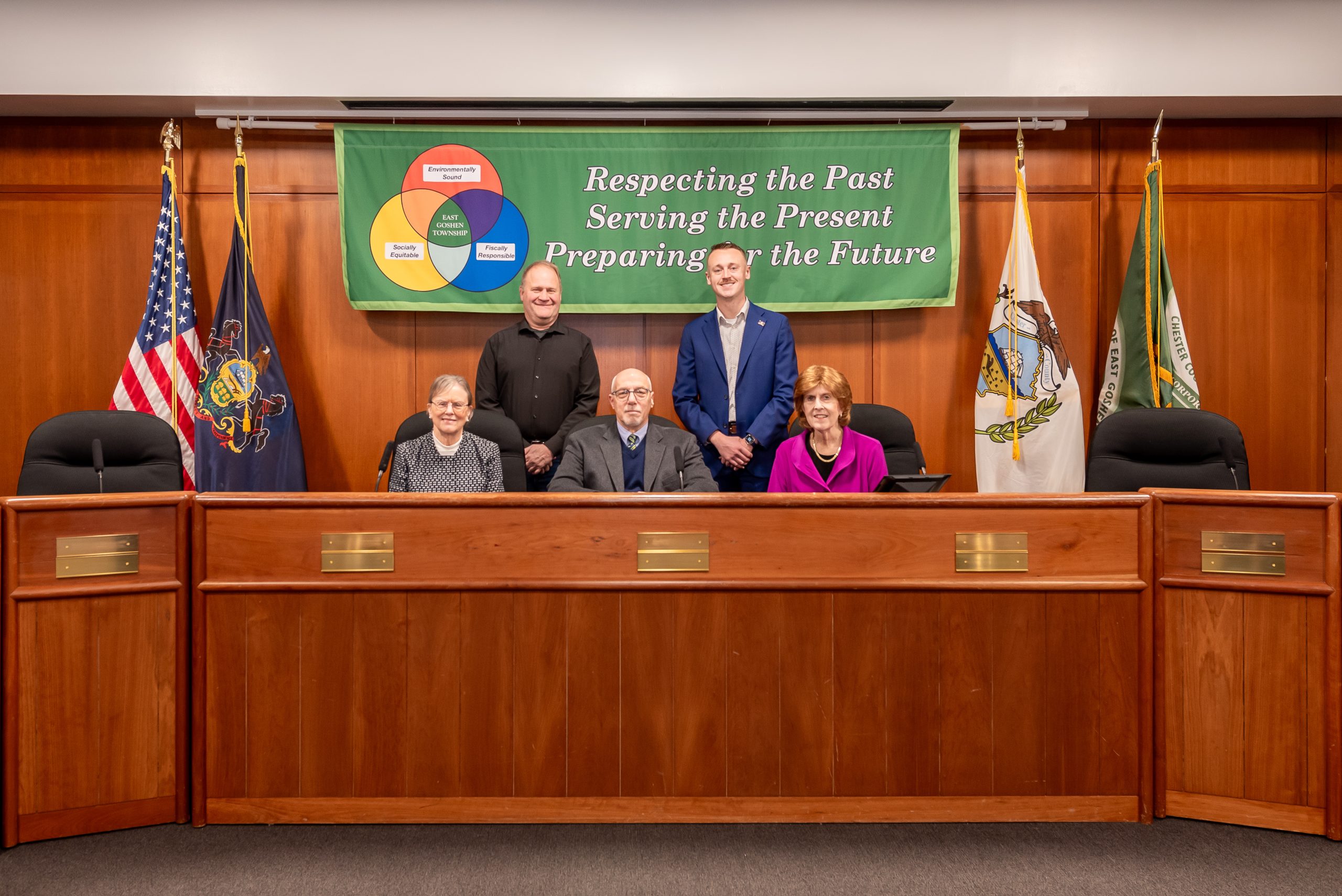
- Five members, serving six-year terms
- Meetings begin at 7:00 PM on the 1st and 3rd Tuesday of the month.
- Meetings will be held on the 2nd, 4th, and 5th Tuesday of the month as needed.
- All township meetings are held at the Township Building and are open to the public.
- View our meetings live via Zoom.
- View township meetings on YouTube.
- Executive Sessions are not public meetings
| Board of Supervisors | Term Expiration Date |
| Cody Bright, Chair | 2027 |
| Barbara Emery, Vice Chair | 2029 |
| Peter Hicks | 2029 |
| Ann Duffield | 2031 |
| Larry Massaro | 2031 |
Visit our YouTube Channel for meeting video recordings.
Documents
Back to the list | Open the original PDF
Notice: this accessible version was created automatically from the original document. The transcription may not be 100% accurate. It is provided for searching and for screen readers; please refer to the original document for the official version.
6/27/17 June 27, 2017 1
EAST GOSHEN TOWNSHIP BOARD OF SUPERVISORS MEETING J.R. FUGETT MIDDLE SCHOOL; 500 ELLIS LANE; WEST CHESTER, PA
THURSDAY, JUNE 27, 2017 FINAL APPROVED MINUTES Present: Chairman Marty Shane; Vice Chairman Carmen Battavio; Supervisors Charles (Chuck) Proctor, Janet Emanuel, & Michael Lynch; Township Manager Rick Smith; Bob Fleming (Goshen Fire Company); Bill Turner (Chester County DES); Don Herb (Chester County DES-HazMat); Brenda Bernot (WEGO PD); Joe McGinn (Sunoco Logistics); Charlie Stewart (Sunoco Logistics). Call to Order & Pledge of Allegiance Marty called the meeting to order at 7:00 p.m. and led the assembly in the Pledge of Allegiance. Moment of Silence Carmen called for a moment of silence to honor the troops who defend our nation. Recording Leo Sinclair, 211 North Lochwood Lane, and Hugh Brownstone, 39 Cobblestone Drive, Paoli indicated they would be recording the meeting. Marty noted that the Township was also recording the meeting and would put its recording on the website when it was available. Emergency Services Response to Pipeline Incident Bob, Bill, Don, Brenda and Carmen provided an overview of how the various local emergency services agencies would respond and coordinate in the event of a pipeline incident.
Bob noted that all Goshen Fire Company personnel are trained in Hazardous
Materials (HazMat) and the fire company follows a 14-point protocol for responding to HazMat-related emergencies. Bill explained that the County Department of Emergency Services (DES) acts
as a coordinating agency in the event of an emergency and that the local police and fire companies are the first responders. He encouraged residents to sign up for Ready Chesco at www.readychesco.org to stay informed about emergencies in the area. Don added that the DES HazMat Response Team would provide support for
the fire company at the site, including air monitoring and controlling product. Brenda observed that all police officers are required to be trained in the
National Incident Management System (NIMS) protocols, which guide emergency management responses. She also noted that WEGO has mutual aid agreements with many other police departments, who would be available to assist WEGO in the event of a major incident.
6/27/17 June 27, 2017 2
Carmen explained that the Township has an emergency operations plan, also
based on NIMS, to provide logistical support for emergency responses. He noted that Kevin Miller, a long-time Public Works employee and the Deputy Chief of the West Whiteland Fire Company, is the Township’s Emergency Management Coordinator. Marty asked the emergency services personnel present to provide an example of how the various agencies would respond if a natural gas leak were detected in East Goshen.
Bill explained that after the 911 call was received the fire company, police,
County HazMat team would be immediately dispatched. Bob explained that after arriving on site, a senior officer from the fire
company would probably act as the incident commander, although depending on the size of the emergency there could be multiple incident commanders. The incident commander(s) would make a determination about whether evacuation or shelter-in-place instructions should be issued. He noted that the fire company’s first priority in responding to an emergency is life safety, followed by incident stabilization and then property preservation. Bill added that DES would play a large role in communicating information to
the public. Don explained that the HazMat team would be deployed to assist the incident
commander. Brenda added that the police would probably serve in a support role,
including establishing a perimeter around the leak. Charlie noted that Sunoco would also be notified in the event of a 911 call
about the pipeline, and there would be an “all hands” response to assist the incident commander. Joe provided an overview of the Mariner East pipelines. He explained that there is an existing 8” pipeline, called Mariner 1, which is roughly 80 years old and in 2014 was repurposed to convey liquefied natural gas, and that new 20” and 16” pipelines, called Mariner 2, are being installed now. These pipelines will convey ethane, propane and butane. He noted that there are roughly 67,000 miles of liquefied natural gas pipeline and about 200,000 miles of pipeline for all gases in the United States and that statistically pipelines are very safe. He observed that most accidents that have occurred are in old, lightly-regulated cast iron distribution pipelines. He stated that leaks, when they do happen, are small. He added that Sunoco has a 24 hour hotline (855-430-4491). David Shuey, 1547 Millrace, noted that the Mariner 1 pipeline is 80 years and when it was inspected in 2014 no issues were identified but then there was a recent leak in Morgantown, PA. He asked how we can be sure that Mariner 1 is safe. Joe responded that the leak in Morgantown was relatively small and posed no hazard to
6/27/17 June 27, 2017 3
human safety. Charlie added that data are still be analyzed about that incident. Rick advised that Sunoco replaced both of their pipelines in East Goshen in 1997 and 2001. Lex Pavlo, 1611 South Speakman Lane, asked if liquefied natural gas is colorless and odorless how it would be detected. He also stated that he doubts there is a clear plan to have everyone evacuated safely. Bill responded that all schools and nursing homes are required to have an evacuation plan that is tested annually. Joe added that if there was a leak, it would probably make a sound, similar to when you turn on your propane grill. Bob added that Sunoco has the ability to monitor the pipeline by computer around the clock. Alice Lenthe, 627 Beaumont Circle, asked whether air monitoring occurs before a leak. She also noted that if there was an explosion it would likely take out fire station 56 and the PECO substation, which would complicate the emergency response. Charlie stated that there is no continuous air monitoring along the line, but there is such monitoring at Sunoco facilities. Joe noted that the shut off valves for Mariner 1 are at Boot Road and 202 in the north and near Duffer’s Tavern in Thornbury Township in the south. For Mariner 2, the valves are next to Station 56 in the north and at the same location as for Mariner 1 in the south. Tony Perretta, 1601 Bane Way, asked why he wasn’t made aware that Mariner 1 was repurposed in 2014. Joe observed that the Township held a number of public meetings on this issue in 2014. Allan Pomerantz, 1141 Merrifield Drive, raised concerns about the usefulness of an evacuation plan in the event of a major blast. Bill Donaldson, 987 Kennett Way, asked whether first responders would be on the same channel in the event of an emergency. Don replied that it depends on what is being responded to, but that the communications system can handle a major emergency. Mary Ann Kusner, 1026 Kennett, asked how quickly first responders can respond to an emergency. Bill explained that all first responders are dispatched within 90 seconds of a 911 call. Gordon Yocum, 1054 Kennett, asked how valves are spaced and how much gas can dissipate over time. Melissa DiBernardino, 1602 Old Orchard Lane, asked how children at Ss Peter and Paul School would be evacuated. Bill responded that all schools have evacuation plans, but if it wasn’t possible to evacuate by car, children would be evacuated on foot.
6/27/17 June 27, 2017 4
Jerry O’Brien, 1424 Springton Lane, asked where Sunoco’s first responders are located. Charlie responded that at any given time there are between 8-10 Sunoco trucks that could respond to an emergency in the 5-county area, plus any Sunoco employees who are at the Boot Road pump station. Christina Zettner, 1570 Alison Drive, asked about the emergency plan for the West Chester Area School District. Mary McCloskey, 1727 Clocktower Drive, asked if the leak detection system can be manually overridden or hacked. She asked why the system didn’t catch the leak in Morgantown. Joe responded that the Morgantown leak was too small for the system to detect, but that the system would have sounded an alarm if the leak posed a threat to health and safety. Joe noted that the system can be manually overridden. Charlie added that it is protected from hackers by firewalls. Linda Polishuk, 1424 Grand Oak Lane, raised concerns about why there is no state pipeline siting agency and there is no extraction tax in Pennsylvania. John Snyder, 255 Chatham Way, asked what the probabilities are of a pinhole leak and a rupture. Charlie indicated that he didn’t have that information readily available, but that he would provide it shortly to the Township. Mr. Snyder also asked what percentage of the product will be used locally. Joe explained that the butane will primarily be used locally as a gasoline additive and that the propane in the winter will be used locally for home heating. Carolyn Horchos, 1601 E. Glenmont, asked how information about an emergency will be communicated to residents. Bill encouraged residents to sign up for ReadyChesco at www.readychesco.org. Carl Horchos, 1601 E. Glenmont, asked if there had been a leak already on Route 352, whether radon might be released when Sunoco drills through Rocky Hill, and whether the gas can be ignited by a car. Joe responded that there was an inadvertent return on 352, but that this was related to the drilling. He noted that radon testing is done as part of the project engineering. Charlie added that a car ignition could theoretically ignite the gas, but that gas dissipates quickly. David Kohler, 1750 Hunters Circle, stated that he is ashamed of the state government for allowing this to happen and noted that the state needs a severance tax. Pam Onyx, 657 Heatherton Lane, asked about a pipeline on a pier on the Chesapeake Bay and whether there are any devices for detecting leaks. Tom Mayer, 1216 Upton Circle, asked how many miles there were between the shut- off valves and how long it would take for the gas to dissipate if the valves were shut
6/27/17 June 27, 2017 5
off. Charlie responded that the rate of dissipation would depend on a number of factors, but that the distance between the valves is about 6 miles. Tom Casey, West Goshen Township, asked about a legal matter between Sunoco and West Goshen Township. There being no further business, Carmen made a motion to adjourn at 10:40. Janet seconded. The motion passed unanimously.
Respectfully submitted, Jon Altshul Recording Secretary